The Shipment
September 24, 2026
Xi Visits DC: The U.S.-China Summit
(Not So) Fun Fact: The U.S. national average diesel price sits at $6.51 per gallon – just below the recent record high of $6.53 – which is 76 percent higher than one year ago.
The U.S.-China Summit
What’s Happening: Officials from the United States and China are meeting this week to discuss the geopolitical and economic relationship between the two countries. President Trump will meet with Chinese leader Xi today, marking Xi’s first U.S. visit since 2023 and first official White House reception since 2015. The two leaders are expected to discuss bilateral trade, security concerns, artificial intelligence, and various other points of contention put on hold since the trade war truce was established last year and solidified in May. Initially, United States Trade Representative (USTR) Greer stated that the truce was unlikely to be extended this week, but might be at future U.S.-China meetings in November and December. Last night, however, Treasury Secretary Bessent told reporters the truce has been extended until January 10. A key topic of discussion will be proposals from the May meeting for boards of trade and investment intended to introduce a reciprocal reduction of tariffs on “non-sensitive” products and manage bilateral economic ties. While there is optimistic speculation that tariffs could be reduced on $30 billion of each nation’s imports, USTR Greer has downplayed such hopes, saying negotiators are still trying to find a “critical mass” of products. Sources in the private sector emphasize that the administration has left them in the dark regarding progress on the board of trade. If and when they come, new tariff reductions are likely to impact agricultural and energy products, as well as medical devices, with aircraft and heavy machinery also on the table. The board of investment’s first project – if established – may be to allow Chinese automobile manufactures into the U.S. market, as President Trump has hinted he is favorable to the idea – to the chagrin of the U.S. auto industry.
Why It Matters: Managing expectations appeared to be the top priority in the lead- up to the Trump-Xi meeting. There will undoubtedly be a Truth Social post and a subsequent White House fact sheet that reintroduces announcements from the last U.S.-China summit. Recall previous announcements included China committing to purchase 200 Boeing planes, $17 billion in agricultural products annually through 2028, and 25 million tons of soybeans annually through 2028. May’s announcements also included the reciprocal tariff reductions, the boards of trade and investment, and rekindling China’s exports of critical minerals and imports of U.S. beef and poultry. To put it bluntly, China has failed to live up to most of these commitments. The Boeing deal is still a work in progress. There have not been tariff reductions. And the status of the boards is entirely unknown to even private businesses hopeful of a stable U.S.-China economic relationship. In terms of the import commitments, China once again falls short. In 2025, China imported $8.3 billion worth of U.S. agricultural products compared to $24.4 billion in 2024 and $28.8 billion in 2023. From January to July of this year, China’s imports increased to $8.8 billion, but current trends fall well below the stated $17 billion goal (which itself is below the historic average). Excluding soybeans, U.S. agricultural exports to China only reached $3.9 billion in the first seven months of 2026.
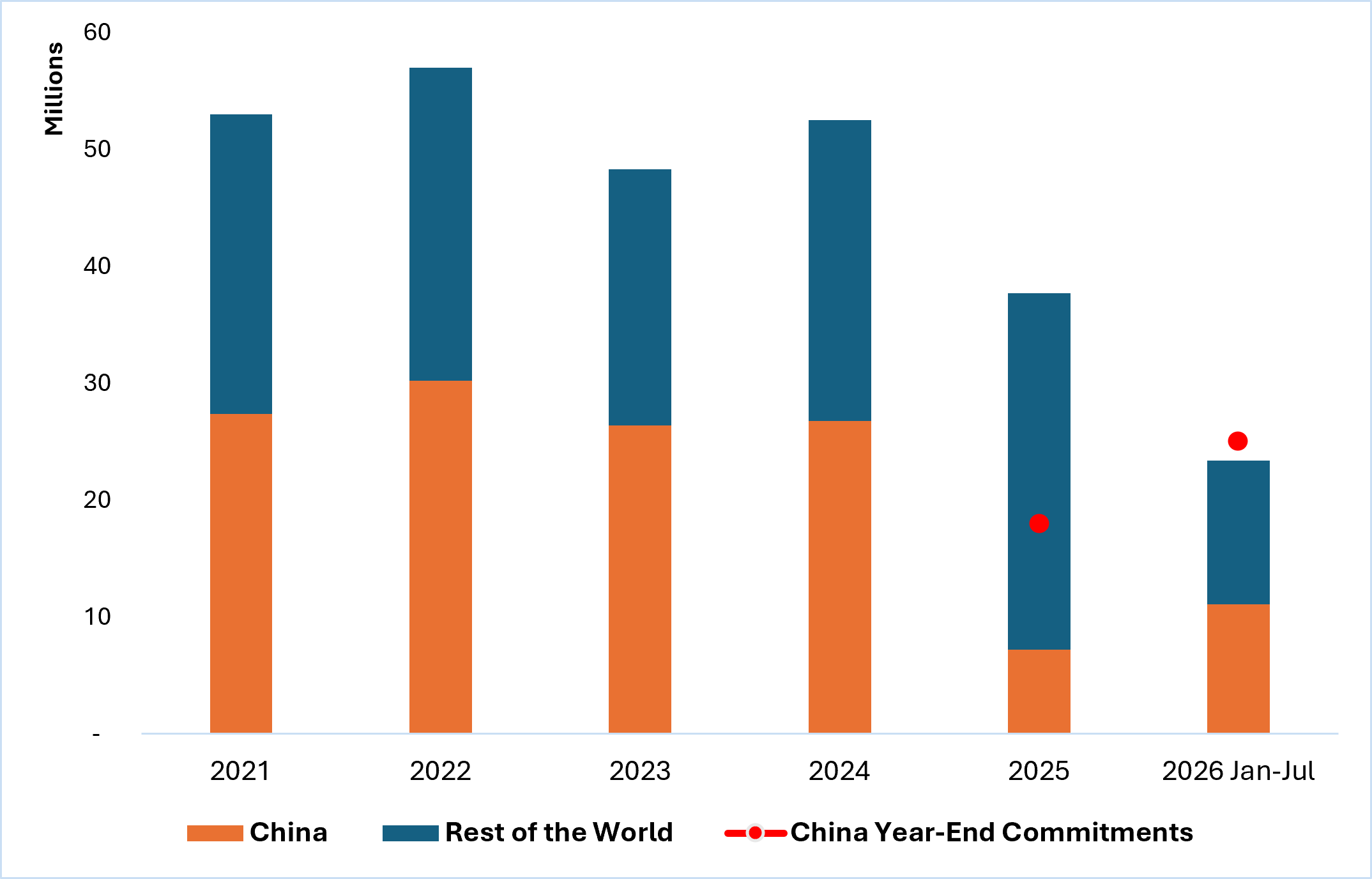
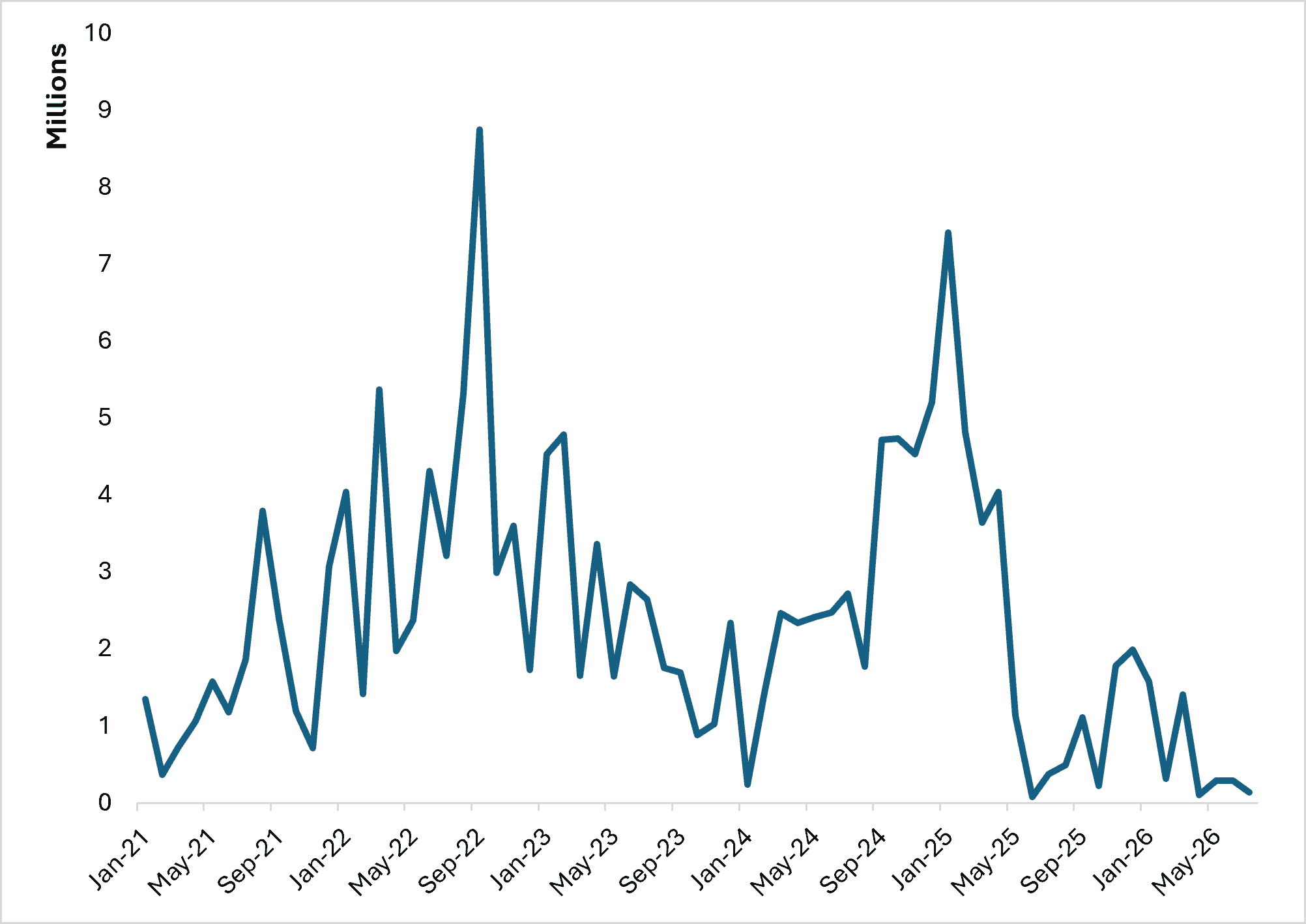
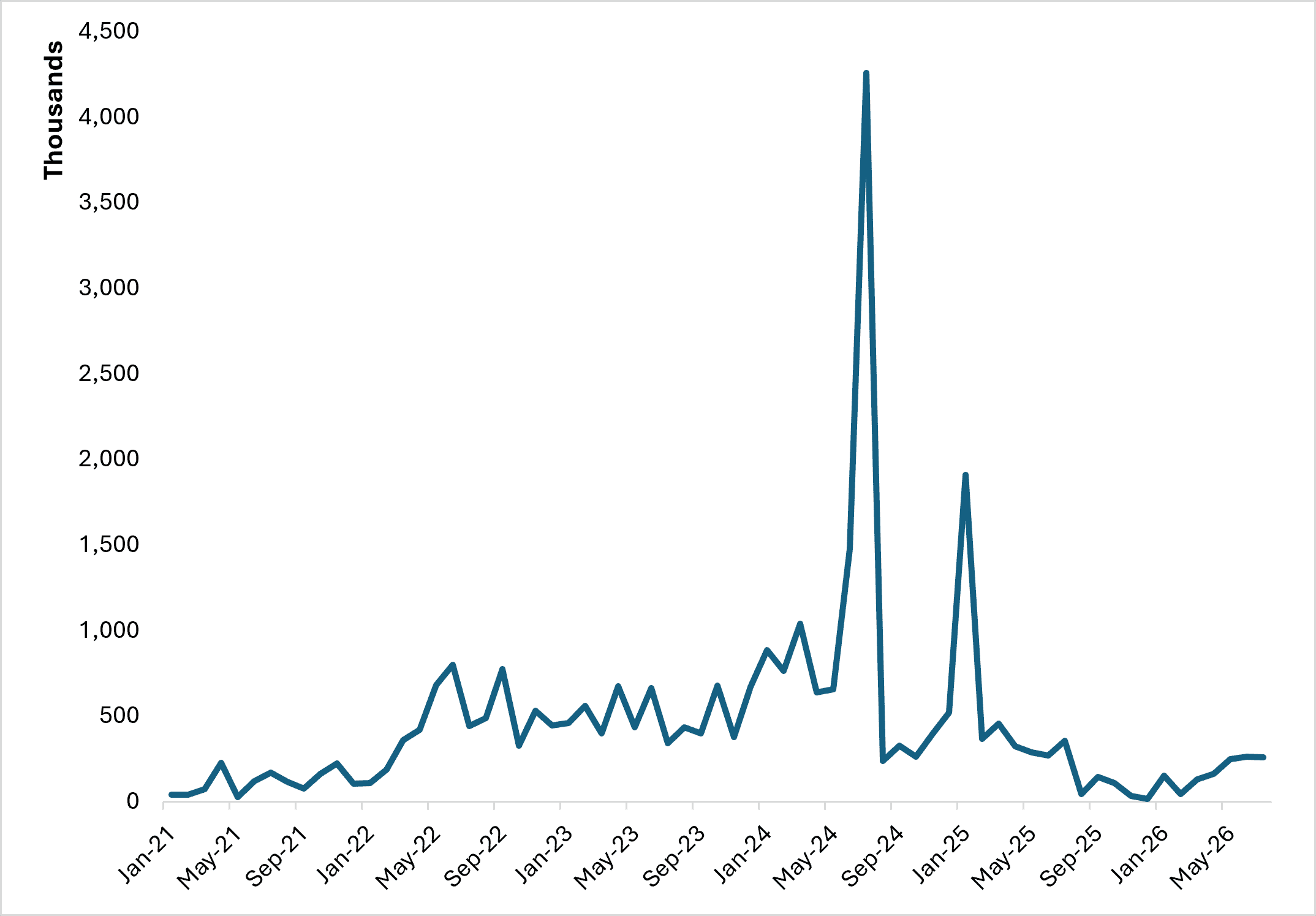
Last year, China committed to purchasing 12 million tons of soybeans by the end of 2025, which the Trump Administration marketed as a major win for farmers. The data show that this handshake deal never materialized as China purchased 1.2 million tons of soybeans in November and December, off by a factor of 10. After it was clear China once again failed to meet its commitments, Treasury Secretary Bessent explained that China would make these purchases by “the end of the growing season,” or around February 2026 (the White House fact sheet says otherwise). This updated deadline did not change the result. China only purchased 6.8 million tons of soybeans between November and February. It looks as though China will also fail to meet the 25-million-ton target for 2026 as U.S. exports to China are at 11.1 million as of July. In terms of China’s promise to restore critical mineral exports, the evidence is mixed. Looking at U.S. imports of a group of rare earths including cerium, scandium, and yttrium it appears that the value and volume has not been suppressed and has recovered from last year’s dip. At the same time, U.S. imports of gallium, graphite, and a handful of other rare earths remain at low levels similar to during the trade war. One report confirms this and states that China continues to restrict exports of rare earths and rare earth magnets despite the U.S.-China trade truce. The Shipment’s analysis of Chinese export data also confirms that certain critical mineral exports to the United States have yet to recover.
Looking Ahead: The truce was set to expire November 10, the date many of the paused U.S. trade actions are set to resume, including potential Section 301 tariffs targeting China’s shipbuilding dominance and the expansion of the U.S. Entity List to cover additional Chinese companies. The expiration of Section 301 tariff exclusions for certain imports from China is set for November 29. USTR Greer expects a trade truce extension of three to six months. The new January 10 deadline kicks the can down the road further and provides an extra two months for both sides to negotiate further. It is unclear whether this shorter-than-expected extension is to allow for final touches on a larger economic deal or if it is a sign that negotiations have not been especially fruitful. Time will tell.
In Other News
What Happened With Greenland: At the United Nations on Tuesday, President Trump signed an agreement with Denmark and Greenland strengthening the U.S./NATO security posture in Greenland – and seemingly putting to rest his ambition to annex or purchase the autonomous Danish territory. The deal was first announced last Friday on Truth Social, with the president stating that the pre-existing U.S. military presence in Greenland will be expanded. The White House published the agreement, which has a few key points to consider. The first is that it reaffirms the sovereignty of Denmark and recognizes the people of Greenland have a right to self-determination. This of course leaves open the possibility that Greenland declares itself independent from Denmark, in which case this deal would still apply. In the meantime, however, Greenland remains a territory of Denmark and any rhetoric that implies U.S. political control over the island would be misleading. The deal does reinforce U.S. strategic involvement in Greenland, allowing the proposed Golden Dome defense system, modernization of the Pituffik space base, the establishment of two new defense areas, and the construction of unmanned military installations. Notably, all U.S. goods and service contracts relating to these projects are meant to go toward Greenlandic sources first, which may be a massive economic boon for the island’s roughly 55,000 inhabitants. Additionally, this deal prohibits foreign direct investment from states or investors outside of NATO, NATO partner nations, or an EU member state if their involvement is a potential national security risk. The agreement mentions the possibility of minerals cooperation, although the deal does not provide precise details. As previous American Action Forum research has highlighted, Greenland holds close to $200 billion worth of accessible mineral resources and $2.7 trillion worth of mineral reserves. Were U.S. or allied companies to invest in this relatively untapped mineral wealth, it would greatly reduce U.S. reliance on China for certain rare earths in the long term.
Figure 1: U.S. Exports of Soybeans (Millions of Metric Tons)
Source: The United States International Trade Commission
Figure 2: U.S. Imports of Natural Graphite from China (Millions of Kilograms)
Source: The United States International Trade Commission
Figure 3: U.S. Imports of Germanium, Gallium, and Other Rare Earths from China (Thousands of Kilograms)
Source: The United States International Trade Commission