The Shipment
May 21, 2026
The China Trade Commitment
(Not So) Fun Fact: As of today, the U.S. national average gas price sits at $4.56 – roughly flat compared to last week and nearly 55 percent higher than at the beginning of the Iran conflict.
So, What Happened in China?
What’s Happening: There was little to take away from President Trump’s visit with Leader Xi of China last week, with minimal details provided in the fact sheets released by both countries. Discussions included Beijing approving Chinese airlines’ purchase of 200 Boeing planes, a commitment to buy $17 billion in U.S. agricultural products annually until 2028, and a restoration of market access for U.S. beef and poultry. In exchange, the United States is expected to “address” the enhanced inspections of Chinese dairy and aquatic products. The announcement that may have lasting implications for U.S.-China relations is the creation of new boards of trade and investment, which are meant to manage future bilateral economic ties. Additionally, China’s Ministry of Commerce announced that the two countries “have agreed in principle to discuss a reciprocal tariff reduction framework arrangement on products of equivalent scale worth 30 billion U.S. dollars or more on each side.” As of now, no corresponding statement has been made by the White House regarding tariff reductions; details on what products might be covered or when this might become a formal agreement remain unknown. These non-specific messages are in stark contrast to the roughly 40 agreements Xi plans to sign with President Putin of Russia during their meeting this week.
Why It Matters: President Trump’s recent visit represents a continuation of the status quo established last October, when the U.S.-China trade truce was first announced. Although China’s purchase commitments may appear substantial, without an enforceable document to point to, it is unlikely that President Trump’s visit will yield major results. The track record of U.S.-China trade relations supports this presumption. For instance, let’s look at China’s imports of U.S. soybeans. Back in October, China committed to purchasing 12 million tons of soybeans by the end of 2025 after a months-long trade war ravaged U.S. soybean exporters. The Trump Administration marketed this promise as a major win for U.S. farmers and continues to emphasize China’s commitment to purchase 25 million tons of soybeans annually through 2028. But the promises of this handshake deal never materialized: China purchased about 1.4 million tons of soybeans in November and December. After it became clear China failed to deliver, Treasury Secretary Bessent explained that the deal was actually that China would make these purchases by “the end of the growing season” or around February 2026 (the White House fact sheet says otherwise). The updated deadline did not change the result. China only purchased 7 million tons of soybeans between November and February. Even if March is included, the figure sits at 9.2 million tons. While China has yet to come close to its promised purchases, Secretary Bessent claims that the soybean purchase commitments “are really all taken care of.” In the case of a Chinese government promise, the Shipment will believe it when it sees it.
Looking Ahead: It is likely that dialogue between the United States and China will continue through the one-year anniversary of the trade truce. Many of the paused U.S. actions are set to resume in November, including potential Section 301 tariffs targeting China’s shipbuilding dominance, the expiration of Section 301 tariff exclusions, and the expansion of the U.S. Entity List to cover additional Chinese companies. Were any of these U.S. actions to occur, China would almost certainly respond by reintroducing rare-earth export controls and retaliatory tariffs – setting U.S.-China relations right back to where they were in the heat of the 2025 trade war. Just as the Shipment expected some sort of minor announcement from last week’s meeting, expectations are that the Trump Administration will do what it can to prevent a catastrophic rare-earth export restriction from taking shape and that Chinese counterparts will do what they can to prevent damaging U.S. tariffs.
In Other News
Updates on the European Union Trade Deal: After a few hours of negotiations on Wednesday, the European Parliament, the Council of the European Union (EU), and the European Commission reached a compromise on legislation to enact parts of the U.S.-EU trade deal from July 2025. The deal would eliminate EU tariffs on some U.S. agricultural and industrial products in exchange for U.S. tariffs being capped at 15 percent on most EU exports. The agreement includes various fail safes for the EU in the event the United States attempts to alter the deal further. These include the ability to suspend the deal if the United States fails to meet commitments or if a surge in U.S. imports harms EU businesses; it also includes a sunset clause that ends the deal in December 2029 unless re-implemented. The compromise agreement comes after months of deliberations and delays that frustrated President Trump to the point of threatening a 25-percent tariff on EU cars if the trade deal is not passed by July 4. The trade committee of the European Parliament is expected to vote on the legislation on June 2, with a plenary vote scheduled for June 16 or 17.
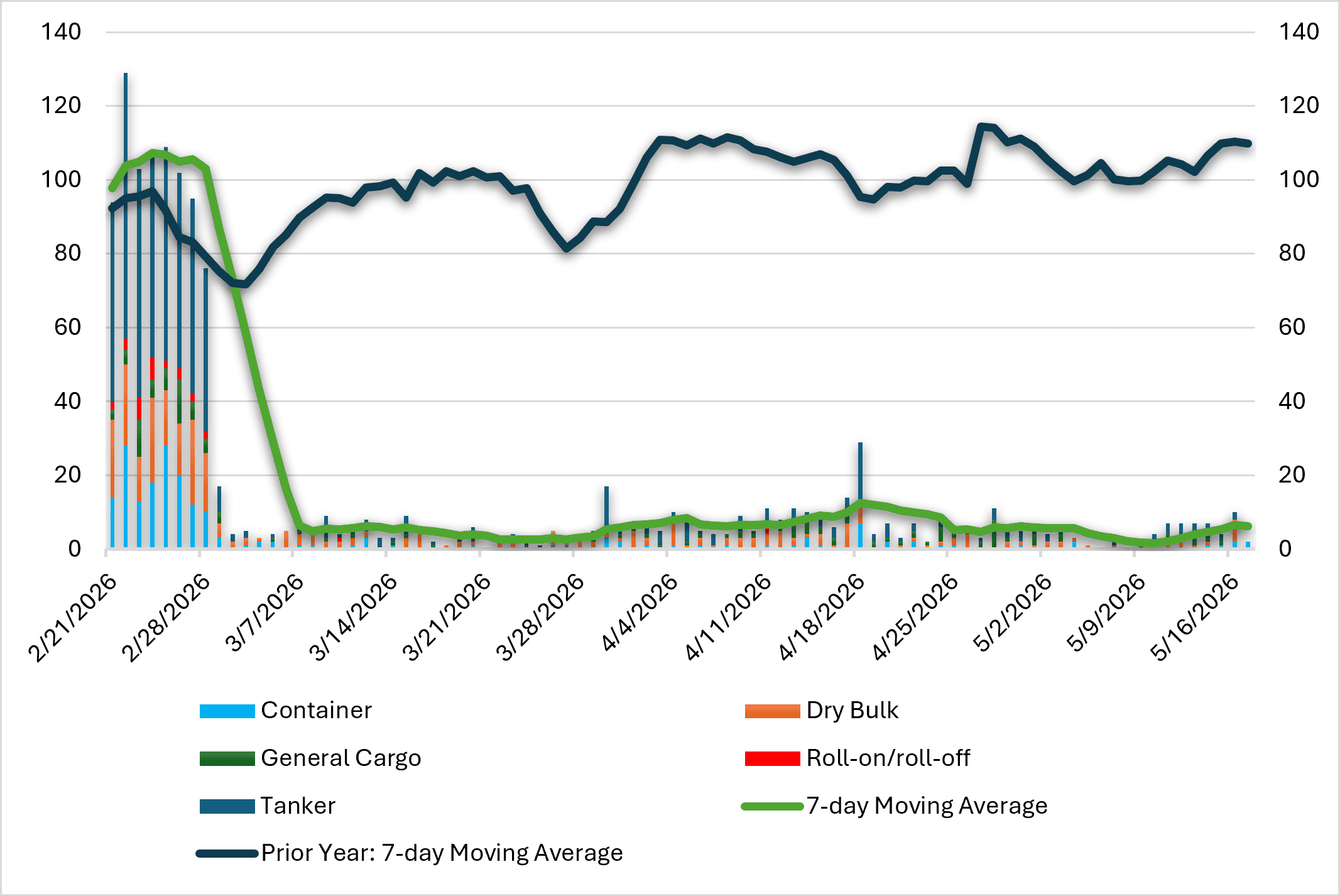
The Strait of Hormuz Remains Messy: As of May 17, the Strait of Hormuz remains effectively “closed” as traffic sits at about 6 percent of normal pre-war levels. Although there is currently a lull in U.S. military operations against Iran, the Iranian government continues to press its claimed ownership of the strait while the United States maintains a blockade of Iranian ships. The Iranian Revolutionary Guard has continued to threaten ships while also negotiating with foreign governments and charging fees to allow tankers to transit without repercussions. Preference is given to both Russia and China in the strait followed by India and Pakistan followed by any negotiated deals for ships to pass. Meanwhile, the U.S. navy has boarded roughly five Iranian-linked commercial vessels since the U.S. blockade began. It is possible that this tenuous situation escalates once again to military strikes if a U.S.-Iran deal continues to be delayed.
Figure 1: U.S. Exports of Soybeans
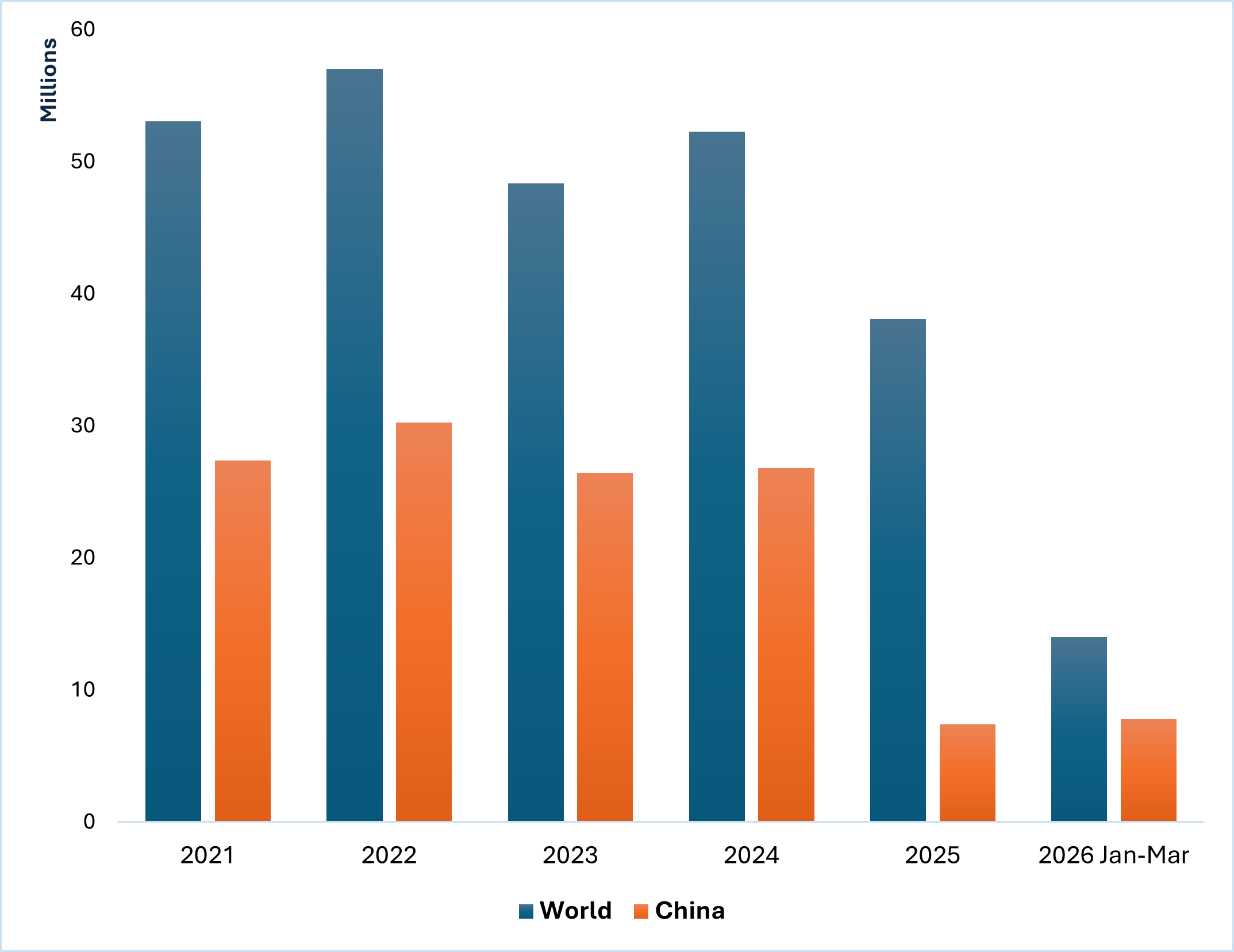
Source: United States International Trade Commission
Figure 2: Strait of Hormuz Transit Calls by Number of Ships (Through May 17, 2026)