Testimony
September 2, 2026
Less Red Tape, More Opportunity: Unleashing American Workers and Job Creators
Testimony for the House Committee on Education & Workforce Subcommittee on Workforce Protections
*The opinions expressed herein are mine alone and do not represent the position of the American Action Forum. I am grateful to Dan Goldbeck, Brian Faughnan, Angela Kuck, and Sarah Smith for their assistance. All errors are my own.
Chairman Mackenzie, Ranking Member Omar, and members of the Subcommittee, I am honored to testify on issues related to unleashing America’s workers and job creators. In addition to such specifics as workplace safety, bargaining for pay and benefits, and other issues, it is crucial that workers and their employers operate in a vibrant economic setting. In this regard, I would like to make three main points:
- The tax provisions of the 2025 reconciliation legislation are a crucial element of supporting entrepreneurs, businesses, and their workers;
- The Trump Administration has had a remarkable record of controlling the growth of the regulatory state, relieving workers and their businesses of the burden of costly rules; and
- The task that remains unfinished is eliminating the anti-growth threat of the large and growing federal debt.
Let me discuss each in turn.
Recent Tax Policy and the Economic Environment
The Tax Cuts and Jobs Act (TCJA) of 2017 was a pivotal improvement in tax competitiveness and pro-growth tax policy. The 2025 reconciliation, known at the time as the One Big Beautiful Bill Act (OBBBA), cemented these improvements in the tax environment. While most people appreciated keeping their taxes down, making permanent the top rate of 37 percent and the other lower individual tax rates was also a crucial piece of business tax reform.
More than one-half of all business income is distributed from pass-thru entities such as partnerships to be taxed on individual income tax returns. This means that the structure of tax rates for individuals is a key part of business tax policy. Keeping rates lower improves incentives for risk-taking and entrepreneurship.
In addition, the OBBBA made permanent the expensing of equipment investment, software investment, and research and development expenditures. These investment decisions are at the center of growth in productivity, real wages, and workers’ standards of living.
Finally, OBBA cemented in place a regime for America’s large, global enterprises that permits them to compete effectively for overseas markets. It is counterproductive to handicap the overseas sale of U.S. workers’ products.
Regulatory Reform
Compliance with the regulatory state is costly and those funds compete with paying higher wages, providing workers benefits, and expanding the productivity of the firm. It is essential that regulations be promulgated only where necessary and designed to have as small a cost as possible. The Trump Administration has an excellent track record in this area.
The recent history of burden costs – the costs imposed on the private sector by federal regulations – is summarized in the chart below. Over eight years, the Obama Administration averaged $108 billion of annual regulatory costs, while the first Trump Administration imposed only $16 billion in total. (This comparison is approximate ignoring, for example, pre-inauguration activity by the previous administration.) The difference is like night and day to the small business community and its workforce.
The Biden Administration averaged a stunning $469 billion over four years, including one year exceeding $1 trillion. This administration has reversed course sharply. While 2026 is not yet complete, it is already averaging a reduction of the regulatory burden of $594 billion a year.
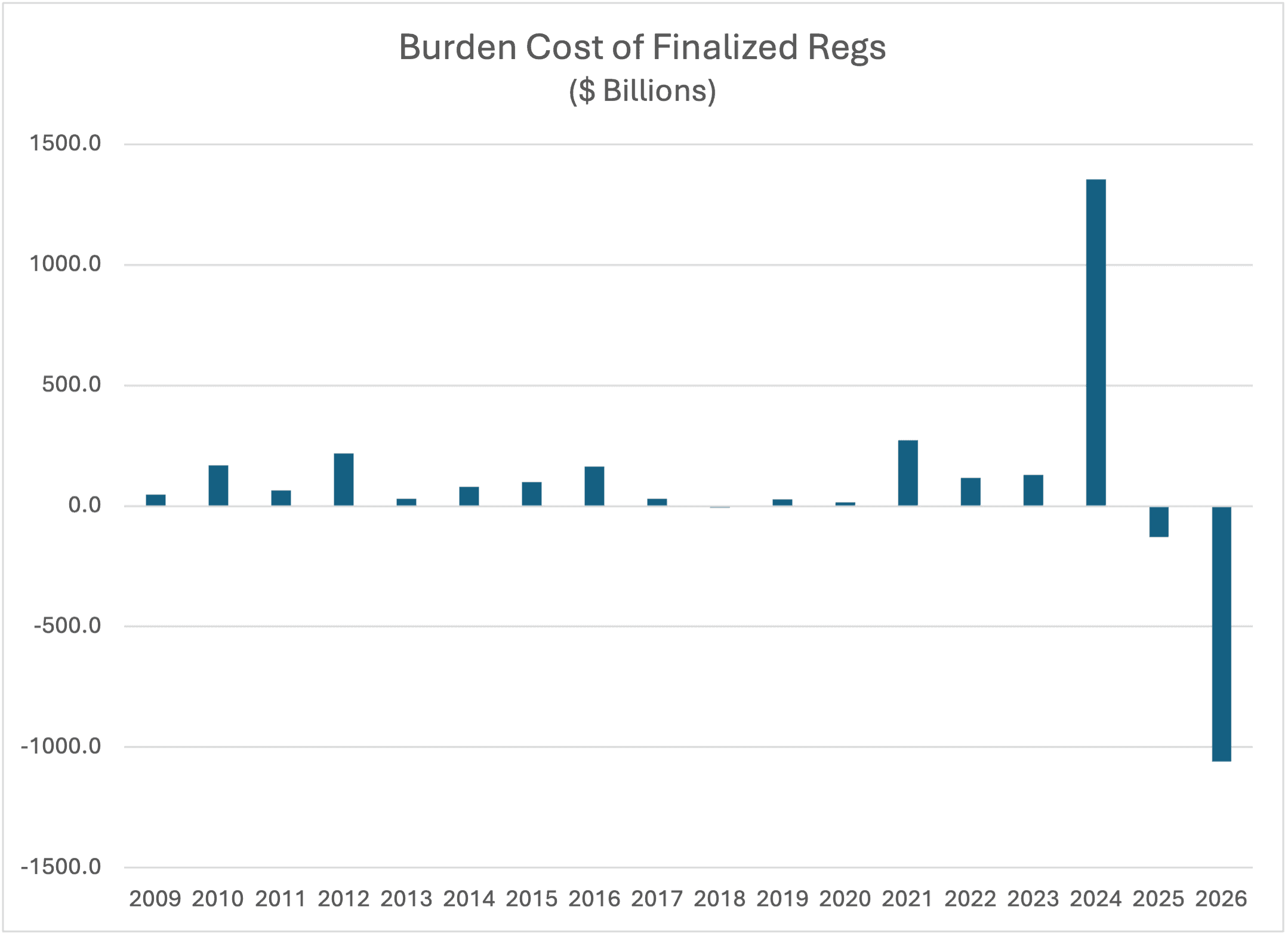
The next task for Congress is statutory regulatory reform. Regulations are a substitute for taxation and spending as a means to accomplish policy goals. Yet regulations impose costs on the economy just as taxes do. For this reason, a pro-growth strategy will control the growth of regulatory costs. Over his two terms, President Trump’s regulatory budgets have delivered a much more efficient regulatory state. Congress should adopt a permanent, statutory version of this regime.
The Threat of Excessive Debt Accumulation
The excessive debt accumulation in the past quarter century has budgetary and economic consequences. The large amount of debt and interest costs produces budgetary inflexibility. Interest must be paid in a timely fashion, limiting Congress’ ability to change spending to meet new demands.
On the economic front, the fact that the federal government is borrowing $2 trillion each year means that those dollars are not available to finance college or advanced degrees, for additional training for workers, new software, factory expansion, mergers and acquisition, capital investment, or any of myriad ways to enhance productivity. Slower growth in productivity translates into slower growth in real wages and GDP.
The United States is already paying a price for the high level of debt. The growth in GDP per capita – a crude measure of the standard of living – has grown a full percentage point slower in the 21st century than in the 20th century, with the result that it now takes 56 years for the standard of living to double compared to the 29 years in the 1960–2000 period. The cumulative loss of income per person is the foundation of the affordability crisis. Better growth would provide the resources to meet many more needs of U.S. households.
Continuing on this trajectory will exacerbate these headwinds to growth and slow the growth of federal revenues at the same time. Ultimately, global lenders will demand higher interest rates to compensate for the risk that the United States fails to make payments in a timely fashion. The cycle of higher rates, slower growth, slowing revenue growth, and greater debt accumulation cannot be maintained. Lenders will cut off the United States, and in the resulting economic crisis there will be forced cuts in spending and draconian tax increases. The domestic and global financial systems will be in disarray.
Thank you, and I look forward to your questions.