Testimony
March 18, 2026
Testimony on Labor Inflows, Maintaining Competitiveness, and Supporting an Aging Population
Joint Economic Committee
*The opinions expressed herein are mine alone and do not represent the position of the American Action Forum. I am grateful to Brian Faughnan, Angela Kuck, and Sarah Smith for their assistance. All errors are my own.
Chairman Schweikert, Ranking Member Hassan, and members of the Committee, I am honored to testify on issues related to high-skilled immigration, the workforce, and supporting an aging population. I would like to make three main points:
- Immigration is not a threat to U.S. workers; however, the failure of the K-12 education system is a threat.
- S. workers will be engaged in a global economy and competing with other countries’ workers whether there is immigration or not; allowing immigration permits the United States to capture benefits of that competition.
- The United States should not fear immigration, but it should dislike and deter illegal immigration.
Some in the American public and policy community have a negative view of immigration, associating it with illegal border crossings, taking Americans’ jobs, and diminished economic opportunity. I believe this is a serious misreading of the situation. Immigration can be a powerful force for economic growth. The native-born population has sub-replacement fertility – not enough babies to even keep the population steady. Thus, in the absence of immigration, the U.S. population would decline, and the economy would correspondingly shrink. The question should not be whether to have immigration or not; it should be about the best way to use immigration to shape the future population, labor force, and competitiveness of the U.S. economy.
The Failing K-12 Education System
Even in the absence of immigration, success in the labor market will depend on workers’ skills. At present, roughly a quarter to one-third of U.S. 4th and 8th graders are seriously deficient in reading and mathematics. That is a recipe for poor ultimate educational attainment, low skills, and inability to compete in the labor market.
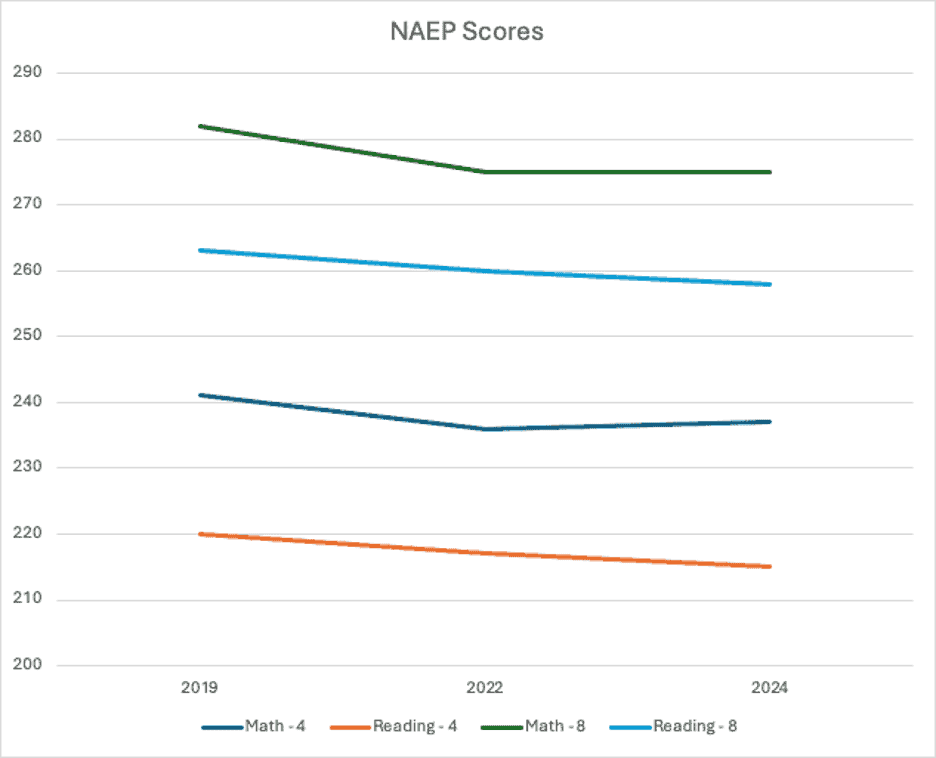
The failure of the K-12 education system is vividly documented by the National Assessment of Educational Progress (NAEP) – colloquially known as the nation’s report card. Rather than documenting educational progress, however, the assessments have turned out to simply be a barometer of educational decline. The graph (below) shows the recent results for reading and mathematics of the 4th and 8th grades. When scores for 4th and 8th graders declined in both reading and math in 2022, many were quick to dismiss it as an after-effect of the COVID-19 pandemic. As the graph displays, however, the most recent results are even more troubling, with nearly across-the-board declines from 2022. The sole exception is math scores for 4th graders (where some high-performing students did even better), which rose slightly but remain below 2019 levels.
These results are depressing, if not surprising. They have the same character as the special 2022 survey of long-term trends. NAEP scores were trending downward prior to the COVID-19 pandemic and have declined precipitously in recent years – particularly for lower-performing students.
The most recent NAEP scores reinforce the policy message: There needs to be a major intervention to assist lower-performing students as well as a sustained commitment to improve K-12 education systems overall. In the absence of such actions, education losses at the K-12 level over the past decades will in the long run translate into losses in labor skills and economic growth and prosperity.
Competing in a Global Economy
The claim is often made that immigration is depressing U.S. workers’ wages and costing U.S. workers jobs. There are many, many studies looking at the link between immigration and wages. On the whole, the record indicates that immigration raises the wages of the native born. The technical explanation is that the two types of labor are complements, not substitutes. That means immigrants make the native born more productive, which raises their wages.
A more important point is that in a global economy U.S. workers are already competing with foreign workers – something that would not change whether those workers remain abroad or move to the United States The competition takes place in the markets for goods and services that, in turn, dictate what wages can be paid. Whatever the impact of that global competition, it has already happened whether the immigrant was originally across the street, across the state, or across the ocean.
There is, however, a benefit to having immigrants move to the United States so that U.S. firms can reap the benefits of their skills. Immigrants work longer (both per week and over the life-cycle) on average than the native born and are disproportionately entrepreneurial. To maximize the benefits of this, there is a good case to be made for reforming the visa system to make it more responsive to economic conditions; admitting those with skills that are in short –supply; and providing fewer visas for those attributes that are relatively abundant in the labor market.
Illegal Immigration Is a Problem
While U.S. workers should not fear legal immigration, they should support efforts to reduce illegal immigration. Protocols to enforce the law by identifying and deporting illegal immigrants are an expensive and disruptive tax on U.S. employers, which translates into reduced productivity and pay. Because illegal immigrants cannot compete openly, they may find employment in jobs not well matched to their skills – limiting their contributions to the American economy. Reducing the efficiency of the labor market lowers productivity and reduces the very benefits that make legal immigration look attractive.
Thank you and I look forward to your questions.