Week in Regulation
July 7, 2025
A Full Fireworks Show
Even in a holiday-shortened week, there were plenty of fireworks – both literal and figurative – going off across the nation’s capital. Of course, the main show on the policymaking side came from Capitol Hill, where Republicans managed to squeak through H.R. 1, the reconciliation bill more commonly known as the “One Big Beautiful Bill Act” (OBBBA). There was also quite a flurry of activity on the executive agency side of things. In a week that even surpassed the busiest Biden Administration week in terms of rulemaking volume, there were 45 rulemakings – led predominantly by dozens of deregulatory proposals from the Department of Labor (DOL) – with some measurable economic impact. Across all rulemakings, agencies published $9.3 billion in total cost savings and cut 10.7 million paperwork burden hours.
REGULATORY TOPLINES
- Proposed Rules: 124
- Final Rules: 131
- 2025 Total Pages: 29,650
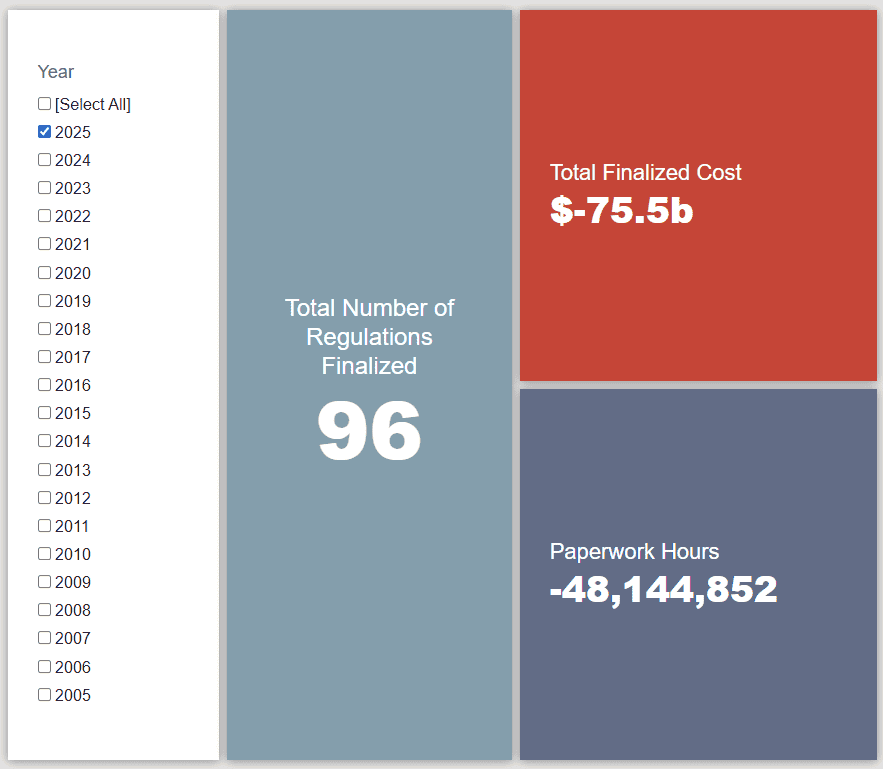
- 2025 Final Rule Costs: -$75.5 billion
- 2025 Proposed Rule Costs: $173.9 billion
NOTABLE REGULATORY ACTIONS
The most consequential rulemaking of the week was DOL’s proposed rule on “Rescission of Executive Order 11246 Implementing Regulations.” As the title suggests, the proposal seeks to officially enact the portion of President Trump’s EO 14173 that repealed the Lyndon Johnson-era EO 11246. In its cost-benefit analysis, DOL expects that a substantial number of federal contractors will no longer need to comply with the various EO 11246-related reporting requirements. The agency estimates that this will result in nearly 10 million hours and $1 billion in time savings annually (or nearly $7 billion in present value across a 10-year horizon).
The second-most deregulatory measure of the week from DOL was the proposed rule entitled “Prohibiting Illegal Discrimination in Registered Apprenticeship Programs.” The agency states that the proposal “is necessary to remove regulatory requirements that impose unnecessary administrative burdens on registered apprenticeship program sponsors and hinder the continued growth of this successful workforce development model.” DOL estimates that the proposal’s removal of certain regulatory requirements related to apprenticeship programs could yield roughly $739 million in net cost savings ($749 million in total savings minus roughly $10 million in upfront implementation costs).
Finally, a substantial portion of this week’s rulemaking haul came in a series of proposed rules from the Occupational Safety and Health Administration (OSHA), a DOL sub-agency, that seek to relax several regulatory requirements regarding particular worker safety apparatuses. The most significant of the bunch – and DOL’s estimated total costs savings for each – include the following:
- “Amending the Medical Evaluation Requirements in the Respiratory Protection Standard for Certain Types of Respirators” – $704 million in savings
- “Safety Color Code for Marking Physical Hazards; Textiles; Sawmills; Safety Color Code for Marking Physical Hazards for Shipyard Employment” – $364.5 million in savings
- Revising “substance-specific respirator requirements to allow different types of respirators to be used under OSHA’s Lead standards” – $171.5 million in savings
- Revising “substance-specific respirator requirements to allow different types of respirators to be used under OSHA’s Methylene Chloride standard” – $127 million in savings
Given that all these rulemakings are still in the proposed rule stage, these generally represent preliminary estimates of the proposals’ effects. Indeed, most of the rules in this cohort solicit feedback from interested parties on specific questions. Across the various cost-benefit analysis sections included in each rulemaking, however, there is limited-to-no discussion of the potential trade-offs on the benefits side of forgoing current safety requirements. These proposed changes may very well be justified from a full cost-benefit perspective, but if the agency does not address that side of the equation in the final rules, it likely opens these actions up to greater legal and political scrutiny.
TRACKING TRUMP 2.0
Outside of this agency rulemaking activity, the most significant story in Washington this past week was the eventual passage of H.R. 1, or the OBBBA. Under the rules governing the reconciliation process that require the relevant bill’s provisions to be primarily budgetary in nature, there are generally limitations to how much such legislation can affect regulatory policy. This was largely true of the OBBBA, but there were some aspects that could have ramifications in the rulemaking arena.
The most direct provisions relating to agency actions came in sections 85001 and 85002 that obviated the implementation of a pair of Department of Education rules regarding student loan programs. Another provision that could have significant regulatory implications is section 40006, which zeroes out the penalties for non-compliance with Corporate Average Fuel Economy standards, which are traditionally some of the most economically significant rules promulgated by the Department of Transportation.
Finally, the other item that could have some eventual effects is the $100 million in supplementary appropriations to the Office of Management and Budget (OMB). It is, however, unclear exactly how that will play out. The version originally passed by the House directed such funds “to pay expenses associated with improving regulatory processes and analyzing and reviewing rules issued by a covered agency.” The version that eventually passed the Senate and then signed into law earmarked these funds “for purposes of finding budget and accounting efficiencies in the executive branch.” While that is no longer the explicit aim of the relevant statutory language, the infusion of these funds into OMB for such purposes may free up other existing funding for it to direct toward addressing the rulemaking review process.
There were no significant, broad-based regulatory policy pronouncements from the administration this past week. Additionally, there was no real movement on the Congressional Review Act (CRA) front. With Congress firmly ensconced in figuring out the reconciliation bill ahead of the unofficial July 4 deadline, there was little time for any other legislative action.
Be sure to check the AAF CRA tracker for a full survey of activity under the law during the first part of 2025. As of today, members of the 119th Congress have introduced CRA resolutions of disapproval addressing 45 Biden-era rules that collectively involve $138 billion in compliance costs. Of these, 16 have been passed into law, repealing a series of Biden Administration rules that had a combined $3 billion in associated compliance costs – roughly 2 percent of that potential $138 billion total. While the main window of CRA action has largely passed, there are still outstanding resolutions that could move legislatively. AAF will continue to monitor and update such developments as appropriate.
TOTAL BURDENS
Since January 1, the federal government has published $98.4 billion in total net costs (with $75.5 billion in cost savings from finalized rules) and 80.3 million hours of net annual paperwork cuts (with 48.1 million hours coming from final rules).