Week in Regulation
December 1, 2025
A Healthy Serving of Savings
While not quite delivering a “main course,” the past week of regulatory activity – shortened by the Thanksgiving holiday – produced its share of substantial side dishes. There were nine federal rulemakings containing some kind of measurable economic impact. The Department of Health & Human Services (HHS) and Environmental Protection Agency (EPA) each contributed some significant deregulatory actions. Across all rulemakings, federal agencies published roughly $514.1 million in total cost savings and cut 5.4 million paperwork burden hours.
REGULATORY TOPLINES
- Proposed Rules: 35
- Final Rules: 58
- 2025 Total Pages: 54,911
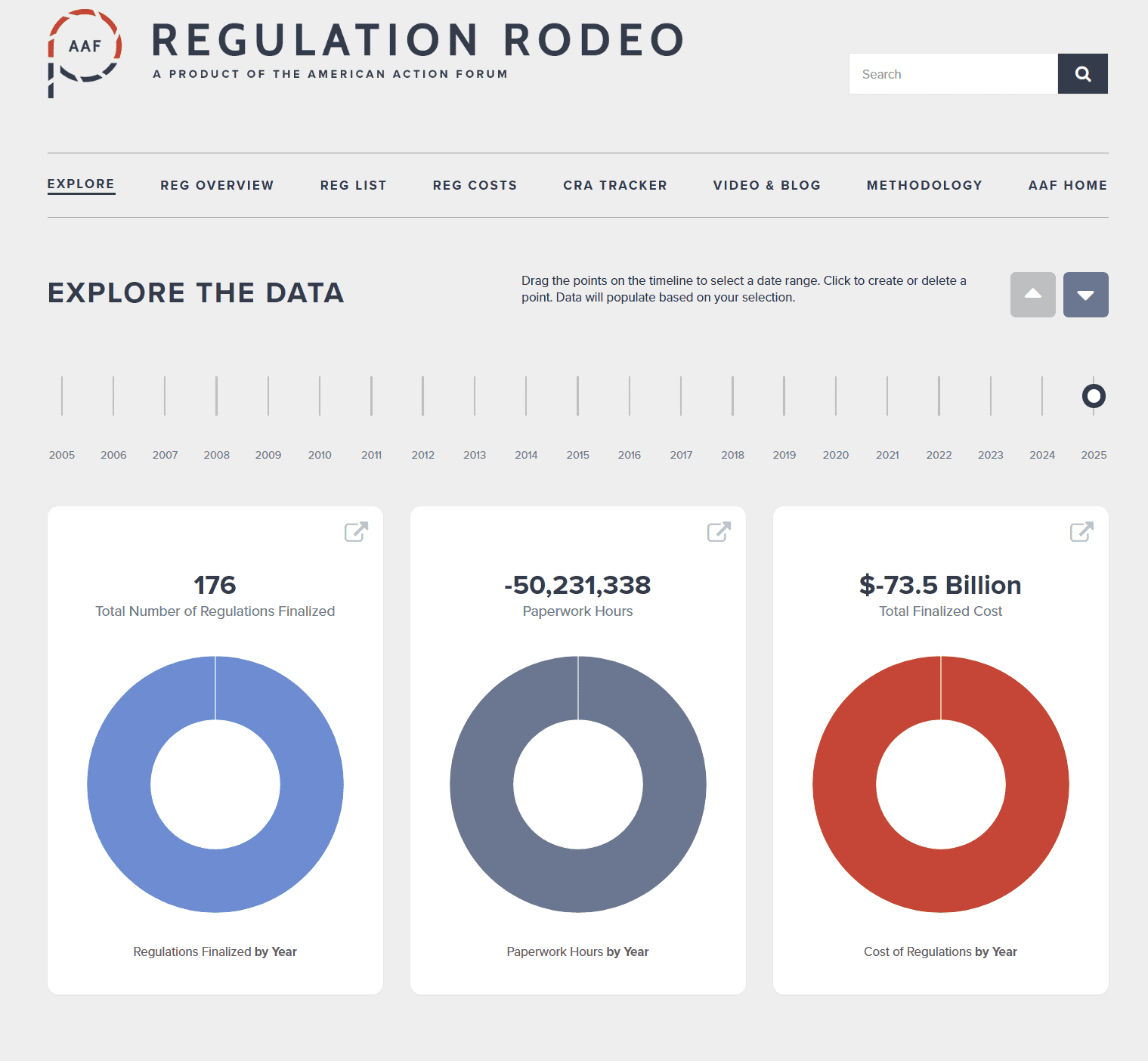
- 2025 Final Rule Costs: -$73.5 billion
- 2025 Proposed Rule Costs: -$628.1 billion
*IMPORTANT ANNOUNCEMENT*
The American Action Forum (AAF) is proud to announce a revamped version of our Regulation Rodeo (or, RegRodeo) project. For those unfamiliar with it, AAF’s RegRodeo database houses information on federal regulations going back to 2005. Launched in 2015, RegRodeo tracks every proposed and final rule published in the Federal Register that includes a quantified economic impact or paperwork burden estimate. This version makes the following improvements to the site:
- Clearer graphics and layout;
- An updated, more intuitive user interface;
- Enhanced ability to share findings across social media platforms;
- The opportunity to export selected sets of regulatory cost/savings data; and
- Direct links to additional AAF material on regulatory policy matters such as the Congressional Review Act (CRA).
NOTABLE REGULATORY ACTIONS
The most consequential rulemaking of the week was the HHS final rule regarding “Medicare Program: Hospital Outpatient Prospective Payment and Ambulatory Surgical Center Payment Systems; Quality Reporting Programs; Overall Hospital Quality Star Rating; Hospital Price Transparency; and Notice of Closure of a Teaching Hospital and Opportunity To Apply for Available Slots.” As is typical with Medicare payment rules, the main impact comes in the rule’s adjustment to transfer payments. For RegRodeo purposes, however, the more interesting aspect is the changes made to various relevant paperwork requirements. Assessing the new paperwork burden estimates of the dozens of affected forms against the currently available estimates yields roughly 5.1 million hours and $83.1 million in annual paperwork and associated cost reductions, respectively.
The runner-up of the week was the EPA proposed rule regarding “Hazardous and Solid Waste Management System: Disposal of Coal Combustion Residuals From Electric Utilities; Extension of an Alternative Closure Requirement Deadline.” As the title suggests, the agency:
Is proposing to extend, by three years, one compliance deadline applicable to certain coal combustion residuals (CCR) surface impoundments operating pursuant to the alternative closure requirements. Specifically, EPA is extending the deadline for owners and operators to complete closure of their unlined CCR surface impoundments larger than 40 acres from October 17, 2028, to October 17, 2031.
In the accompanying Regulatory Impact Analysis, EPA estimates that this extension will afford affected entities between $89.3 million and $146 million in total cost savings (with a mid-point estimate of approximately $117.6 million).
TRACKING TRUMP 2.0
Given the holiday week, there were no new major announcements or developments from either the White House or Congress on regulatory policy matters.
The AAF CRA tracker provides a full survey of activity under the law thus far in 2025. As of today, members of the 119th Congress have introduced CRA resolutions of disapproval addressing 69 rulemakings across the Biden and Trump Administrations that collectively involve $138 billion in compliance costs. Of these, 16 have been passed into law, repealing a series of Biden Administration rules that had a combined $3 billion in associated compliance costs – roughly 2 percent of that potential $138 billion total. While the main window of CRA action has largely passed, there are still outstanding resolutions that could move legislatively. AAF will continue to monitor and update such developments as appropriate.
TOTAL BURDENS
Since January 1, the federal government has published $701.6 billion in total regulatory net cost savings (with $73.5 billion in cost savings from finalized rules) and 74.5 million hours of net annual paperwork cuts (with 50.2 million hours coming from final rules).