Week in Regulation
January 12, 2026
Aircraft Radio Proposal Starts 2026 With Sizable Costs
The first full week of 2026 was a relatively middling one in terms of regulatory activity – but for one proposed rule. There were nine rulemakings with some kind of quantified economic effect. The outlier proposed rule that tilted the scales was a Federal Aviation Administration (FAA) measure seeking to update regulatory provisions regarding radio altimeters in aircraft due to statutory changes made under the legislation commonly known as the “One Big Beautiful Bill Act.” Across all rulemakings, federal agencies published roughly $4.9 billion in total costs and added 647,436 paperwork burden hours.
REGULATORY TOPLINES
- Proposed Rules This Week: 21
- Final Rules This Week: 35
- 2026 Total Pages: 1,038
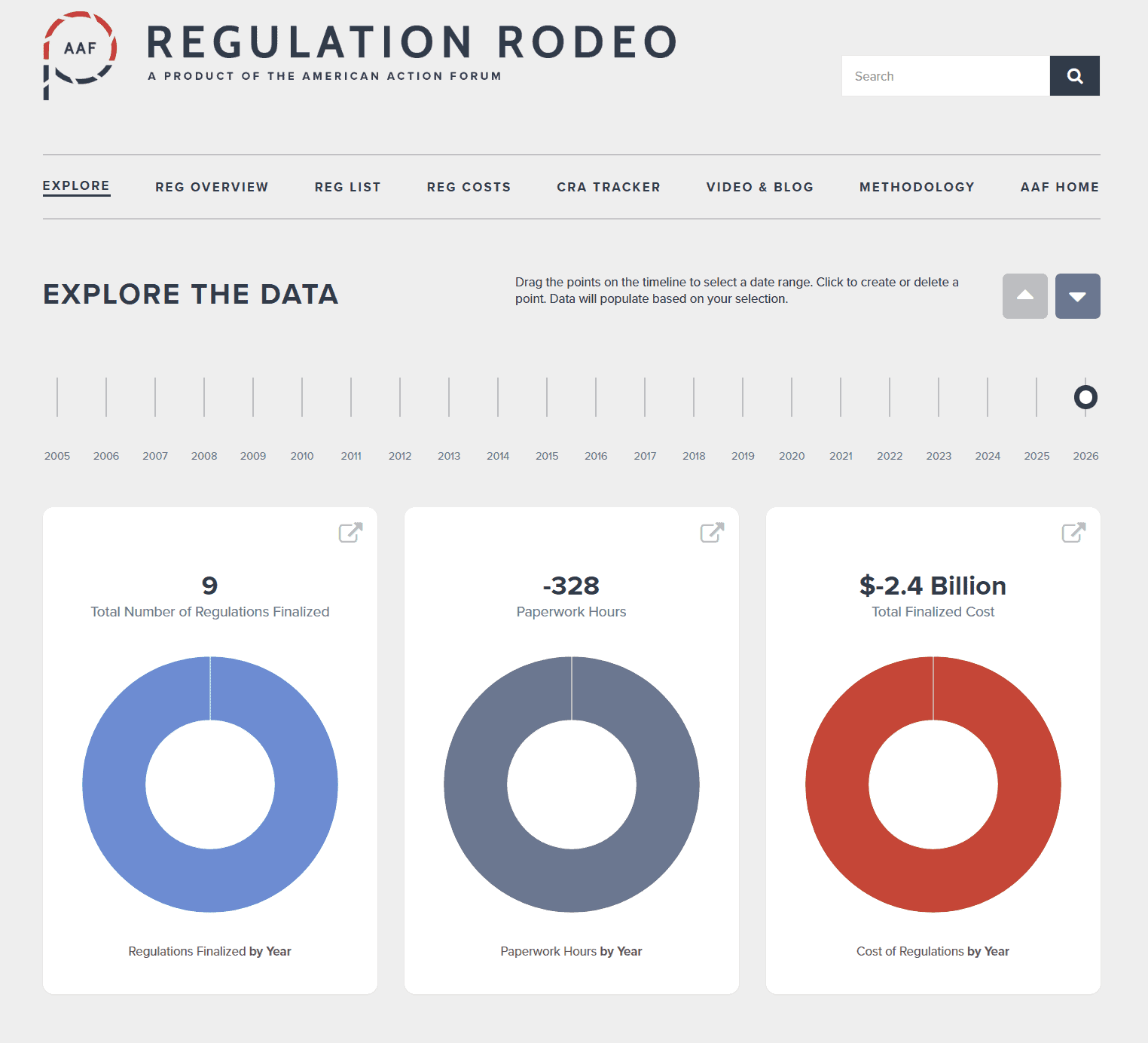
- 2026 Final Rule Costs: -$2.4 billion
- 2026 Proposed Rule Costs: $5.3 billion
NOTABLE REGULATORY ACTIONS
As mentioned above, the most significant rulemaking of the week was the proposed rule from FAA regarding “Requirements for Interference-Tolerant Radio Altimeter Systems.” The agency summarizes the proposal purpose thus:
In July 2025, President Trump signed the One Big Beautiful Bill Act. Section 40002 of that law re-institutes the Federal Communications Commission’s general auction authority and specifically directs the Commission to complete a system of competitive bidding for not less than 100 megahertz in the 3.98-4.2 gigahertz band (Upper C-band). To ensure safe, efficient, and reliable aviation operations in the presence of wireless signals in the Upper C-band, the Federal Aviation Administration is proposing new regulations that would require all radio altimeters to meet specific minimum performance requirements. These new radio altimeters must withstand interference from wireless signals in neighboring spectrum bands and continue to provide accurate altitude readings to both pilots and integrated aircraft safety systems.
FAA currently estimates that the total cost to affected operators to retrofit their aircraft under the new requirements will be nearly $4.5 billion.
TRACKING TRUMP 2.0
The past week, the American Action Forum (AAF) published a review of regulatory policy developments in 2025. This insight included an accounting of actions taken under Executive Order (EO) 14192, the Trump Administration’s current regulatory budget framework. AAF found, at least when considering rules that had a clear “deregulatory” or “regulatory” designation, that “federal agencies were successful at a top-line level in meeting the 10 deregulatory actions for every one regulatory action ratio as well as producing $140 billion in net savings.” In assessing rulemakings that include an EO 14192 designation thus far into 2026 (including the handful of rules published January 2), there have been five “deregulatory” rules with combined total savings of $2.4 billion. The radio altimeter rule discussed above brings sizable costs as a “regulatory” action but does not factor into this count yet since it is still a proposed rule.
CONGRESSIONAL REVIEW ACT (CRA)
The AAF CRA tracker provides a full survey of activity under the law thus far into this term. As of today, members of the 119th Congress have introduced CRA resolutions of disapproval addressing 70 rulemakings across the Biden and Trump Administrations that collectively involve $138 billion in estimated compliance costs. Of these, 22 have been passed into law, repealing a series of Biden Administration rules that had a combined $3 billion in associated compliance costs. The Trump Administration estimates that the repeal of this rule yields an additional $936 million in savings. While the main window of CRA action has largely passed, there are still outstanding resolutions that could move legislatively. AAF will continue to monitor and update such developments as appropriate.
TOTAL BURDENS
Since the start of 2026, the federal government has published $2.9 billion in total regulatory net costs (with $2.4 billion in cost savings from finalized rules) and 2.1 million hours of net annual paperwork increases (with 328 hours in reductions coming from final rules).