Week in Regulation
February 23, 2026
Endangerment Finding Repeal Officially Lands
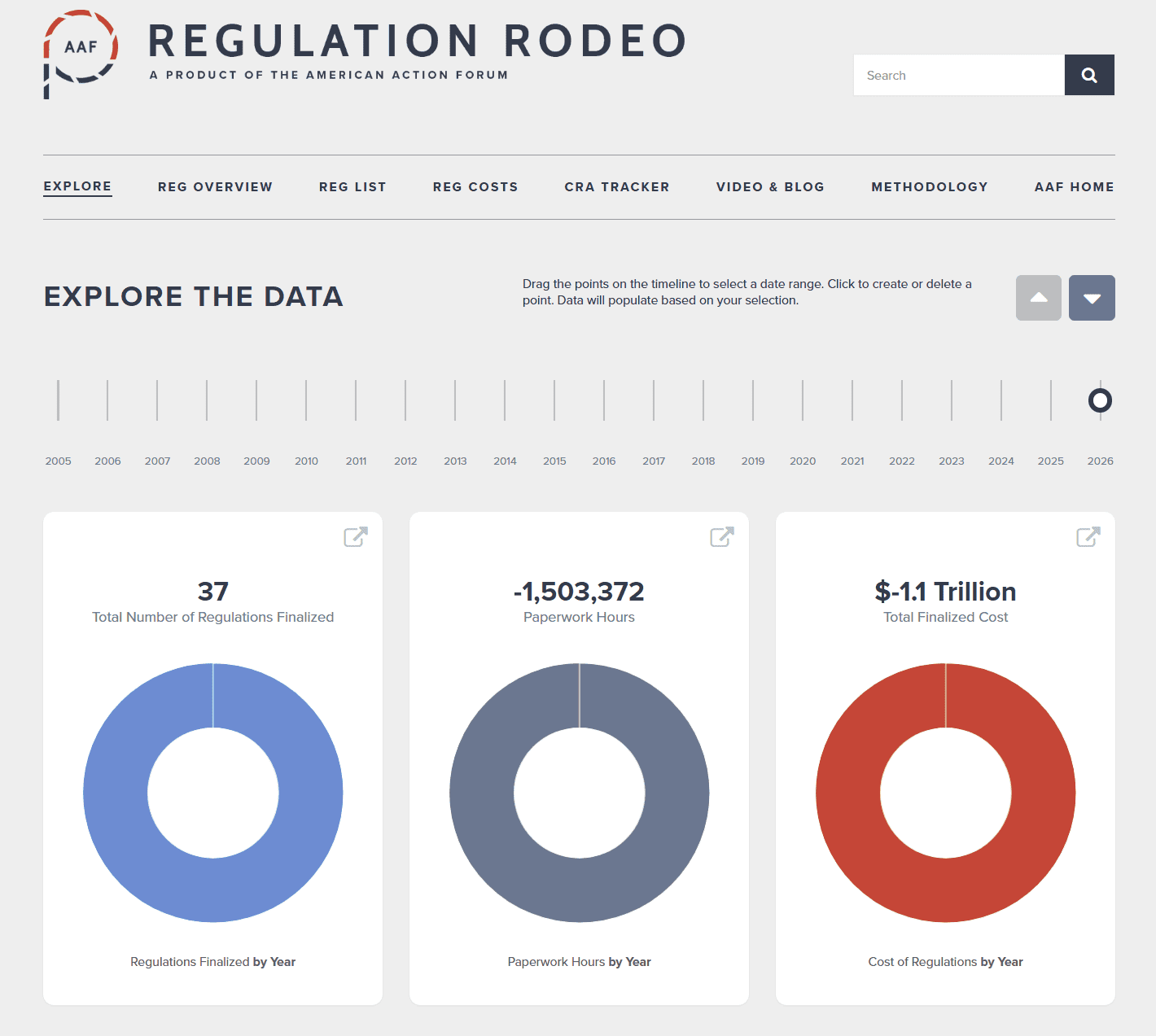
On a surface level review, this past week in regulation resembled the week that preceded it. There were 10 rulemakings with some kind of quantified economic estimates – including a handful of rules with effects (costs either added or reduced) measured in the billions of dollars. One item, however, blotted out the regulatory sun. The Environmental Protection Agency (EPA) officially published its rescission of the “endangerment finding” for greenhouse gas (GHG) emissions. This single rule pushes the second Trump term decidedly into the realm of trillion-dollar impacts. Federal agencies published roughly $1.1 trillion in total cost savings but added 1.6 million paperwork burden hours.
REGULATORY TOPLINES
- Proposed Rules This Week: 25
- Final Rules This Week: 52
- 2026 Total Pages: 8,337
- 2026 Final Rule Costs: -$1.1 trillion
- 2026 Proposed Rule Costs: $7.8 billion
NOTABLE REGULATORY ACTIONS
As mentioned above, the (far and away) most consequential rulemaking of the week was the final rule from EPA regarding “Rescission of the Greenhouse Gas Endangerment Finding and Motor Vehicle Greenhouse Gas Emission Standards Under the Clean Air Act.” The American Action Forum (AAF) previously walked through the estimated top-line cost reduction total here after its unofficial release. To maintain relative consistency with previous estimates of comparable rules, AAF is recording $1.1 trillion in total savings for RegRodeo purposes. Under the administration’s methodology for Executive Order (EO) 14192, EPA pegs the present value savings total at $769 billion. Regardless of the particular figure, it is clear that the calculated economic magnitude of this rule is immense. There remains a great deal of uncertainty, however, what the near-term, real-world impact will be since one can expect this to be one of the most legally scrutinized rulemakings in modern history.
While this endangerment finding rescission eclipsed all other rulemakings, there were some other significant rules that carried impacts in the billions of dollars. The Department of Agriculture (USDA) published a pair of proposed rules on livestock inspection. USDA estimates that its changes to “Maximum Line Speed Under the New Swine Slaughter Inspection System” will yield $1.8 billion in cost reductions while similar changes to young chicken and turkey inspection procedures will mean $1.3 billion in total savings to relevant operators. On the cost-adding side of the ledger, a proposal rule establishing a “Prohibition on Certain Semiconductor Products and Services” for defense contractors would bring $1.3 billion in total costs for affected entities.
TRACKING TRUMP 2.0
In assessing 2026 rulemakings that include an EO 14192 determination, there have been 18 “deregulatory” rules with combined total savings of $1.1 trillion against one “regulatory” rule that involves roughly $70 million in costs. Adding that to the total agencies produced during 2025 (at least from rules that had a clear “regulatory” or “deregulatory” designation), the Trump Administration has enacted $1.2 trillion in total cost reductions thus far under the auspices of EO 14192. Rules for which agencies have claimed one of the EO’s exemptions have accounted for an additional $372 million in costs so far in 2026.
CONGRESSIONAL REVIEW ACT (CRA)
There were no developments of any note on the CRA front. The AAF CRA tracker provides a full survey of activity under the law thus far into this term. As of today, members of the 119th Congress have introduced CRA resolutions of disapproval addressing 74 “rules” across the Biden and Trump Administrations that collectively involve $135.7 billion in estimated compliance costs. Of these, 22 have been passed into law, repealing a series of Biden Administration rules that had a combined $3 billion in associated compliance costs. The Trump Administration estimates that the repeal of this rule yields an additional $936 million in savings. While the main window of CRA action has largely passed, there are still outstanding resolutions that could move legislatively. AAF will continue to monitor and update such developments as appropriate.
TOTAL BURDENS
Since the start of 2026, the federal government has published $1.1 trillion in total regulatory net cost savings (with $1.1 trillion in reductions from finalized rules) and 27.9 million hours of net annual paperwork increases (with 1.5 million hours in reductions coming from final rules).