Week in Regulation
July 3, 2023
June Wraps Up With Proposals on Drilling and Mergers
In what ended up being a relatively spry week, there were 11 rulemakings from last week that had some measurable economic impact. The most significant items, however, were two proposed rules dealing with the “premerger notification rules” and drilling operations in the Outer Continental Shelf (OCS). Across all rulemakings, agencies published $4.9 billion in total costs and added 3.3 million annual paperwork burden hours.
REGULATORY TOPLINES
- Proposed Rules: 32
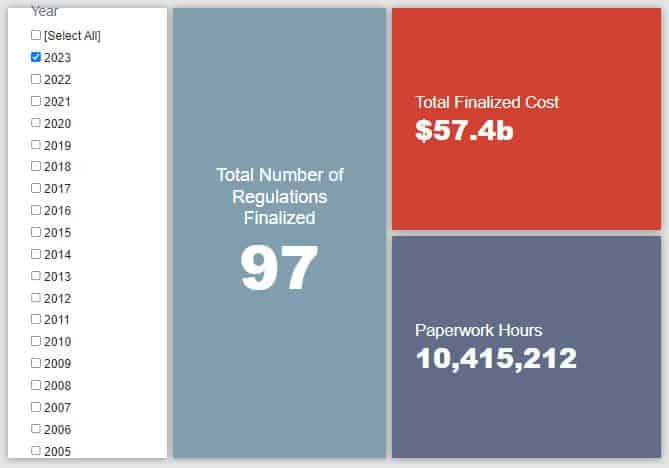
- Final Rules: 60
- 2023 Total Pages: 42,513
- 2023 Final Rule Costs: $57.4 billion
- 2023 Proposed Rule Costs: $320.9 billion
NOTABLE REGULATORY ACTIONS
The most consequential rulemaking of the week was the Department of Interior’s (DOI) proposed rule regarding “Risk Management and Financial Assurance for OCS Lease and Grant Obligations.” In the particular, the rulemaking:
Would require that the holders of interests in Outer Continental Shelf leases and grants provide financial assurance for their own contractual and regulatory obligations, including decommissioning obligations, to prevent the Federal Government from incurring costs to perform those obligations and to avoid the environmental or safety hazards associated with delayed compliance.
Under these new requirements, the “aggregate private cost to lessees of financial assurance premiums” would rise by nearly $320 million annually, or by roughly $3.4 billion total over a 20-year period.
The other notable action of the week came in the form of the Federal Trade Commission (FTC) proposed rule regarding “Premerger Notification; Reporting and Waiting Period Requirements.” Under relevant statutes, parties seeking to merge must submit filings to FTC and officials at the Department of Justice “a short period of time before consummating such transactions” to allow relevant agencies a chance to review the competitiveness implications of such a merger. This proposal seeks to increase the amount of information that parties to prospective mergers must submit. FTC estimates that these new requirements will involve nearly 760,000 more hours of paperwork with a commensurate cost of roughly $350 million each year.
TRACKING THE ADMINISTRATIONS
As we have already seen from executive orders and memos, the Biden Administration will surely provide plenty of contrasts with the Trump Administration on the regulatory front. And while there is a general expectation that the current administration will seek to broadly restore Obama-esque regulatory actions, there will also be areas where it charts its own course. Since the AAF RegRodeo data extend back to 2005, it is possible to provide weekly updates on how the top-level trends of President Biden’s regulatory record track with those of his two most recent predecessors. The following table provides the cumulative totals of final rules containing some quantified economic impact from each administration through this point in their respective terms.
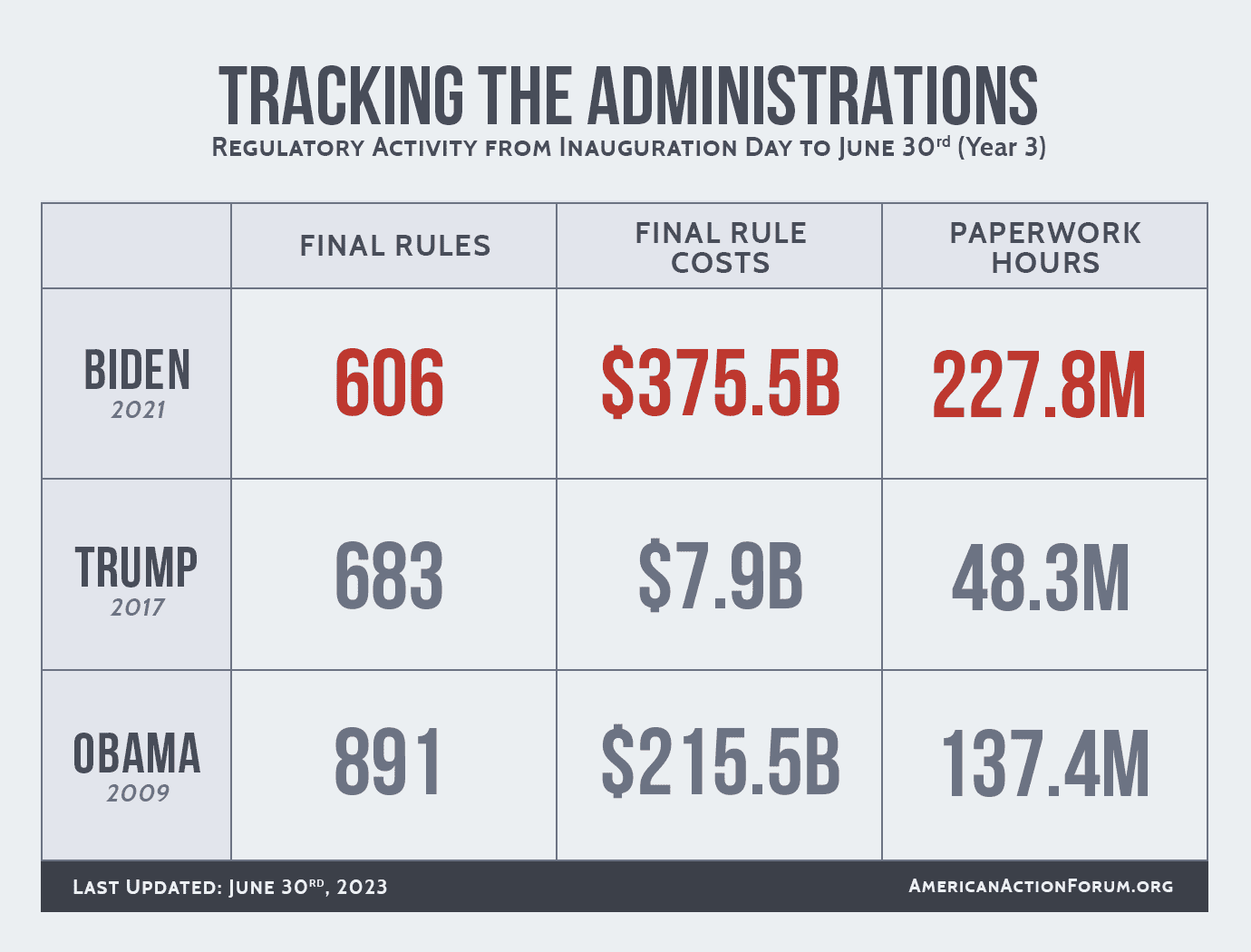 While most of the week’s action came from proposed rules, there was some movement on the final rule side for the Biden Administration, as well. A Federal Aviation Administration rule that would require a secondary security barrier on certain aircraft provided most of the week’s action here with $236.5 million in total costs. Meanwhile, for the other two administrations, the most significant changes came under Obama with costs and paperwork increasing by $1 billion and 930,000 hours, respectively. Energy efficiency standards for certain residential heating appliances and an Affordable Care Act rule regarding how insurers handle appeals were the primary drivers of those trends.
THIS WEEK’S REGULATORY PICTURE
This week, the Pipeline and Hazardous Materials Safety Administration (PHMSA) looks to update how freight rail operations carrying hazardous materials (hazmat) disclose their cargo to relevant authorities and stakeholders.
 Source: Photo by Craig Marolf on Unsplash
Last Tuesday, PHMSA published its proposed rule regarding “Hazardous Materials: FAST [Fixing America’s Surface Transportation] Act Requirements for Real-Time Train Consist Information.” In short, the proposal would “require all railroads to generate in electronic form, maintain, and provide to first responders, emergency response officials, and law enforcement personnel, certain information regarding hazardous materials in rail transportation to enhance emergency response and investigative efforts.”
If this seems like a clear response to the situation that unfolded with the Norfolk Southern derailment near East Palestine, OH earlier this year,that is because it is – only in part, though. The proposed rule’s preamble mentions “East Palestine” 10 times and notes that PHMSA is acting on a safety recommendation from the National Transportation Safety Board. As the proposal’s title suggests, however, the rulemaking is also implementing aspects of the FAST Act. That aspect of the proposed rule is less timely.
An AAF analysis shortly after the East Palestine incident found that the Department of Transportation – and PHMSA in particular – had numerous rulemakings in the works that could have helped mitigate that situation but were stuck in regulatory limbo. This proposed rule (with the Regulatory Identifier Number: 2137-AF21) is one of those rulemakings. It has been under development since Spring 2016 with last week marking the most substantive development since its inception. In a sentiment that echoes one in the AAF analysis piece, PHMSA notes that:
While PHMSA understands the availability of electronic real-time train consist information may not have changed the outcome of the recent Norfolk Southern train derailment in East Palestine, OH, that accident and similar events that have occurred in recent years highlight the importance of providing emergency response personnel with timely, complete, and accurate information regarding hazardous materials within a train—as any additional time for responders to prepare for what they will encounter may reduce risks and result in significant public safety, commercial, and environmental benefits.
The proposal’s new requirements would impose roughly $33 million in total costs on relevant operators. Interested parties have until August 28 to submit comments.
TOTAL BURDENS
Since January 1, the federal government has published $378.3 billion in total net costs (with $57.4 billion in new costs from finalized rules) and 151.3 million hours of net annual paperwork burden increases (with 10.4 million hours in increases from final rules).