Week in Regulation
March 9, 2026
March Begins on Moderately Deregulatory Note
Coming on the heels of two weeks with economic effects measured in the billions or even trillions of dollars, the first week of March seemed downright quaint in terms of regulatory impacts. To be sure, it was still an active week of rulemaking with 14 actions containing some kind of quantified economic analysis. Proposed deregulatory measures from the Environmental Protection Agency (EPA) and Internal Revenue Service (IRS), respectively, were the main items of the week. Overall, federal agencies published roughly $814.5 million in total cost savings and cut 1.4 million paperwork burden hours.
REGULATORY TOPLINES
- Proposed Rules This Week: 35
- Final Rules This Week: 57
- 2026 Total Pages: 11,101
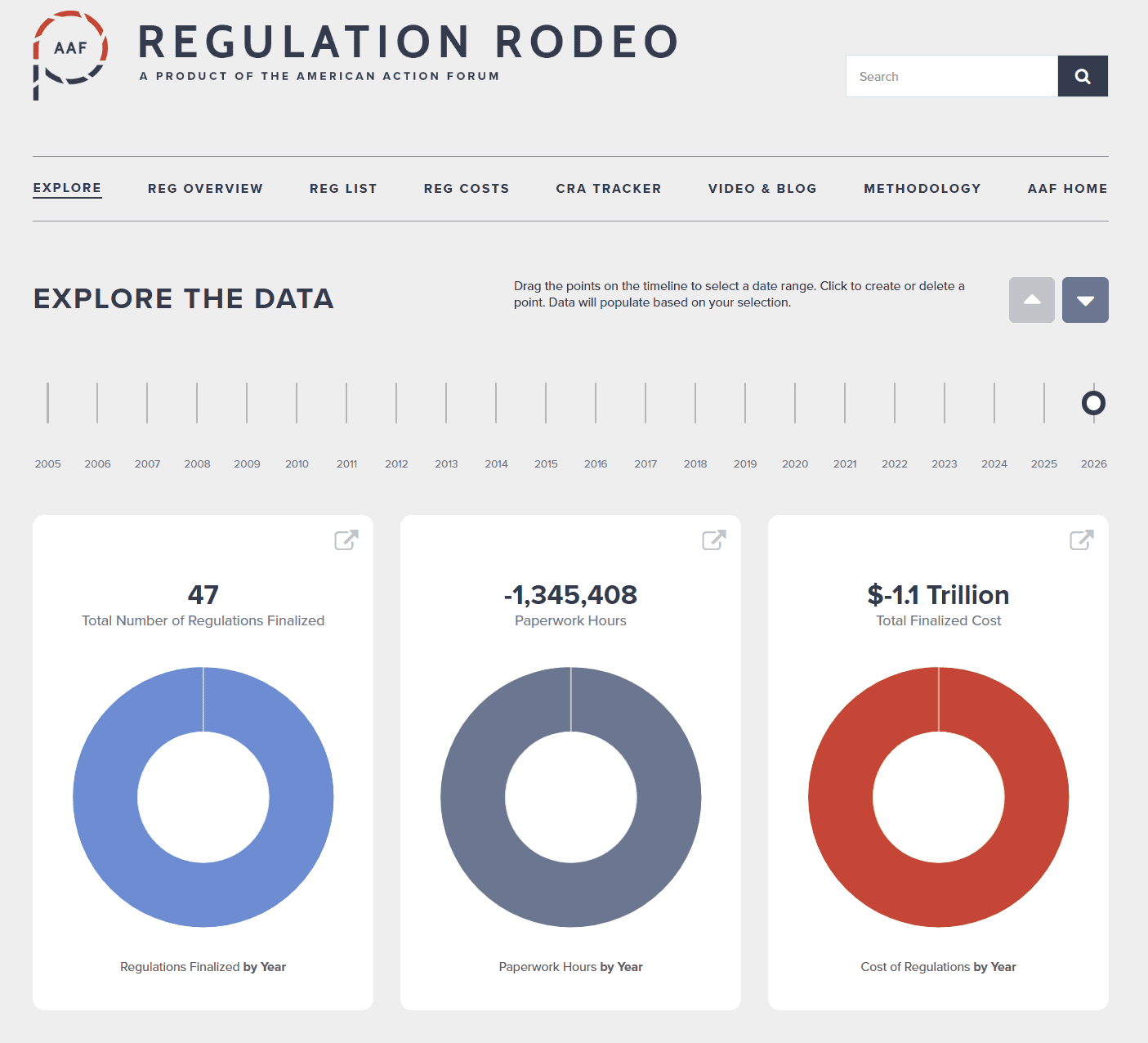
- 2026 Final Rule Costs: -$1.1 trillion
- 2026 Proposed Rule Costs: $144.6 billion
NOTABLE REGULATORY ACTIONS
The most significant rulemaking of the week was the proposed rule from EPA regarding “Clean Water Act [CWA] Hazardous Substance Facility Response Plans [FRP]: Compliance Date Delay and Changes To Reflect Administration Policy.” As the title suggests, the proposal seeks to push back the compliance date of Biden Administration rulemaking on the matter. Specifically, EPA “proposes a three-year delay of the compliance date by which a regulated facility is required to prepare and submit their CWA hazardous substance FRP, to June 1, 2030.” In the accompanying Regulatory Impact Analysis, the agency estimates that this will yield roughly $547 million in total cost reductions for affected facilities.
The week’s runner-up in terms of total quantified impact was the IRS proposed rule on “Removal of Final Regulations Identifying Certain Partnership Related-Party Basis Adjustment Transactions as Transactions of Interest.” This is another instance where: A) the title largely speaks for itself, and B) the agency seeks to roll-back a Biden Administration rule on the topic at hand. In this instance, though, IRS is seeking to rescind the prior administration’s regulatory language rather than simply delay the implementation thereof. The primary regulatory cost effect of removing these requirements would be in cutting out roughly 857,000 hours of annual paperwork burdens that carried $163 million in commensurate costs.
TRACKING TRUMP 2.0
With last week’s main rulemakings still being in the proposed rule stage, there was no measurable change in the year-to-date Executive Order (EO) 14192 regulatory budget math. In assessing 2026 rulemakings that include an EO 14192 determination, there have been 20 “deregulatory” rules with combined total savings of $1.1 trillion against one “regulatory” rule that involves roughly $70 million in costs. Adding that to the total agencies produced during 2025 (at least from rules that had a clear “regulatory” or “deregulatory” designation), the Trump Administration has enacted $1.2 trillion in total cost reductions thus far under the auspices of EO 14192. Rules for which agencies have claimed one of the EO’s exemptions have accounted for an additional $372 million in costs so far in 2026.
CONGRESSIONAL REVIEW ACT (CRA)
There were some modest rumblings on the CRA front last week. Members of the Utah delegation in both chambers introduced companion resolutions targeting a Department of Interior (DOI) notice on “Grand Staircase-Escalante National Monument Record of Decision and Approved Resource Management Plan.” The document is another example of a “rule” under the CRA that does not fit cleanly as a typical rulemaking. For resolutions of disapproval targeting more typical rulemakings, one turns to the upper chamber this past week. Senator Elizabeth Warren (D-MA) introduced a set of CRA resolutions seeking to rescind a trio of Trump Administration rules on various financial issues. One could expect to see some movement on the resolutions regarding the DOI notice given that Republican lawmakers introduced them, whereas Senator Warren’s resolutions will likely languish in the current Congress.
The American Action Forum (AAF) CRA tracker provides a full survey of activity under the law thus far into this term. As of today, members of the 119th Congress have introduced CRA resolutions of disapproval addressing 78 “rules” across the Biden and Trump Administrations that collectively involve $135.7 billion in estimated compliance costs. Of these, 22 have been passed into law, repealing a series of Biden Administration rules that had a combined $3 billion in associated compliance costs. The Trump Administration estimates that the repeal of this rule yields an additional $936 million in savings. While the main window of CRA action has largely passed, there are still outstanding resolutions that could move legislatively. AAF will continue to monitor and update such developments as appropriate.
TOTAL BURDENS
Since the start of 2026, the federal government has published $954.6 billion in total regulatory net cost savings (with $1.1 trillion in reductions from finalized rules) and 27.2 million hours of net annual paperwork increases (with 1.3 million hours in reductions coming from final rules).