Week in Regulation
October 27, 2025
One Rulemaking and One Memo
As the federal government shutdown drags on, the level of activity in the Federal Register continues to be negligible. This past week saw just a single rulemaking that had any real economic impact. With the week’s one rulemaking with measurable impacts, federal agencies published roughly $29.6 million in total costs and added 658 paperwork burden hours. Perhaps the most significant news of the week in terms of broader regulatory policy, however, came in the form of a memorandum from the Office of Information and Regulatory Affairs (OIRA) providing further direction to agencies (at least, whenever it is they resume normal operations) on their deregulatory efforts.
REGULATORY TOPLINES
- Proposed Rules: 8
- Final Rules: 2
- 2025 Total Pages: 48,448
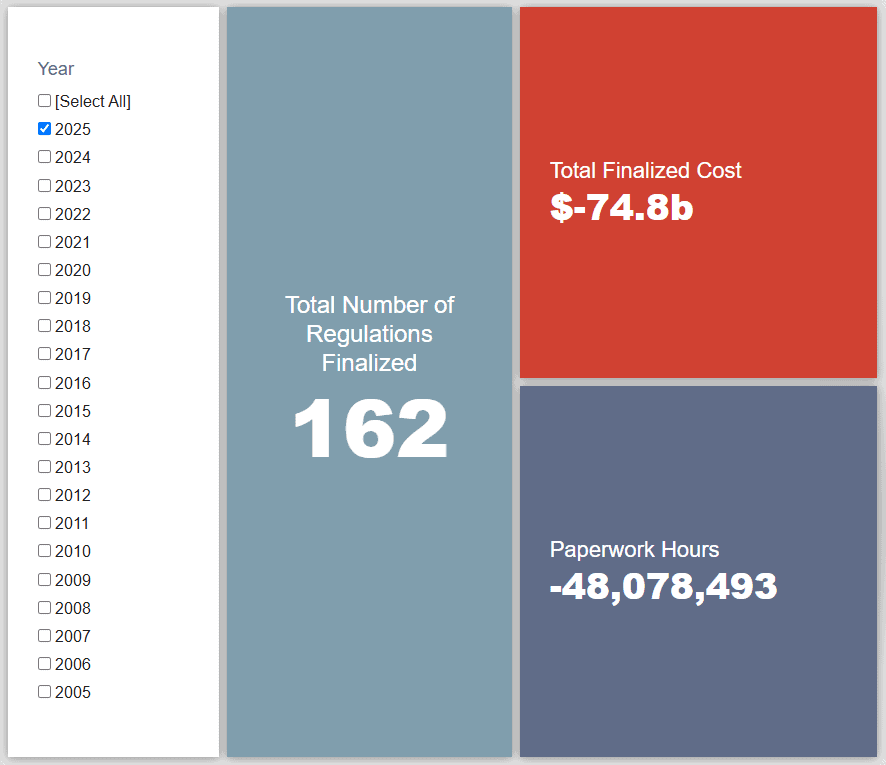
- 2025 Final Rule Costs: -$74.8 billion
- 2025 Proposed Rule Costs: -$628 billion
NOTABLE REGULATORY ACTIONS
The proposed rule from the Department of Homeland Security (DHS) titled “U.S. Citizenship and Immigration Services Employment-Based Immigrant Visa, Fifth Preference (EB-5) Fee Rule” stands out for being the one rulemaking action of the week with any measurable effects. As the proposal’s title suggests, the main effects will be on the fee levels for the EB-5 visa program. There will, however, be some administrative burdens for applicants under this rulemaking. DHS estimates these costs to be roughly $29.6 million over a 10-year horizon. The sub-agency in charge of this rulemaking, U.S. Citizenship and Immigration Services, was able to produce this action during the shutdown because it is one of many DHS components that can largely continue normal operations despite the lapse in appropriations.
TRACKING TRUMP 2.0
Perhaps the most consequential bit of regulatory policy news came in the form of a memo sent out to agencies by Acting OIRA Administrator Jeffrey Clark regarding “Streamlining the Review of Deregulatory Actions.” The memo contains the following three main sections:
- “GENERAL PROVISIONS DESIGNED TO SPEED AND STREAMLINE OIRA REVIEW”;
- “PROVISIONS DIRECTED AT REPEALING FACIALLY UNLAWFUL REGULATIONS,” and;
- “PROVISIONS DIRECTED AT DEVELOPING BETTER DEREGULATORY RECORDS WHERE NECESSARY OR VOLUNTARILY OPTED FOR BY AGENCIES.”
The first section establishes a series of OIRA review time limits for deregulatory actions (namely, “a presumptive maximum 28-day OIRA review period for deregulatory actions that are executed with factual records (see part III infra) and a presumptive maximum 14-day OIRA review period for facially unlawful rules [see section 2]”) and directs agencies to largely forgo a series of certifications required by various past executive orders (EO). These review time limits may very well speed up the rulemaking process for these items since the average review time for rules under this administration thus far has been 67 days: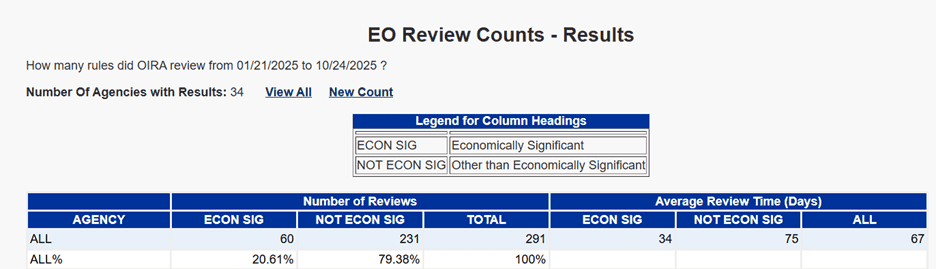 The foregoing of the EO certifications will likely be less meaningful since many of these sections in rulemakings already include perfunctory, boilerplate language.
The memo’s second section is likely its most significant. Building off of a presidential memo from this spring (April 9 memo) that directed agencies to identify regulatory provisions that contravened any of 10 Supreme Court rulings, this more recent memo directs agencies to assert the “good cause” exemption under the Administrative Procedure Act and bypass the regular notice-and-comment process when repealing provisions under the auspices of the April 9 memo. Specifically:
In short, your agency should identify and rescind regulations where (a) the question is clearly one of lawfulness or unlawfulness under the ten Supreme Court cases listed by in the April 9 Presidential Memorandum, and (b) where the agency has determined that the best interpretation is that the regulation is unlawful. Where the agency is convinced that the regulation is unlawful and that position has a reasonably good chance of success on the merits, the regulation should be repealed. Nevertheless, the agency should provide a brief statement of why the identified regulation is unlawful and good cause exception applies.
It is difficult to know the near-term practical impact of this section, since basically any such recission made under it will come under immediate legal challenge that will require extensive adjudication – mostly likely all the way back up to the Supreme Court. Nevertheless, taken at face value, it would represent a remarkably expeditious way for agencies to repeal a whole host of regulatory provisions assuming they make a cognizable case for unlawfulness under the April 9 memo’s parameters.
Finally – and perhaps lastly in terms of measurable impact – comes the memo’s third section that focuses on the characteristics of agency deregulatory action analysis. This section directs agencies to coordinate with OIRA to more actively identify quantitative effects of deregulation and then provides a series of cost-benefit considerations that OIRA believes agencies should include in their analyses where possible. This section may have some salutary effects on the robustness of agency analysis in their deregulatory actions that insulate them further from legal challenge, but that is about the only appreciable effect one can discern from it.
There were no developments on the Congressional Review Act (CRA) front this past week. The American Action Forum (AAF) CRA tracker provides a full survey of activity under the law thus far in 2025. As of today, members of the 119th Congress have introduced CRA resolutions of disapproval addressing 65 rulemakings across the Biden and Trump Administrations that collectively involve $138 billion in compliance costs. Of these, 16 have been passed into law, repealing a series of Biden Administration rules that had a combined $3 billion in associated compliance costs – roughly 2 percent of that potential $138 billion total. While the main window of CRA action has largely passed, there are still outstanding resolutions that could move legislatively. AAF will continue to monitor and update such developments as appropriate.
TOTAL BURDENS
Since January 1, the federal government has published $702.8 billion in total regulatory net cost savings (with $74.8 billion in cost savings from finalized rules) and 69.6 million hours of net annual paperwork cuts (with 48.1 million hours coming from final rules).