Week in Regulation
October 6, 2025
Regulatory Action From EPA Stands Out During Busy Week
While the ongoing government shutdown will bring rulemaking activity to trickle in the coming days and/or weeks, this past week was a fairly lively one in the pages of the Federal Register. There were 18 items with some kind of measurable economic impact. The Environmental Protection Agency (EPA) was the main agency of the week, providing the most significant regulatory and deregulatory actions of the haul. Across all rulemakings, agencies published roughly $1.9 billion in total costs and added roughly 228,000 paperwork burden hours.
REGULATORY TOPLINES
- Proposed Rules: 37
- Final Rules: 97
- 2025 Total Pages: 48,012
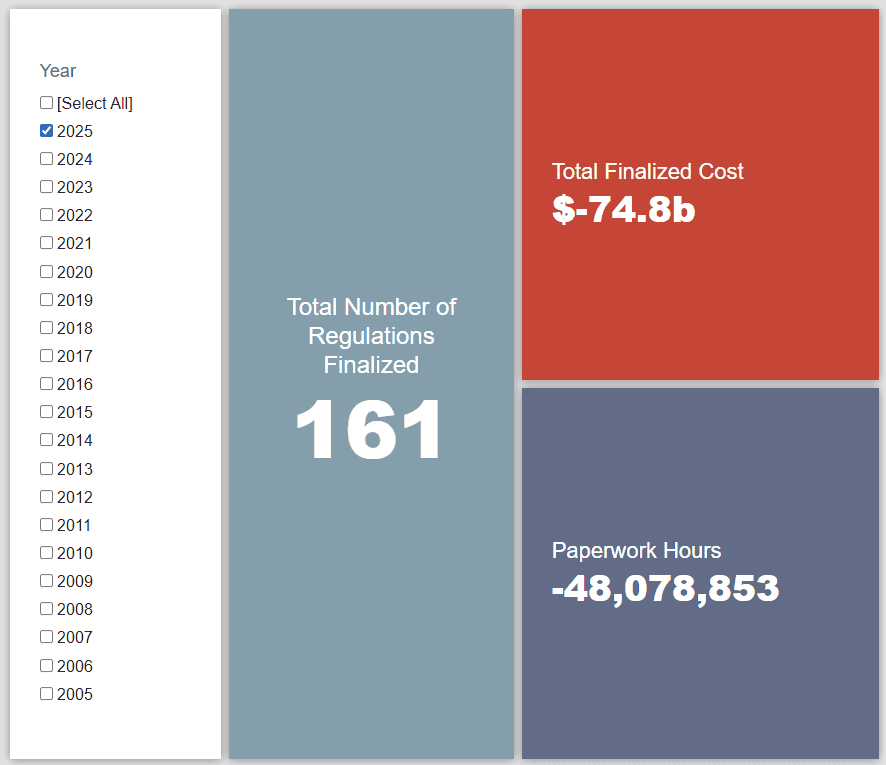
- 2025 Final Rule Costs: -$74.8 billion
- 2025 Proposed Rule Costs: -$628 billion
NOTABLE REGULATORY ACTIONS
The most consequential rulemaking of the week was the rule from EPA regarding “Water Quality Standards To Protect Aquatic Life in the Delaware River.” In particular, the regulation sets “a designated use of protection and propagation of resident and migratory aquatic life and corresponding dissolved oxygen water quality criteria for the mainstem Delaware River in Zone 3, Zone 4, and the upper portion of Zone 5 (in total, river miles 108.4 to 70.0).” EPA issued the proposed version of the rule in 2023, making it an initiative that dates to the Biden Administration. As such, it is hardly surprising that it falls under the “regulatory” side of the ledger for the purposes of Executive Order (EO) 14192. The agency estimates that the rule’s requirements will involve $185.6 million in annualized costs to affected water safety authorities, or roughly $2.3 billion in present value over a 10-year period.
EPA also had a substantial deregulatory action, albeit, one that had more modest estimated cost reductions. The proposed rule on “Effluent Limitations Guidelines and Standards for the Steam Electric Power Generating Point Source Category-Deadline Extensions,” would – as the title suggests – push back some deadlines established under a 2024 rule on the matter. The schedule of extensions is the following:
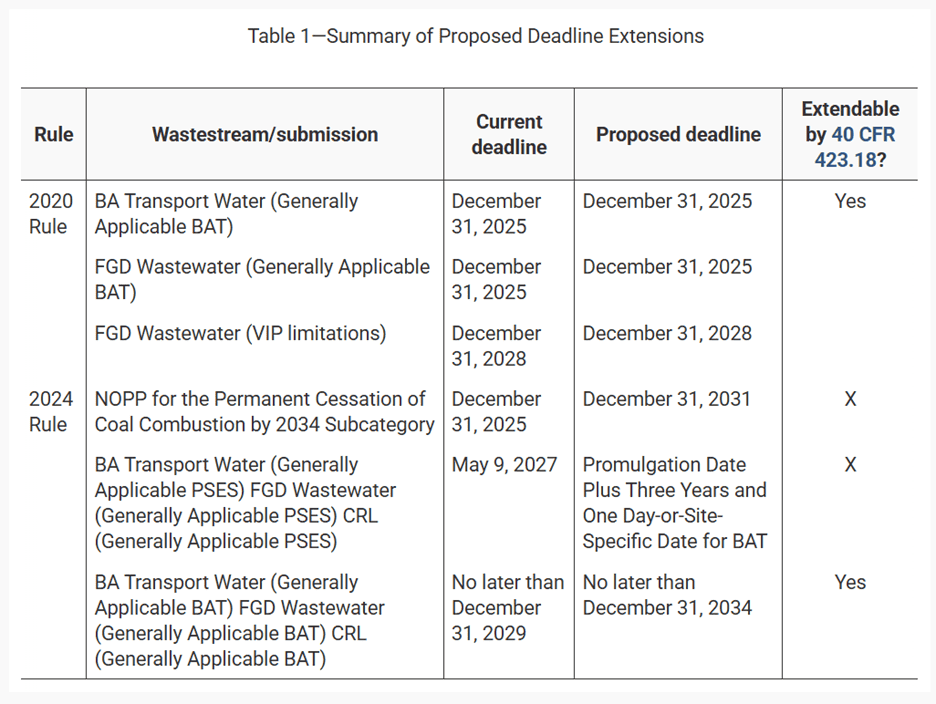
EPA projects that, under these implementation delays, “estimated annualized cost savings are $79 million to $215 million.” Taking the midpoint of that range means $147 million in annual savings, or roughly $386 million total across a three-year window.
TRACKING TRUMP 2.0
The ongoing government shutdown is, of course, more of a fiscal matter than a regulatory one. Nevertheless, it will have some impact on the administration’s broader regulatory policy agenda. With agencies generally shuttered, one can already see administrative actions slow to a crawl in the Federal Register. The length of this shutdown will be the primary determinant of how significant this downturn in regulatory activity will be. For instance, looking back to the weeks-long shutdown across 2018 and 2019, the Federal Register had what is likely the lightest issue on record on January 15, 2019, that amounted to a barely half-page notice extending a disaster relief filing deadline.
The only action on the Congressional Review Act (CRA) front was from Senator Sheldon Whitehouse (D-RI) introducing yet another series of resolutions of disapproval against Trump Administration rules – including one that seeks to repeal the Department of Interior’s rule on “Restoring Names That Honor American Greatness: Gulf of America.” The American Action Forum (AAF) CRA tracker provides a full survey of activity under the law thus far in 2025. As of today, members of the 119th Congress have introduced CRA resolutions of disapproval addressing 64 rulemakings across the Biden and Trump Administrations that collectively involve $138 billion in compliance costs. Of these, 16 have been passed into law, repealing a series of Biden Administration rules that had a combined $3 billion in associated compliance costs – roughly 2 percent of that potential $138 billion total. While the main window of CRA action has largely passed, there are still outstanding resolutions that could move legislatively. AAF will continue to monitor and update such developments as appropriate.
TOTAL BURDENS
Since January 1, the federal government has published $702.8 billion in total regulatory net cost savings (with $74.8 billion in cost savings from finalized rules) and 69.6 million hours of net annual paperwork cuts (with 48.1 million hours coming from final rules).