Week in Regulation
September 15, 2025
Second Week of September Draws Just a Pair of Rules: September 8 – 12
This past week was a remarkably sparse one in terms of measurable regulatory activity. There was a grand total of two rulemakings that contained quantified economic estimates. The more significant of the pair was a Department of Defense (DOD) rule on cybersecurity requirements for defense contractors. The other was a relatively minor Department of Interior measure rolling back a 2024 Biden-era rule that involved a nominal paperwork burden. Across all rulemakings, agencies published roughly $254.8 million in total costs but cut 1,459 paperwork burden hours.
REGULATORY TOPLINES
- Proposed Rules: 29
- Final Rules: 49
- 2025 Total Pages: 44,198
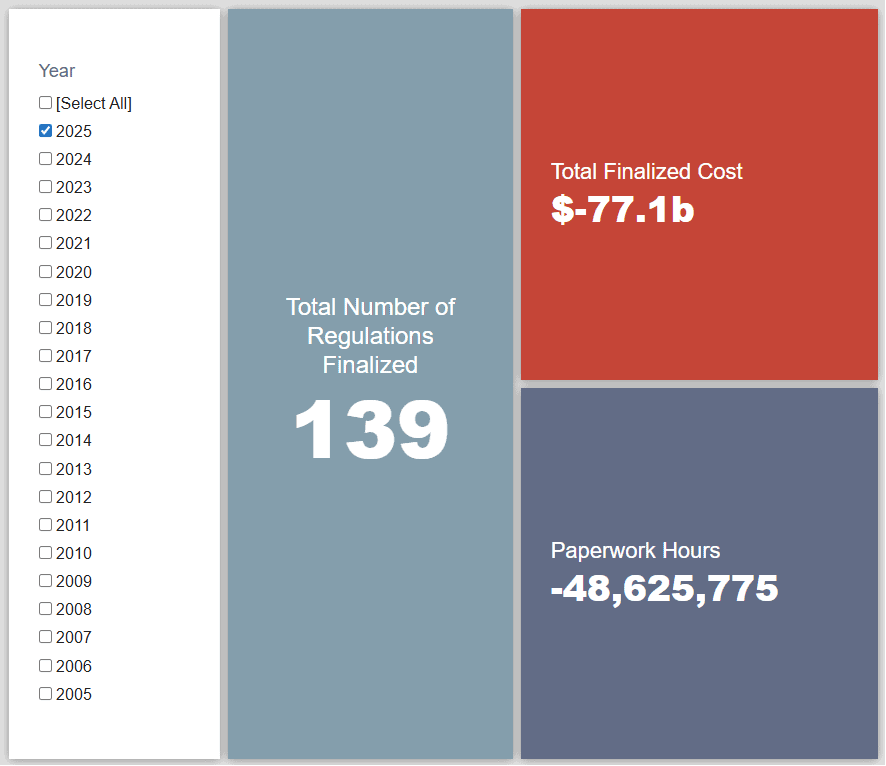
- 2025 Final Rule Costs: -$77.1 billion
- 2025 Proposed Rule Costs: -$624.6 billion
NOTABLE REGULATORY ACTIONS
The most consequential item of the week was the DOD rule regarding “Defense Federal Acquisition Regulation Supplement: Assessing Contractor Implementation of Cybersecurity Requirements (DFARS Case 2019-D041).” Of note, the rulemaking is a carry-over from a proposed rule released last year under the Biden Administration. Per the final version’s summary:
DOD is issuing a final rule amending the Defense Federal Acquisition Regulation Supplement (DFARS) to incorporate contractual requirements related to the final Cybersecurity Maturity Model Certification program rule, titled Cybersecurity Maturity Model Certification Program. This final DFARS rule also partially implements a section of the National Defense Authorization Act for Fiscal Year 2020 that directed the Secretary of Defense to develop a consistent, comprehensive framework to enhance cybersecurity for the U.S. defense industrial base.
The agency now estimates that these new requirements will result in nearly $255 million in total costs for affected contractors. DOD believes these costs are justified since the estimated “benefit from reducing the threat of malicious cyber activity” numbers in the hundreds of billions of dollars.
TRACKING TRUMP 2.0
As noted last week, the American Action Forum (AAF) took a look at the administration’s recently release Unified Agenda (UA). That analysis found the following:
In broad strokes, the UA data reveal that the Trump Administration expects to be quite active on the deregulatory front in the near-term and has a large portion of its rulemakings designated as “regulatory” on the backburner for now. With 285 “deregulatory” actions, the Department of Transportation (DOT) is able to claim the mantle of most deregulatory agency, but even with that lofty figure, it – and essentially all other agencies – are not on track to meet the EO’s 10-to-1 deregulatory-to-regulatory rulemaking goal.
There were no further announcements from the White House that carried broad-based implications for the administrative state.
There were also no new developments on the Congressional Review Act (CRA) front. The AAF CRA tracker provides a full survey of activity under the law thus far in 2025. As of today, members of the 119th Congress have introduced CRA resolutions of disapproval addressing 58 rulemakings across the Biden and Trump Administrations that collectively involve $138 billion in compliance costs. Of these, 16 have been passed into law, repealing a series of Biden Administration rules that had a combined $3 billion in associated compliance costs – roughly 2 percent of that potential $138 billion total. While the main window of CRA action has largely passed, there are still outstanding resolutions that could move legislatively. AAF will continue to monitor and update such developments as appropriate.
TOTAL BURDENS
Since January 1, the federal government has published $701.8 billion in total regulatory net cost savings (with $77.1 billion in cost savings from finalized rules) and 69.4 million hours of net annual paperwork cuts (with 48.6 million hours coming from final rules).