Weekly Checkup
October 2, 2026
CMS Should Wait on Its Fixed-combination Drug Policy
The Centers for Medicare & Medicaid Services (CMS) is entering a critical, final period for considering a consequential change to how the Medicare Drug Price Negotiation Program (MDPNP) treats certain fixed-combination medicines. CMS wants to avoid a scenario where a manufacturer could take a drug approaching negotiation – with a new formulation, an additional ingredient, and different route of administration – and shift patients toward that newer (patented) product before Medicare’s negotiated price takes effect. But this proposal may be an overreaction to a problem that has not yet surfaced.
Under current policy, fixed-combination products containing different active ingredients generally constitute separate qualifying single-source drugs. Under its June 2026 proposed rule, CMS would generally aggregate an older product and a fixed-combination version when an additional active ingredient creates a new formulation and enables a different route of administration. The newer formulation could therefore inherit the original drug’s negotiation timeline rather than start its own.
But a plausible loophole is not the same thing as a demonstrated one. CMS acknowledges that fixed-combination formulations have not yet affected drug selection, and the agency says it cannot reliably estimate the budgetary impact of changing the policy. Those are substantial uncertainties on which to base a permanent rule governing an expanding category of medicines.
The immediate targets are easy to identify. Keytruda and Opdivo, two major oncology biologics, now have subcutaneous versions that combine the original biologic with an enzyme that allows administration beneath the skin. Keytruda Qlex, for example, combines pembrolizumab with berahyaluronidase and was approved by the Food and Drug Administration (FDA) in September 2025 for the solid-tumor indications of intravenous Keytruda. Keytruda and Opdivo are included in a recent Journal of Managed Care & Specialty Pharmacy (JMCP) analysis projecting the 20 drugs most likely to be selected for the 2029 negotiation cycle. Thus, if the rule is finalized and the JMCP is close to accurate, this evidence would be a narrow empirical foundation for a sweeping permanent policy.
These products are not simply new labels placed on old medicines. Their therapeutic ingredients may be familiar, but how they are delivered can change materially. These material changes are enough to require separate FDA review and approval. Appropriate patient profiles can differ, and the innovation and reformulation resources put into patient-centered advancements are non-zero values.
CMS acknowledges that fixed-combination formulations have not yet affected drug selection. It is therefore acting prospectively, based largely on concern about how manufacturers could respond as more Part B biologics become negotiation eligible. This is important to consider, because Keytruda and Opdivo are not isolated examples. A review of FDA approvals suggests that at least nine existing biologic families already fit the basic structure contemplated by CMS’ proposal (see table below). Not all will ever be eligible for negotiation; biosimilar competition, orphan drug exemptions, and other statutory rules will remove some from consideration. But they demonstrate that CMS is not simply addressing two anomalous products. It is preemptively reorganizing treatment innovation and administration before enough data is gathered.
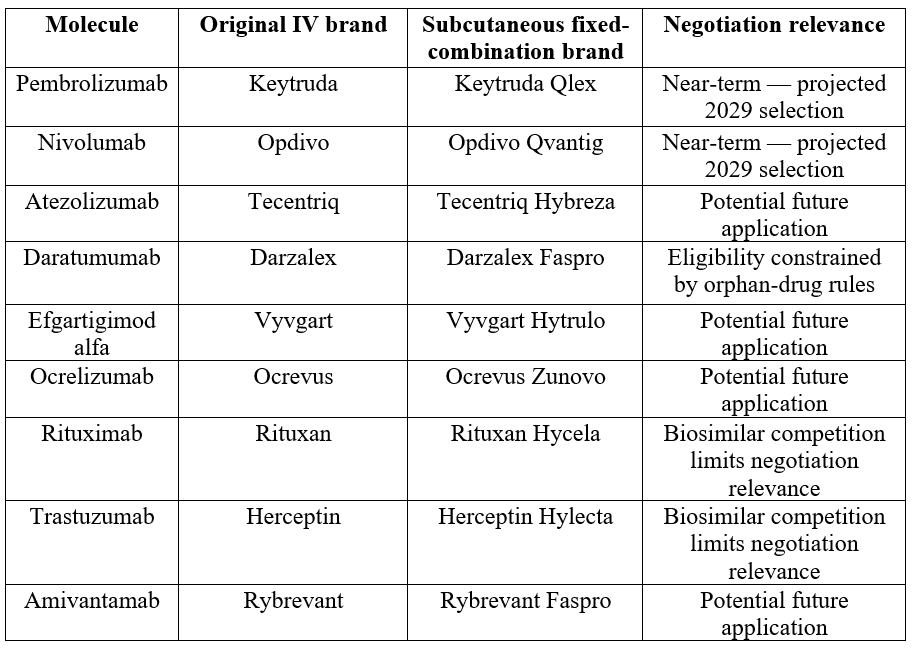
Note: Author’s analysis based on CMS’ proposed §429.125(b)(4)(i), FDA approvals, and published research on hyaluronidase formulations. Inclusion indicates apparent fit with the proposed structure, not current eligibility for Medicare negotiation.
Among the products already on the market, uptake varies dramatically: Subcutaneous formulations represented only about 5 percent of Medicare spending for rituximab and trastuzumab but nearly 83 percent for daratumumab. The same study found genuine clinical differences in some cases; infusion reactions with daratumumab fell from 34.5 percent with the intravenous product to 12.7 percent with its subcutaneous formulation.
Those figures cut against a one-size-fits-all policy such as the one CMS is proposing. Some reformulations barely penetrate the market; others rapidly become the preferred method of treatment. Some provide modest convenience; others materially change administration and adverse-event profiles. Some may indeed be designed partly to preserve market share as competition or negotiation approaches; others are natural evolutions for marketability.
But CMS’ proposed rule largely collapses those possibilities into the same regulatory answer. That is especially difficult to justify when the agency cannot yet establish the fiscal payoff. CMS is attempting to prevent manufacturers from responding strategically to negotiation, but manufacturers changing behavior in response to a new pricing regime is hardly surprising. The appropriate question is whether the response produces enough circumvention to justify treating a distinct FDA-approved fixed combination as though its negotiation clock began years before the product existed. Right now, CMS does not have that evidence.
The agency reached a more judicious conclusion only a year ago. In its final guidance for the 2028 cycle, CMS declined to change the fixed-combination policy and said it would continue examining the program-integrity risk. The subsequent rulemaking has clarified how CMS might intervene, but it has not supplied the missing evidence that intervention is necessary.
CMS should holster its regulatory weapons until the circumstances call for action. The MDPNP is still in its first year of implementation – transparent and complete audits of how IPAY 2026 has affected consumption and spending patterns haven’t been completed, and we don’t yet know how the program has changed Medicare.
CMS does not need to ignore product hopping indefinitely. It can watch how Keytruda Qlex, Opdivo Qvantig, and subsequent other products affect utilization, spending, competition, and drug selection. If manufacturers do indeed use fixed combinations to systematically circumvent negotiation, CMS will have a stronger case for acting. What it should not do is turn a possible future workaround into a permanent rule today. Medicare price negotiation is detrimental enough without treating innovation as evasion before the evidence demonstrates the difference.