Weekly Checkup
July 31, 2026
The Federal Government’s $33.6 Trillion Health Care Problem
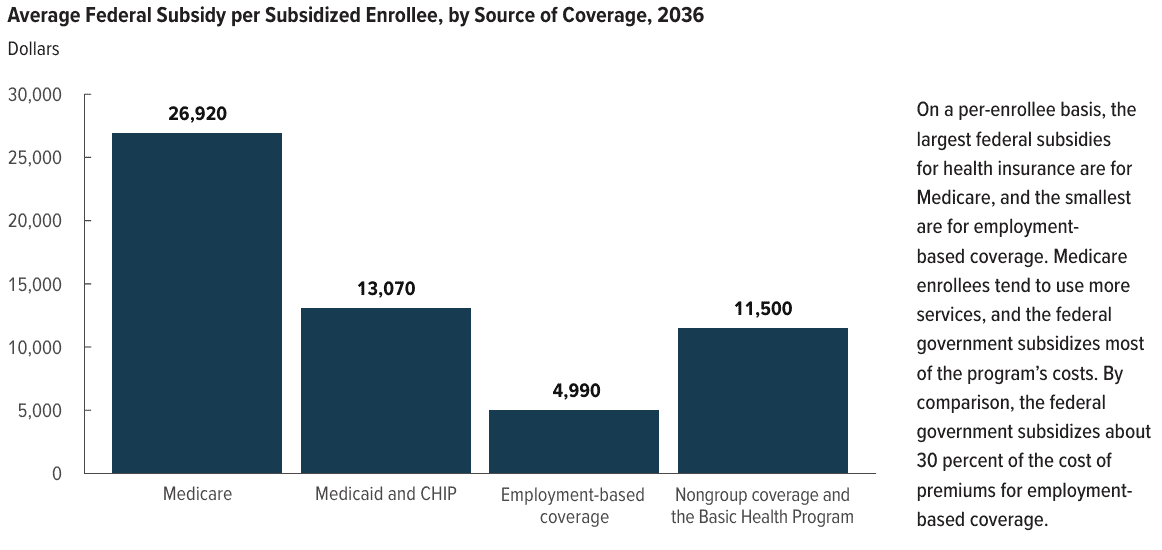
The Congressional Budget Office’s (CBO) latest report on federal health-insurance subsidies estimates the federal government will subsidize health coverage by approximately $2.4 trillion in 2026, by $3.9 trillion by 2036, and by a total of $33.6 trillion over the intervening decade. For all the focus on health care costs in the United States, CBO’s new numbers make one thing clear: The United States does not merely tolerate expensive health care. It subsidizes nearly every major route through which health care is purchased.
The report captures more than direct government spending. Its definition of federal subsidies includes Medicare spending, federal Medicaid and Children’s Health Insurance Program funding, Affordable Care Act premium tax credits, and the revenue lost by excluding employment-based health benefits from income and payroll taxes. As outlined in the report, the subsidies are unevenly dispersed:
- Medicare – $16.1 trillion
- Medicaid and the Children’s Health Insurance Program (CHIP) – $8.4 trillion
- Employment-based coverage – $7.2 trillion
- The premium tax credit and related spending – $1.2 trillion
- Supplemental or partial benefits – $0.7 trillion
CBO also projects that an average of 318 million people will have insurance in any given month over the period. Yet the uninsured population is expected to rise from 30 million in 2026 to 37 million in 2036. Federal subsidies will therefore increase by 65 percent while the country ends the period with more people lacking coverage. This growth rate outpaces projected GDP growth over the same decade (46 percent).
Source: CBO
None of this should be mistaken for an argument against coverage. Insurance protects patients against unpredictable and catastrophic medical costs. Medicare and Medicaid serve populations that private markets might struggle to cover adequately without public financing. Marketplace subsidies and the employer tax exclusion help millions of Americans maintain coverage. Those goals should not be impugned simply because the financing mechanisms deserve closer scrutiny.
The concern is instead the breadth, scale, and increasingly open-ended character of federal support. When the government absorbs a large and growing share of insurance costs, the institutions setting prices and purchasing care face less pressure to economize and resist higher spending. Subsidies make coverage more affordable at the point of purchase, but they can also insulate the underlying system from the structural changes required to make care less expensive. That is the subsidy trap. Policymakers respond to high health care costs by increasing assistance, but additional assistance weakens the incentives to control costs. A policy that improves affordability for an individual patient may still, when applied without moderation across the entire system, contribute to higher aggregate spending.
The tax treatment of employer-sponsored insurance provides a clear example. Employer contributions – and most employee premium contributions – are excluded from income and payroll taxes. That preference supports coverage for millions of workers, but it also encourages compensation through health benefits rather than wages and places few limits on how expensive those benefits may become.
Similar problems appear elsewhere. Medicare can pay different amounts for comparable services depending on whether they are delivered at a physician’s office or a hospital outpatient department, encouraging migration toward more expensive settings. Medicaid’s matching structure divides additional program costs between states and Washington. Marketplace subsidies protect consumers from rising premiums while reducing the immediate pressure to confront why those premiums increased.
While each policy has a defensible purpose, collectively these subsidy policies create a system in which nearly every cost increase can be passed to someone else. Insurers pass expenses through premiums. Employers receive tax benefits for paying them. States share Medicaid costs with the federal government. Medicare relies on payroll taxes, beneficiary premiums, and general revenue. The ultimate purchaser is often several steps removed from the patient and provider.
CBO’s projections should challenge the instinct that the answer to every affordability problem is another subsidy. Additional assistance is politically attractive because its benefits are immediate and visible, while its costs are dispersed among taxpayers, future deficits, and foregone wages. But policymakers who espouse broader access should be especially interested in reforms that slow the growth of the underlying prices, because every unnecessary dollar spent makes future coverage commitments harder to sustain. Increasing support can make an expensive product easier to purchase without making the product itself less expensive.
CBO’s eye-popping $34 trillion projection for the next decade is evidence that the federal government is not simply observing the growth of U.S. health care spending – it is underwriting it. Until policymakers confront that relationship, health care may become more heavily subsidized without becoming meaningfully less expensive.
Chart Review: CMS Rule Phases Down “Hold-harmless” Threshold for Medicaid Expansion States
Evan McLaughlin, Health Policy Intern
On July 21, 2026, the Centers for Medicare and Medicaid Services (CMS) published a Notice of Proposed Rulemaking (NPRM) to amend the indirect “hold-harmless” threshold of provider taxes as part of the implementation of the One Big Beautiful Bill Act. Provider taxes are mandatory state-imposed fees on health care entities that are used by 49 states to help finance the non-federal share of Medicaid spending and draw down additional federal matching funds. A central component of the CMS proposal is a revision to the existing provider tax hold-harmless threshold, which limits the extent to which states can return provider tax revenues to the providers that paid the taxes. Under the proposed rule, CMS would gradually reduce the allowable hold-harmless threshold for states that expanded Medicaid under the Affordable Care Act, thereby helping ensure the taxes are not used primarily to maximize federal matching funds.
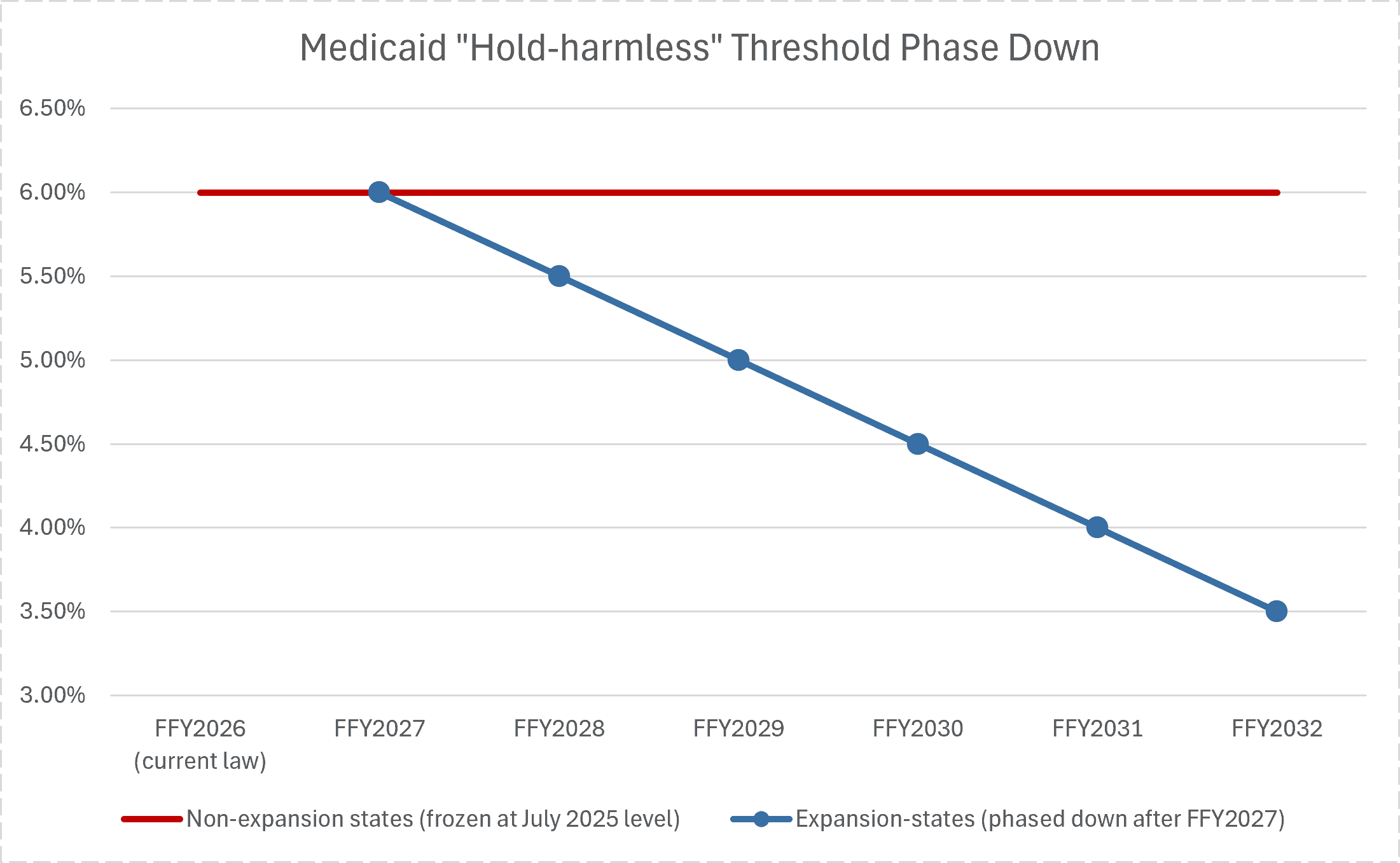
Beginning in FY2028, the threshold would be reduced by 0.5 percent annually until the threshold reaches 3.5 percent in FY2032, while the threshold for non-expansion states would remain at the July 2025 level of 6 percent. CMS proposed this change in response to concerns that some states were using provider tax arrangements to maximize federal Medicaid matching payments in ways that circumvent the intended structure of the federal-state financing partnership. By lowering the hold-harmless threshold, CMS aims to limit financing arrangements that function as a way for states to draw down additional federal matching funds. CMS estimates that this rule will reduce federal expenditure by $246 billion between 2026 and 2035.