Weekly Checkup
December 20, 2024
Vaccines: Past and Future
As a child of the 1950s, I have a dim memory of receiving the polio vaccine when it was first developed, and the palpable excitement that surrounded the event. Polio had hung like a cloud over my parents’ lives and the notion that we were free from its threat was cause for celebration.
Fast forward to 2024 and the nominee-in-waiting for secretary of Health and Human Services, Robert F. Kennedy Jr., has openly questioned the efficacy and safety of the vaccine. Indeed, President-elect Trump felt compelled to launch a pre-emptive strike during his recent news conference, saying: “You’re not going to lose the polio vaccine.”
Still, the general acceptance of vaccines may have changed. Consumers today make the trade-off of efficacy and safety differently than in the past. To be sure, no drug should ever be evaluated strictly on safety. (There have been proponents of having the Food and Drug Administration (FDA) evaluate drugs simply on that single dimension.) No drug is perfectly safe, so it makes no sense to introduce it unless there is a benefit to be had.
My polio vaccine took place when it was viewed as a looming, and perhaps fatal, event. It was an easy call for my parents to make. But to the modern eye, the probability of contracting polio or another disease may seem quite low, and perhaps not worth the risk of an adverse vaccination event.
One piece of evidence on this front is the existence of the Vaccine Injury Compensation Program, which compensates those who are injured by childhood vaccines. It dates to the National Childhood Vaccine Injury Act in 1988. According to the Health Resources and Services Administrator, the Act was prompted by reports of side effects to the DTP vaccine (diphtheria, tetanus, pertussis), which prompted a spate of lawsuits and fears that vaccine makers would leave the market. Clearly, over time, the balance of risk versus reward had moved toward greater perceived risks and the compensation scheme was intended to address this, at least in part.
A related phenomenon has been the increasing aversion to introducing “unnatural” compounds via vaccines (or in many other settings). The most vivid recent example has been the attention paid to thimerosal – an organomercury compound that acts as an antiseptic and antifungal agent – as a preservative in vaccines. When I was the policy director on the McCain presidential campaign, we were asked at every stop: “Does thimerosal cause autism? Will John McCain ban thimerosal?”
As the FDA repeatedly stressed, “A robust body of peer-reviewed scientific studies conducted in the U.S. and other countries support the safety of thimerosal-containing vaccines.” Despite this, it also notes that: “All vaccines routinely recommended for children 6 years of age and younger in the U.S. are available in formulations that do not contain thimerosal.”
More recently, there has been the controversy that has surrounded the COVID-19 vaccines and boosters. To many, the “anti-vax” movement dates to the pandemic and these products. But looking back, the glow surrounding vaccines in the 1950s and 60s has faded over the past 30 to 40 years.
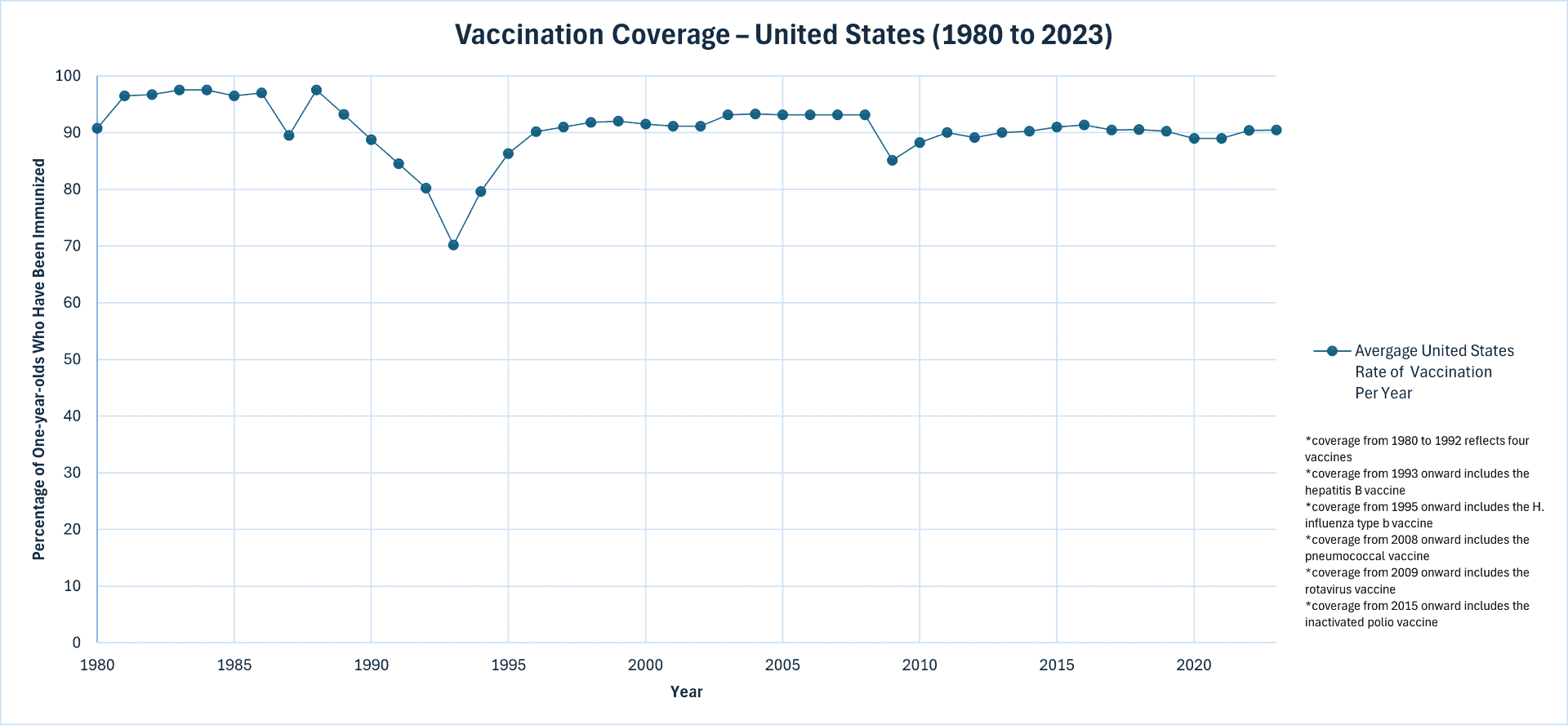
This would lead one to conclude that there must have been a decline in the take-up of vaccines, including the formerly non-controversial childhood vaccines. To check, the chart below shows the vaccination rate for seven common infant vaccines. This is intended as a general proxy for the overall trust in vaccines, as measured by the willingness of parents to vaccinate their newborns.
Surprisingly, the vaccination rate is essentially unchanged. The vaccination rate was 90 percent in 1980 and remains so in the most recent data. There was a dip in the 1990s with the introduction of the most recent two vaccines, but the low initial take-up quickly passed, and the overall vaccination rate recovered.
The notion that Americans are broadly convinced to toss aside their vaccination regimes is simply unfounded. Any health policy built on a plank of reducing the use of vaccines is likely to run into real trouble.
Chart by Parth Dahima, Health Care Data Analyst