The Daily Dish
March 4, 2026
Demystifying Medicare Advantage Funding
Medicare Advantage (MA), aka Medicare Part C, is comprehensive insurance coverage of all inpatient (Part A), outpatient (Part B), and sometimes outpatient prescription drugs (Part D) in a single policy. In simple terms, MA is delivered by private-sector insurers who charge beneficiaries a premium and also receive a subsidy from the federal government. Simple, right?
Yes, until you start asking the question: how much subsidy? In CMS’ CY2027 MA Advance Rate Notice: Breaking Down Its Components, Michael Baker notes:
Each year, the Centers for Medicare and Medicaid Services begins the Medicare Advantage payment cycle by issuing an Advance Notice that lays out proposed updates to payment methodology and provides an estimated year-to-year change in plan payments.
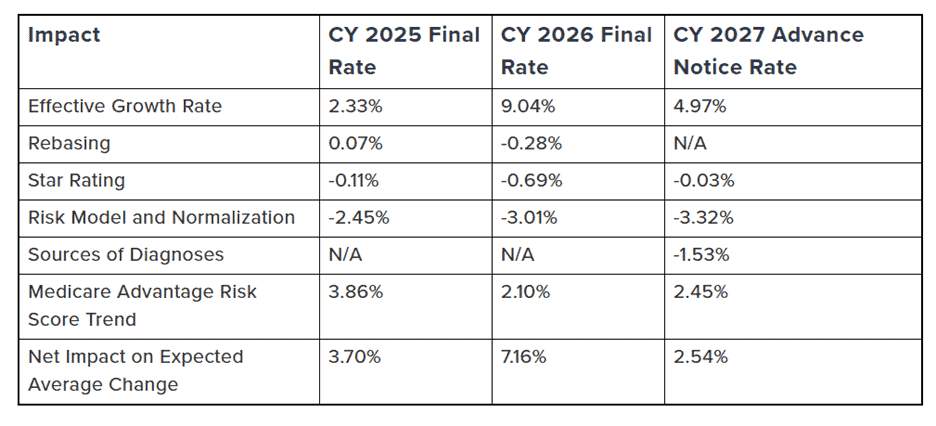
In the most recent such Notice, CMS expected an average increase of 0.09 percent. But, as it turns out, that number hides more than it reveals:
The challenge is that the headline percentage in the Advance Notice is often treated as if it were a single “rate increase” or “rate cut,” when in practice it is neither. It is a net figure built from several moving parts, including benchmark growth, quality payment changes, and risk-adjustment policy updates.
Baker summarizes the various components in a short table that is reproduced at the bottom. Relax, Eakinomics is not going to walk through every component – Baker’s paper does an outstanding job of that. Instead, notice two things. First, the bottom line average expected increase does matter. In the end, MA is a business with very small margins and starving it of funds will mean MA plans folding and seniors being forced to seek out new coverage. (This is happening all across the country.)
Second, each of the components has incentive effects and will alter the way that plans operate. Arithmetically, it is possible to have large, offsetting impacts that produce a small bottom line, but big changes in the operation of plans. And the reverse is possible as well.
In short, it is worth reading through Baker’s unpacking of the Advance Notice. And it is equally important to understand that each year CMS has the power to upend the business models of MA plans and that power should be used judiciously.
Fact of the Day
DOE's spent nuclear fuel storage liabilities are projected to reach $61.9 billion by 2030.