The Daily Dish
June 17, 2025
Growing Monopoly Power Is STILL Not a Thing
One might call this the “Big Is Bad and Everywhere” era of federal policymaking, or it might just be the populist era of policymaking, or those might be the same thing. But for years, members of Congress and presidents have been wailing about big, evil companies and bemoaning rising monopoly power. This may have reached its recent peak in 2021, when then-President Biden issued an executive order entitled “Promoting Competition in the American Economy” – thereby presuming competition needed promoting – and pursued competition policies attempting to arrest excessive market concentration that, the Biden Administration held, was threatening “basic economic liberties, democratic accountability, and the welfare of workers, farmers, small businesses, startups, and consumers.”
At that time, AAF’s Fred Ashton had the temerity to actually check the data, and he found that “newly released data from the 2017 Economic Census shows almost no evidence that oligopolies and monopolies are the predominant market structure in the U.S. economy,” and that “most industries operate in a low-concentration, highly competitive environment.”
He also went on to note that “the distribution of industries with low, medium, and high levels of concentration remained largely stable between 2002 and 2017.”
Data from the 2022 Economic Census have become available, allowing Ashton check if a more up-to-date look at the data tells a different story. The short answer: no. Ashton concludes that “the share of industries operating in high, medium, and low concentration environments has remained relatively stable over the past 20 years.”
The key finding is the figure below (which replicates Figure 1 of the study).
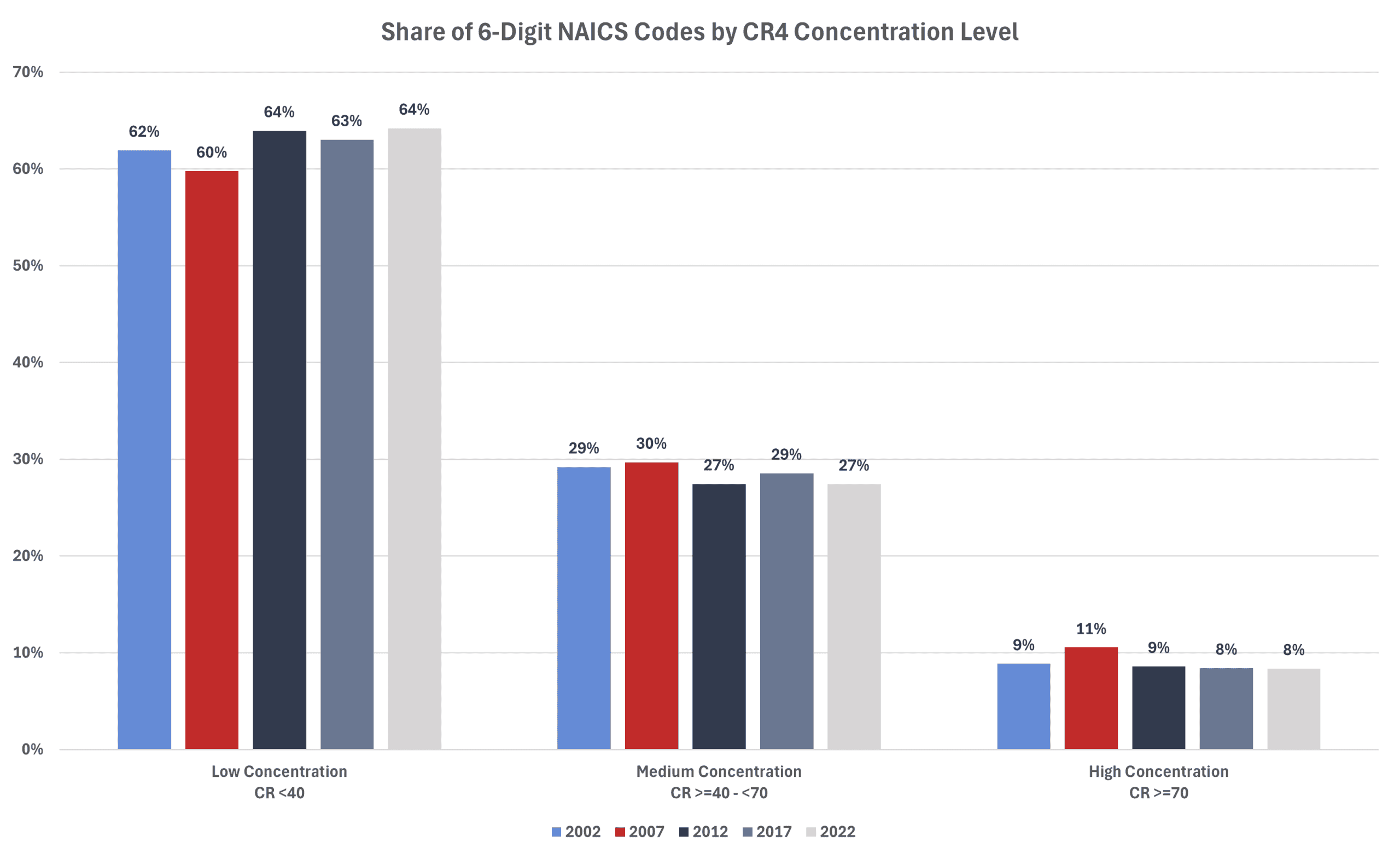
CR4 here is the share of sales by the four largest firms in an industry (industries are identified by the North American Industry Classification System (NAICS)). The main finding is that:
…the distribution of market concentration largely remained unchanged between 2002 and 2022. In 2002, just 9 percent of all 6-digit NAICS industries were classified as highly concentrated with a CR4 of 70 percent or greater. Fast forward to 2022, and the share of highly concentrated industries was slightly lower at 8 percent, unchanged from 2017.
Ashton also checks the data to see whether the industries jump between the various levels of concentration, or whether they tend to stay in the same bucket. That would tell you whether some industries that were once in a state of low concentration became heavily concentrated over time. No dice. The data simply do not support the simple narrative.
A lot of ink, including things such as the 2023 Merger Guidelines for the Federal Trade Commission and the Department of Justice, has been spilled over the supposed growing monopolies in the U.S. economy. It would have been wise to check the data first.
Fact of the Day
Across all rulemakings, agencies published $13.6 million in total costs and added 89,014 paperwork burden hours.