








The Daily Dish
June 28, 2016
June 28th Edition
Last week, the Coast Guard published a pair of rules. The first establishes requirements for towing vehicles with annual costs of $41.5 million, paired with $46.4 million in benefits, and more than 180,000 paperwork burden hours. The Coast Guard also implemented a regulation governing commercial fishing vessels. Annual costs are $34.2 million, with $7.1 million in benefits, and roughly 20,000 paperwork hours. Since January 1, the federal government has published $119.4 billion in compliance costs and has imposed 66.5 million in net paperwork burden hours.
A recent study from JAMA Internal Medicine found that out-of-pocket costs for hospitalization increased for individuals in the U.S. with private insurance between 2009 and 2013. Patients’ out-of-pocket portion for their hospitalization costs rose 6.5 percent each year, from $738 on average in 2009 to $1,013 in 2013. In addition, a recent Federal Reserve report found that 46 percent of Americans would struggle to pay an emergency expense of $400.
Eakinomics: Medicare: Still Going Bankrupt, Guest Authored by Christopher Holt, AAF Director of Health Care Policy
Last week the House GOP Task Force on Health Care released its official blue print for repealing and replacing the Affordable Care Act. This was a significant event, but it both dovetails with and overshadows another piece of health care news from last week—Medicare, it turns out, is still going broke.
Last week the Medicare Trustees released their annual report on the financial health of the Medicare program replete with all the happiness, puppies and sunshine we’ve come to expect (you can read AAF’s analysis here). It’s not a surprise to learn that Medicare is going broke, that’s been the conclusion of the annual report for years. This year’s twist is that it’s happening in 2028, two years earlier than reported last year, while last year’s wrinkle was that it wasn’t happening until 2030, a full four years later than was projected in the 2014 report. As you can see the deck chairs on this Titanic are not bolted down. But whether Medicare is going bankrupt in 10-years or twenty, the iceberg is dead ahead.
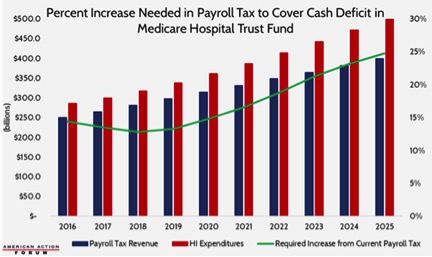
The fact is so well established it’s virtually forgotten. Few serious policy efforts aim at extending the life of the program, or curbing its oxygen starving effect on the discretionary portions of the Federal budget. But soon we won’t be able to ignore the problem anymore. As your regular Eakinomics author frequently observes, US economic growth isn’t exactly going to be booming over the next decade, but health care costs continue to reach skyward. Medicare’s total cash shortfall in 2015 was $324 Billion. As the following chart shows, in order to close the expected 10-year cash deficit for just Part A (Hospital Insurance) the Medicare payroll tax would need to increase by 25 percent.
It’s a nice bit of symmetry then that the plan released by the House Task Force takes aim at this problem; proposing real, substantive reforms to the Medicare program, while working to meet our nation’s commitments to its seniors. But regardless of whether or not one embraces the House GOP’s approach, the requirement for action is undeniable. Either we will make substantial reforms to Medicare, or we will watch it collapse under the burden of its unsustainable commitments.
From the Forum
$755 Million In Burdens by Sam Batkins, AAF Director of Regulatory Policy
Fact of the Day
The administration’s “Silica” dust rule will decimate small business balance sheets, according to the regulation’s own analysis.