The Daily Dish
September 3, 2026
Revisions Published With (Thankfully) Little Fanfare
The Bureau of Labor Statistics (BLS) released its annual preliminary benchmark revision last Friday to little fanfare (more on that later), estimating total nonfarm employment for the 12 months through March 2026 was overcounted by 79,000. The revisions were smaller than the historical average and significantly smaller than the prior two years. The final revisions will be released in February 2027 with publication of the Employment Situation for January 2027.
A quick recap of how the monthly payroll data are collected and why benchmark revisions are needed: The monthly nonfarm payroll number is based on a monthly survey sample of approximately 119,000 businesses and government agencies, representing about 622,000 individual worksites. Producing the monthly payroll number with such a quick turnaround using a survey requires sacrificing a degree of accuracy. To refine the estimate, the agency goes through an annual revision process which incorporates more accurate – although less timely – data. These data are from the Quarterly Census of Employment and Wages report, which uses administrative data collected from state unemployment insurance records, covering more than 95 percent of jobs. (The BLS provides an in-depth explanatory video of the monthly and annual benchmarking and revisions processes.)
Details of the preliminary revisions showed that the overestimate for private employment was even larger at -178,000. Industries with large downward revisions included wholesale trade, (-86,200), manufacturing (-67,000), retail trade (-154,600), and private education and health services (-96,000). Offsetting some of these losses were upward revisions to construction (+62,000), transportation and warehousing (+135,100), and information (+87,000) sectors. Government jobs were originally underestimated by 99,000, buoying the private sector losses.
The revisions implied non-seasonally adjusted payroll gains of 11,000 per month rather than the 18,000 originally estimated. The revisions also suggested that monthly private sector hiring came in at just 24,000 rather than the initial report of 38,000.
After two years of historically large, downward revisions, the preliminary estimate of -79,000 is the smallest since 2021.
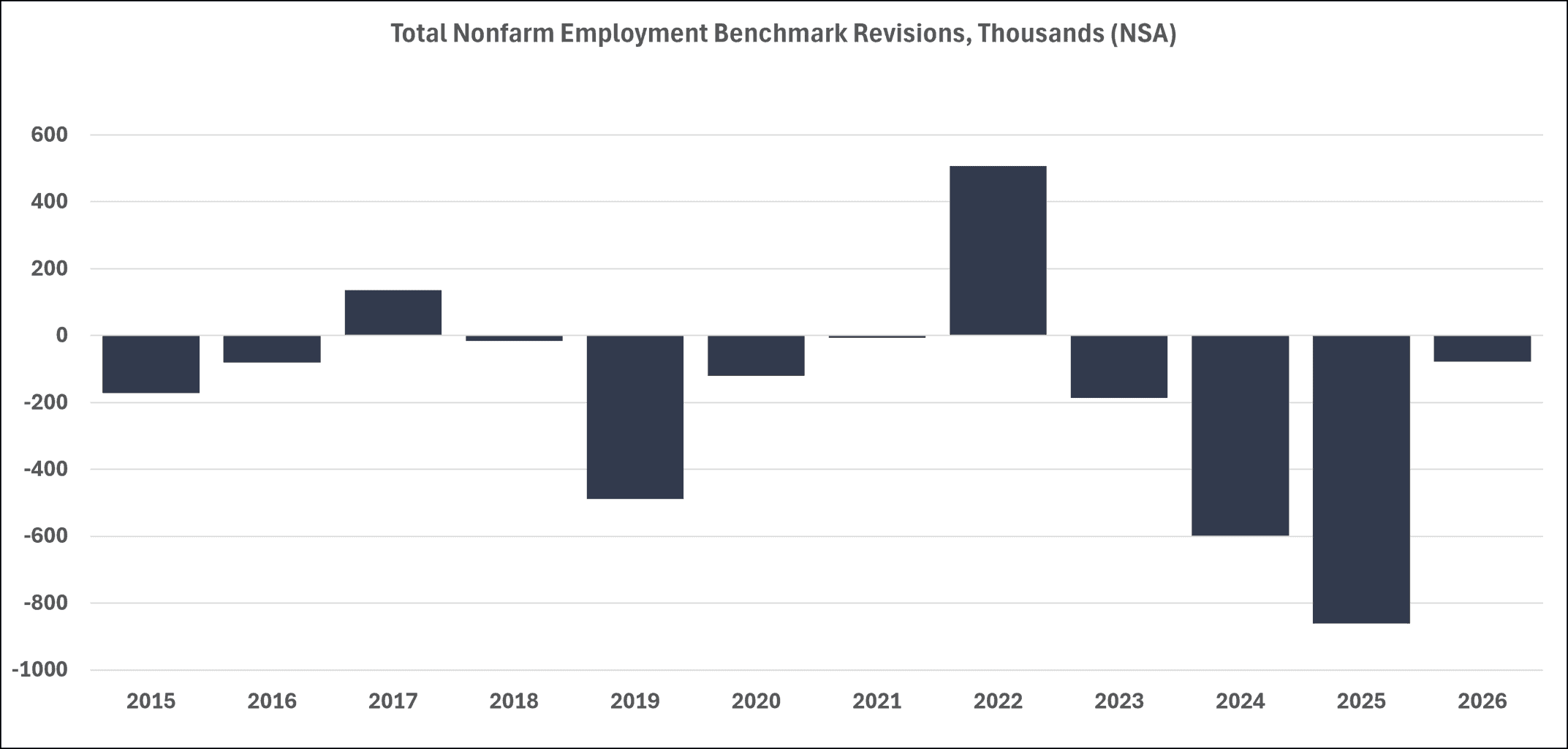
*Source: Bureau of Labor Statistics; Data for 2015–2025 represent final revisions; Data for 2026 are preliminary.
The revisions received little media attention, and for that, the BLS is likely thankful.
Recall that President Trump fired BLS Commissioner Erika McEntarfer in August 2025 alleging that the data produced by the agency were “rigged” for political reasons. Without providing evidence of manipulated data, the president pointed to large revisions to monthly employment data and the 2024 preliminary benchmark revision that showed payrolls were overestimated by an unusually large 818,000. The following month, the Trump Administration declared the BLS “broken” after the agency published its preliminary 2025 benchmark revision that showed job growth was overstated by 911,000, the largest revision on record.
The fallout from the politicization of monthly revisions and annual benchmarking process damaged public confidence in official statistics. In fact, the Center for Economic Policy Research estimated that the loss of confidence may have reduced U.S. GDP by roughly $20 billion.
The relatively benign revisions could be a sign that methodological changes improved the accuracy of initial estimates. And while that is certainly likely, it could also be that continued low hire/low fire environment makes the monthly count more predictable. Whatever the reason, let’s hope it restores some of the lost confidence.
Freddy’s Forecast: August Jobs
The July jobs report showed payrolls unexpectedly declined by 23,000. It was the first monthly decline since February. The unemployment rate ticked lower to 4.1 percent. A quirk in the seasonal adjustment for public school teachers likely drove much of the job losses. It was the May and June combined negative revisions of 103,000 that suggested the job creation could be on a slower trajectory, reflecting the low breakeven rate. Average hourly earnings inched up 0.1 percent for the month and 3.2 percent for the year, failing to keep up with inflation on an annual basis.
Since that last report, data from ADP showed the pace of private-sector hiring downshifted for the third consecutive month in August to 38,000. It was the slowest pace since the 11,000 in January. Small businesses added 3,000 workers while large businesses increased headcount by 34,000. Medium sized businesses remained on the sidelines during the month with no net hiring. Job gains were entirely concentrated in the services sector, which added 48,000 workers to payrolls. Education and health services led the way, adding 45,000 workers. The trade, transportation, and utilities sector, meanwhile, cut 5,000 and professional and business services slashed 16,000 workers. Goods-producing industries shed 10,000 workers during the month, dragged down by 17,000 job losses in the manufacturing sector. Construction, meanwhile, was a bright spot, adding 12,000 jobs.
The Bureau of Labor Statistics’ Job Openings and Labor Turnover Survey data showed that job openings increased to just over 7.27 million in July following the downwardly revised June level of 7.18 million. The hiring rate dropped to 3.2 percent, signaling that it is still incredibly difficult to find a job.
Initial jobless claims inched higher during the week ending August 29 but remained historically low at 206,000. The four-week moving average, which smooths out weekly volatility, has trended higher in recent weeks after sliding every week between June 20–August 1, but remain low. Continuing claims, meanwhile, moved little over the past month, ending at 1.779 million during the week ending August 22.
The Institute for Supply Management reported that manufacturing activity expanded in August, albeit at a slower pace than in July. The overall index dipped 1 percentage point to 54.6 as new orders, production, and employment growth slowed. Survey respondents noted high steel and aluminum prices due to tariffs and other supply chain constraints. The services sector, meanwhile, expanded in August at a faster rate than in the prior month, boosted by strong new orders. The employment index – despite an uptick of 0.4 points – remained in contraction.
For August, expect gains in payrolls to hover near the breakeven rate at 30,000 and the unemployment rate to increase to 4.2 percent. Growth in average hourly earnings remains low at 0.2 percent for a 3.0-percent annual gain.
Fact of the Day
Since the start of 2026, the federal government has published $1 trillion in total regulatory net cost savings and 107.3 million hours of net annual paperwork increases.