Insight
February 4, 2026
AI and the Labor Market, Assessing the Evidence
Executive Summary
- The emergence of generative artificial intelligence (AI) has raised concerns that increasing adoption of this new technology could lead to massive job loss and high levels of unemployment.
- Yet three well-known studies from Goldman Sachs, Massachusetts Institute of Technology (MIT), and The Budget Lab at Yale challenge this apocalyptic job loss narrative, indicating that while AI does have the potential to replace jobs, it can also create new jobs; furthermore, AI’s impact on the labor market thus far has not displaced jobs in any marked way and roughly mirrors that of other periods of technological change, such as that of the internet and computers.
- This insight uses these studies to illuminate AI’s current and potential future impact on the U.S. labor market and concludes that massive job loss and unemployment is not a likely consequence of increasing AI adoption.
Introduction
The emergence of generative artificial intelligence (AI), with its ability to perform work tasks that normally require human intelligence, problem solving capability, and creativity, has raised concerns that increasing adoption of this new technology could lead to massive job loss and high levels of unemployment. Businesses, the narrative would follow, would simply replace their workers with AI technologies to reduce labor costs, leaving potentially millions of workers without a job.
Yet three well-known studies from Goldman Sachs, Massachusetts Institute of Technology (MIT), and The Budget Lab at Yale challenge this apocalyptic job loss narrative. While the research does show that AI can replace human jobs, adoption can also create new jobs as a consequence of labor productivity gains and drive long-term employment growth. Furthermore, research shows that AI’s impact on the labor market thus far has not displaced jobs in any marked way and roughly mirrors that of other periods of technological change, such as that of the internet and computers—meaning that we should not expect AI to impact the labor market in an historically unprecedented way.
This insight uses these studies to illuminate AI’s current and potential future impact on the U.S. labor market and concludes that massive job loss and unemployment is not a likely consequence of increasing AI adoption.
“The Potentially Large Effects of Artificial Intelligence on Economic Growth”
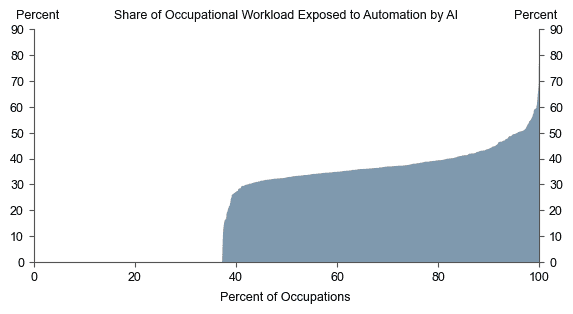
A 2023 Goldman Sachs study estimated that AI could replace about 25 percent of current occupational tasks and about 7 percent of jobs. The authors used data on 900 occupational tasks in the United States and applied an importance- and complexity-weighted average of essential work tasks to each occupation to determine the share of each occupation’s workload that AI could replace. They found that roughly two-thirds of current U.S. jobs are exposed to AI and that most of those have about 25–50 percent of the workload that can be replaced, as illustrated in Figure 1.
Figure 1: Two-thirds of Current Occupations Could Be Partially Automated by AI
Source: Goldman Sachs Global Investment Research
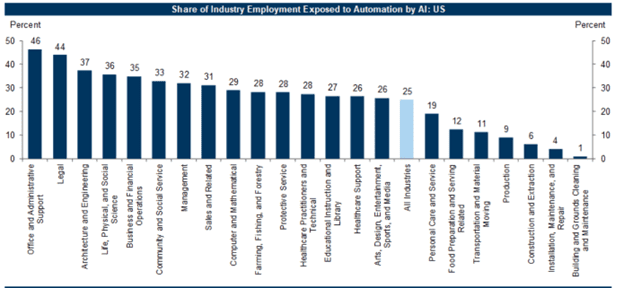
The authors then examined data from the U.S. Occupational Employment and Wage Survey to estimate that about one-quarter of current work tasks could be automated, as shown in Figure 2. They found that the legal and administrative support industries have the most exposure to AI, while jobs in manual labor, such as construction and maintenance, are the least exposed.
Figure 2: One-fourth of Current Work Tasks Could Be Automated by AI in the United States
 Source: Goldman Sachs Global Investment Research
The authors’ findings indicate that while AI can replace a significant number of work tasks, most current U.S. jobs are more likely to be complemented than substituted by automation, meaning that AI is more likely to assist in people’s jobs than to replace them.
To estimate the percentage of jobs that would likely be substituted, complemented, or unaffected by AI, the authors assumed that jobs for which at least 50 percent of importance- and complexity-weighted tasks are exposed to AI are likely to be replaced, jobs with an exposure of 10–49 percent would be complemented, and 0–9 percent would not be affected.
These baseline assumptions are consistent with 7 percent of U.S. jobs being replaced by AI, 63 percent being complemented, and 30 percent being unaffected. As seen in Figure 3, the authors’ findings further suggest that the industries most likely to see the most replacement are the legal and administrative fields, while manual and outdoor fields are likely to see the least. All the other fields would tend to see a productivity boost due to the complementary effects of AI.
Figure 3: Replacement in Legal and Administrative Fields, Little Effect in Manual and Outdoor Jobs, and Productivity-enhancement Everywhere Else 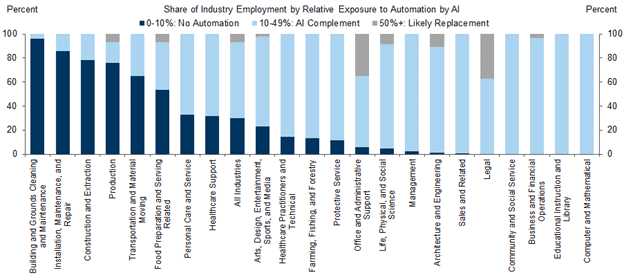 Source: Goldman Sachs Global Investment Research
Along with making work more productive, the authors also anticipate that AI can create new job opportunities both directly and indirectly through increased labor demand driven by productivity gains from adopting the technology. They point out that information technology innovations of the past not only created new jobs to design, develop, and market information technology products, but they also increased aggregate income, boosting demand for jobs in other industries, such as health care, education, and food services.
Further, the authors suggest that technological innovation that initially displaces workers could drive long-term employment growth, pointing to a study by David Autor et al. that used census data to show that 60 percent of workers in 2022 were employed in occupations that did not exist in 1940. This research implies that the employment growth rate of 85 percent over the last 80 years was driven by technological innovation, as seen in Figure 4.
Figure 4: Technological Innovation Leads to the Creation of New Occupations That Account for the Bulk of Employment Growth 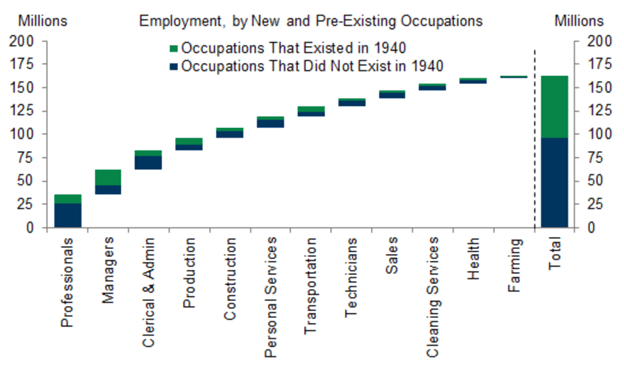
Source: Goldman Sachs Global Investment Research
“The Iceberg Index: Measuring Skills-centered Exposure in the AI Economy”
A more recent study from MIT measured the “ripple effects” of AI adoption, finding that automation can perform about 14 percent of occupational tasks in the United States, a smaller percentage than Goldman Sachs’ estimate of 25 percent, suggesting that the new technology would have a less significant impact to the labor market. To measure AI’s technical exposure—where AI can perform occupational tasks—the authors ran MIT’s Large Population Models at Oak Ridge National Laboratory to simulate the emerging human-AI workforce. To illustrate their findings, they used a depiction of an iceberg to capture both the visible and hidden exposure levels, as seen in Figure 5.
Figure 5: MIT’s Iceberg Index  Source: Massachusetts Institute of Technology
Above the waterline is the “Surface Index” that quantifies AI’s exposure in occupations where AI is currently concentrated, such as software engineers, data scientists, and program managers. This visible AI adoption amounts to about 2.2 percent of wage value or about $211 billion.
What lies beneath the surface of visible AI adoption is the “Iceberg Index,” which measures technical capability through cognitive automation in administrative, financial, and professional services. This hidden mass of AI technical exposure levels is roughly five times greater than the “Surface Index”—representing 11.7 percent of wage value or $1.2 trillion. Adding the results of the two indices together implies that AI can perform roughly 14 percent of current U.S. occupational tasks.
“Evaluating the Impact of AI on the Labor Market: Current State of Affairs”
While the Goldman Sachs and MIT studies found substitutional effects on occupational tasks and jobs, a study by The Budget Lab at Yale took a more comparative and retroactive approach to evaluate AI’s impact on the labor market and found that AI has not replaced jobs in any remarkable way.
The authors evaluated the changes in labor market outcomes since the public release of ChatGPT in November 2022 and compared it to past periods of technological change. They compared the changes in the occupational mix—the distribution of workers amongst all the jobs in the economy—in the period after the introduction of ChatGPT to the corresponding changes after the introduction of computers and the internet. A percentage point difference in the occupational mix means that that percent of workers are in new occupations relative to the starting point.
The results show that the change in the occupational mix in the period after the emergence of ChatGPT has been marginally faster, by about a percentage point, than those of the earlier periods, as shown in Figure 6. This finding indicates that while AI has had a greater labor market impact than other periods, it is not drastically altering labor markets relative to what we have seen in the past. Thus, we can expect AI to impact the labor market in a manner similar to the impact of computers and the internet. Further, this change may not necessarily be attributable to AI, as this trend existed in 2021, before ChatGPT became widely available.
Figure 6: Changes in Occupational Mix Over Different Periods of Technological Change Source: The Budget Lab at Yale
The authors also estimated AI’s economy-wide employment effects by measuring exposure to the technology. To do this, they used OpenAI data to determine whether utilizing ChatGPT would reduce the time it takes to complete an occupational task by at least 50 percent, and categorized occupations into quintiles based on their level of exposure.
They then tried to determine if the share of workers in occupational exposure quintiles has changed since ChatGPT’s introduction. If AI were displacing jobs at scale, the authors indicate, there would be a smaller share of workers in some of the jobs that are most negatively impacted. Based on their analysis, the introduction of the new technology has not changed the quintiles in any pronounced way, as demonstrated in Figure 7, indicating that AI has not had a marked impact, if any, on displacing jobs.
Figure 7: Change in the Proportion of Workers in Occupations Exposed to AI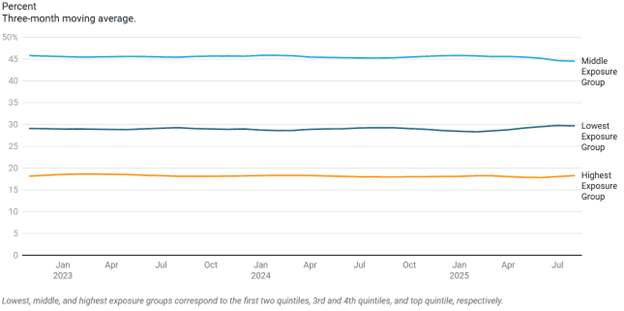 Source: The Budget Lab at Yale
Conclusion
AI’s capability to replace human labor has sparked concern that its increasing adoption could lead to massive job loss and unemployment. Yet the studies reviewed above all suggest that this scenario is unlikely.
To date, AI has not had a remarkable impact on employment outcomes. While some jobs may be eliminated, automation also can lead to the creation of new jobs, offsetting any losses.