Insight
June 24, 2026
Beyond Chips: Can Expanding Export Controls Slow China’s AI Progress?
Executive Summary
- As artificial intelligence (AI) systems play a growing role in military and cyber capabilities, limiting foreign adversaries’ access to the computing resources that enable AI development has become a key national security priority, prompting the United States to expand export controls beyond just physical chips to also restrict related computing and AI technologies.
- Yet questions persist about the long-term effectiveness of export controls as challenges such as chip smuggling, inconsistent implementation among allies, adversaries’ ability to develop alternative pathways, and economic costs to U.S. firms continue to undermine their impact.
- This insight examines how U.S. export controls have evolved from restricting transfer of advanced AI chips alone to encompassing related technologies, and reviews recent legislative proposals that aim to close the regulatory gaps and preserve advantages over competitors – including the MATCH Act, Remote Access Security Act, Chip Security Act, and AI OVERWATCH Act.
Introduction
As artificial intelligence (AI) systems play a growing role in military and cyber power, foreign adversaries’ access to “compute” – the computational resources, including chips and infrastructure, needed to train, deploy, and improve AI systems – has evolved from an issue of technological competition into a national security priority. As a result, export controls, which are intended to undermine advances by U.S. foreign adversaries, have expanded beyond restricting just physical chips to include related computing and AI technologies.
Yet questions persist about the long-term effectiveness of export controls in limiting adversaries’ access as ongoing challenges undermine their impact. Notably, persistent chip smuggling, inconsistent implementation among allies, adversaries’ ability to develop alternative pathways, and the economic costs imposed on U.S. firms – including potential losses in international market share – create both opportunities to circumvent restrictions and significant tradeoffs for policymakers.
This insight examines how U.S. export controls have evolved from restricting transfer of advanced AI chips alone to encompassing related technologies, and reviews recent legislative proposals that aim to close the regulatory gaps and preserve the United States’ AI development advantage over foreign competitors, including the MATCH Act, Remote Access Security Act, Chip Security Act, and AI OVERWATCH Act.
The Importance of Computing and Semiconductor Supply Chains
AI systems are increasingly shaping military power and cyber capabilities. Because compute encompasses the chips and infrastructure required to train, deploy, and improve AI systems, access to compute is a key determinant on the pace and scale of future AI progress. As a result, limiting foreign adversaries’ compute access has evolved from an issue of technological competition into a national security priority. In this context, U.S. export controls that restrict compute inputs have been critical to preserving advantages over adversaries. Notably, as China continues to benefit from advantages in data availability, manufacturing capacity, and human capital – all important inputs for AI development – compute remains one of the few inputs in the AI infrastructure stack that is scarce and subject to supply-chain controls.
U.S. firms control a large share of global compute capacity – the total available amount of compute for AI workloads – giving them significant influence over the infrastructure that supports frontier AI development. As shown in Figure 1, global compute capacity has expanded significantly in recent years, with U.S. firms maintaining a dominant position. In the last quarter of 2025, U.S. firms accounted for 96 percent of total compute capacity – Nvidia accounted for 67 percent, Google 18 percent, and Amazon 11 percent – while the Chinese company, Huawei, holds a small but growing share.
Figure 1: Global Compute Capacity From AI Chips Across Major Companies 2022–25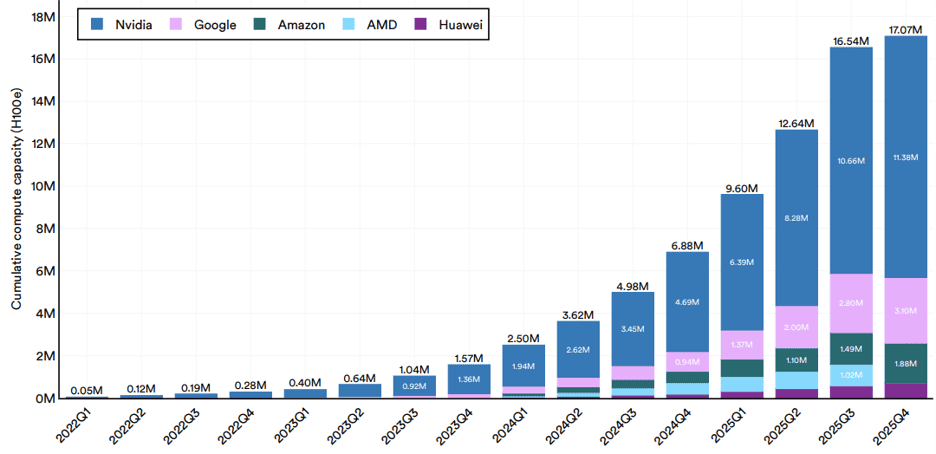 Source: Stanford HAI, 2026 AI Index Report.
Similarly, the semiconductor manufacturing equipment (SME) market is highly consolidated. The “Big Five” semiconductor equipment suppliers are the United States’ Applied Materials, Lam Research, and KLA Corporation, Japan’s Tokyo Electron Limited, and the Netherlands’ ASML. As shown in Figure 2, 89 percent of the market value added for SME is created within the United States (41 percent), Europe (24 percent), and Japan (24 percent).
Figure 2: SME Market Share by Value Added – 2024.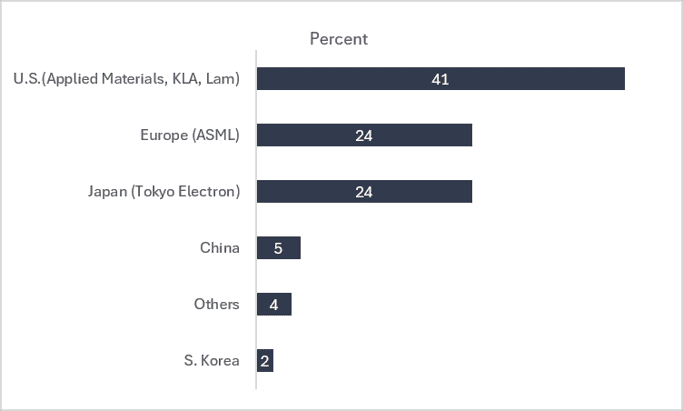
Source: Semiconductor Industry Association, State of the U.S. semiconductor industry.
As a result, the concentration of compute capacity and SME among the United States and a few close allies gives the governments of these countries the opportunity to influence access to the most important inputs required to develop advanced AI systems through export controls and other supply-chain restrictions.
The Expanding Scope of Export Controls
Export control policies have long targeted U.S. foreign adversaries’ access to advanced AI chips with the goal of limiting their ability to develop advanced AI models. Notably, the global tension over the possession and distribution of AI chips between the United States and China started in 2018, as reported by previous American Action Forum research. Yet the importance of these controls has extended beyond the chips themselves. Since 2022, the United States has worked with allies – particularly the Netherlands and Japan – to restrict China’s access to critical SME, which seek to constrain U.S. adversaries’ ability to develop their own semiconductor sector. More recently, export controls have also expanded beyond chips and SME to cover remote cloud computing services, which can provide foreign actors with access to advanced compute without transferring hardware across borders. And in 2026, the Trump Administration restricted foreign access to Anthropic’s most advanced AI models, signaling that export controls are evolving to cover AI systems when they potentially pose national security risks.
The Effectiveness Questions
As policymakers consider expanding export controls to mitigate new threats, they should keep in mind several key challenges. Central to these is how to combat smuggling. Despite the wide set of restrictions designed to limit adversaries’ access to chips, they continue to flow to banned countries through unauthorized channels – mainly because enforcers lack the ability to effectively track AI chips at scale. Another challenge is the lack of coordination among allies as U.S. unilateral controls have historically been stricter than those of Europe and Asia, allowing foreign companies to fill the gap left by U.S. suppliers. Moreover, actors wishing to circumvent restrictions can do so by operating through subsidiaries, affiliates, or intermediary companies. It is also important to recognize that U.S. export controls impose costs on domestic firms, raising compliance costs on affected companies, and potentially leading U.S firms to lose international market share.
Additionally, China’s growing ability to develop highly capable AI models such as DeepSeek despite constraints on compute, suggests that technological adaptation can counteract compute limitations. This is consistent with Cold –War-era experience with the multilateral, U.S.-led, Coordinating Committee for Multilateral Export Controls which showed that while controls delayed adversaries’ technological development, they did not prevent technology acquisition. Adaptation, smuggling, and coordination challenges can undermine the effectiveness of controls over time – a lesson that remains relevant in the context of China. As a result, policymakers should not view export controls as a tool to stop China’s technological progress, but rather to slow it, while designing rules that preserve U.S. leadership in strategically important technologies. Achieving this outcome depends not only on policy design, but also on effective enforcement, robust tracking systems, and international coordination to maintain a computing and AI advantage.
Current Regulatory Proposals
To address these challenges, Congress is currently considering four bills – all of which enjoy broad bipartisan support.
Chip Security Act
The bill, which has passed the House Foreign Affairs Committee, would require stronger tracking and safeguards for advanced AI chips to prevent access to unauthorized users or adversaries. It would also require chip companies to report suspected misuse of sensitive technology and direct the Department of Commerce to study additional ways to prevent chips from being stolen or improperly used.
MATCH Act
The bill would close gaps in existing SME export controls by preventing restricted entities from using subsidiaries or front companies to obtain regulated technologies and by encouraging U.S. allies to adopt similar restrictions. It seeks to create a more coordinated export control regime across allied countries and expands U.S. authority over certain foreign-made products that rely on U.S. technology.
Remote Access Security Act
This bill, which was passed by the House, expands U.S. export control authority to cover remote and cloud-based access to restricted technologies. It is designed to close gaps that allow foreign adversaries to access advanced U.S. computing resources through data centers and cloud services outside their territory.
AI OVERWATCH Act
The bill would strengthen restrictions on exports of the most advanced AI chips to foreign adversaries by codifying limits on high-end chip exports and requiring the U.S. government to verify that recipients do not support military or surveillance activities that threaten U.S. interests. It also facilitates exports to trusted allies under strict security conditions.
As Congress reviews these bills, some lawmakers are seeking to include some of these provisions into the annual defense spending bill, while the Trump Administration is actively targeting export controls beyond chips. The administration recently restricted foreign access to Anthropic’s most advanced AI models, Fable 5 and Mythos 5, after concluding that their advanced cyber capabilities and a reported jailbreak vulnerability – the process of bypassing security limitations on a system – could pose national security risks if accessed by foreign actors.
Conclusion
U.S. export controls are evolving from restricting advanced AI chips to targeting a broader set of technologies that includes SME, cloud infrastructure, and even frontier AI models. Yet persistent challenges – most notably chip smuggling, inconsistent implementation among allies, economic costs to U.S. firms, and adversaries’ ability to develop alternative pathways – suggest that controls are likely to function less as tools to stop adversaries and more as instruments for slowing adversarial progress while preserving U.S. technological advantage over time. As AI advances, the central policy question is no longer whether to control access to computing power, but how to do so effectively across an increasingly distributed global technology stack.