









Insight
February 12, 2026
Can U.S. Nuclear Waste Management Keep Up With the Nuclear Renaissance?
Executive Summary
- To accelerate the U.S. nuclear renaissance, the Trump Administration is pursuing a multi-pronged approach to manage nuclear waste, which includes investing in nuclear waste recycling technologies, funding research and development in nuclear waste management, and offering federal incentives for states to voluntarily host spent fuel disposal and storage activities.
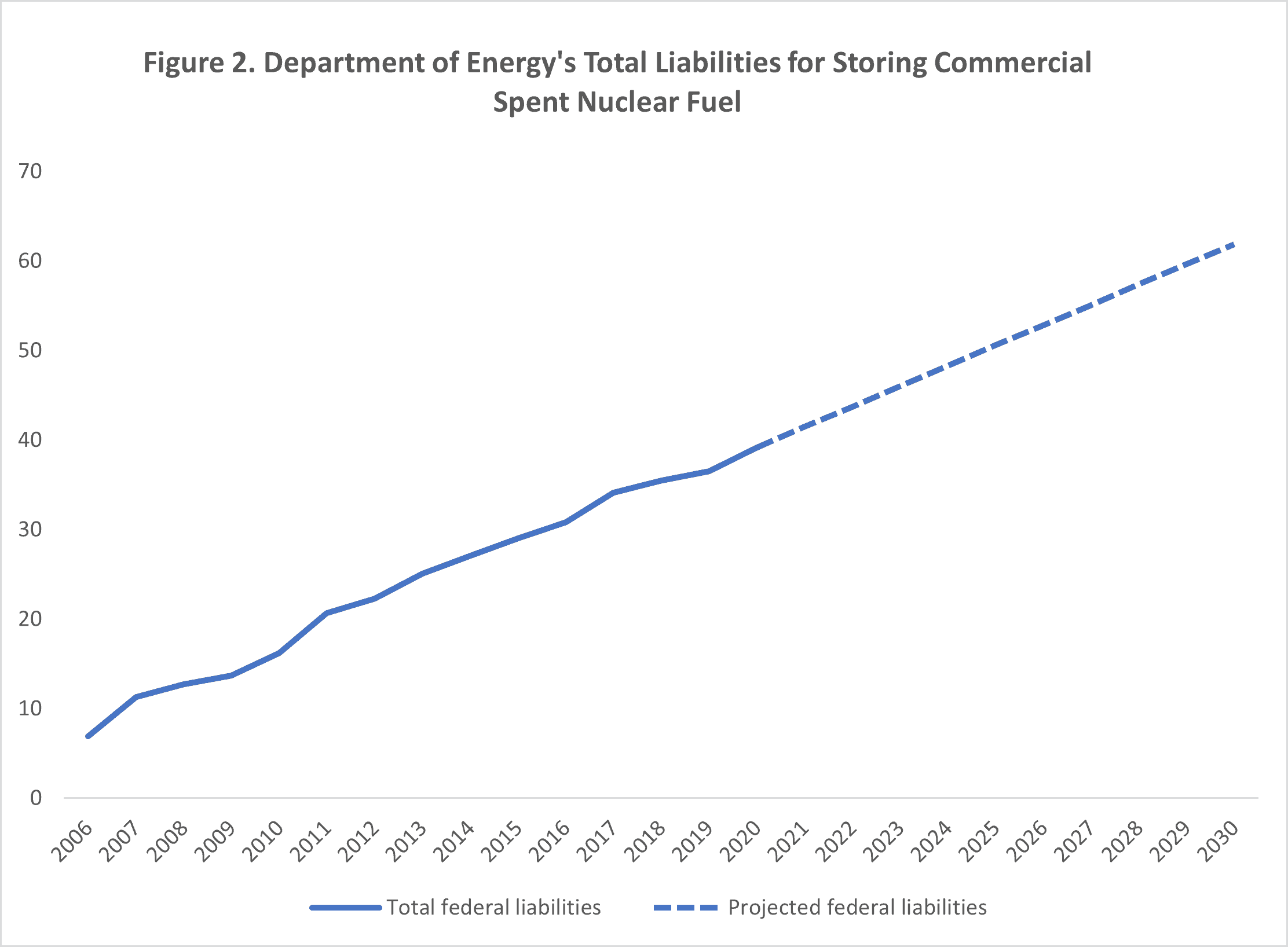
- Yet the federal government has long fallen behind in nuclear waste management, with a decades-long stalemate between the federal and state governments to establish a permanent storage facility; the federal government currently relies on 79 temporary sites to store over 95,000 metric tons of spent fuel, and the annual cost of payments to nuclear utility owners for federal failure to remove spent fuel is projected to reach almost $62 billion by 2030.
- This insight provides an overview of the United States’ current approach to managing nuclear waste and discusses key challenges to developing permanent disposal solutions necessary to support the nuclear energy renaissance.
Introduction
To accelerate the U.S. nuclear renaissance, the Trump Administration is pursuing a multi-pronged approach to manage nuclear waste. It includes offering federal incentives for states to voluntarily host spent fuel disposal activities, investing in nuclear waste recycling technologies, and establishing the Center for Spent Fuel Research to build public confidence in waste transportation and safety.
Yet the federal government has fallen behind in nuclear waste management, with a decades-long stalemate between the federal and state governments to establish a permanent storage facility for the nation’s nuclear waste.
There are currently over 95,000 metric tons of spent nuclear fuel at 79 temporary storage sites across the United States; the federal government has repeatedly fallen short of statutory requirements and deadlines to remove this spent fuel, and is projected to owe nuclear utility owners almost $62 billion by 2030 for its failure.
This insight provides an overview of the United States’ current approach to managing nuclear waste and discusses key challenges to developing permanent disposal solutions necessary to support the nuclear energy renaissance.
U.S. Nuclear Energy Renaissance
The Department of Energy (DOE) recently issued a Request For Information (RFI) inviting states to volunteer to host “Nuclear Lifecycle Innovation Campuses.” This RFI is the latest part of the Trump Administration’s effort to support expansion of the U.S. nuclear energy industry. To accelerate the deployment of advanced nuclear technology, President Trump last year signed four executive orders (EOs) aimed at streamlining regulatory reviews, boosting nuclear energy exports, and reforming the Nuclear Regulatory Commission. (This American Action Forum insight provided detailed analysis of the goals and implications of these EOs.) Additionally, Japan has committed to funding a U.S. nuclear project worth from $80–$100 billion for Westinghouse to build nuclear reactors and other investments.
Nuclear power has served as a low-profile but critical energy source for the United States over the past several decades, generating about 20 percent of the nation’s total electricity and accounting for nearly half of the carbon-free energy it produced. After a long period of stalled public and political support—largely triggered by the 1979 partial nuclear reactor meltdown at Three Mile Island, there has been renewed interest in nuclear energy from lawmakers and industries. The bipartisan Accelerating Deployment of Versatile, Advanced Nuclear for Clean Energy (ADVANCE) Act of 2024 demonstrated significant support from lawmakers for the development and deployment of nuclear energy.
Overview of Nuclear Waste Management
The U.S. Nuclear Regulatory Commission (NRC) regulates the handling, transportation, storage, and disposal of nuclear waste via special regulations.
Nuclear waste includes various radioactive materials, such as uranium mill tailings—the solid residue from recovering uranium from uranium ore— spent reactor fuel, and protective gear for technicians.
Nuclear waste is categorized as high-level or low-level depending on its radioactivity. Low-level waste includes uranium mill tailings and protective gear, such as tools and clothing. High-level radioactive waste consists of irradiated, or spent, fuel that is no longer useful for electricity production. This waste is solid, comprised of small fuel pellets sealed inside long metal tubes known as rods.
There are temporary and permanent solutions for storing spent nuclear reactor fuel. After a nuclear reactor is shut down, newly removed spent fuel must be cooled down and shielded via specially designed pools of water. Once the spent fuel is cooled down, it is stored temporarily on site at the nuclear power plant in canisters residing in dry storage casks.
Permanent storage stores spent fuel in canisters in an underground repository that is at least 1,000 feet deep. While there are no operational permanent repositories anywhere in the world, Finland is on track to become the first country to deploy such a facility. Onkalo, a deep geological disposal repository in Finland, is in its final safety review phase and is expected to be operational soon. It is designed to permanently seal 5,500 metric tons of nuclear waste.
U.S. Approach to Nuclear Waste Management
The United States has been relying on temporary solutions to store nuclear waste. Despite a statutory mandate enacted in 1982, there is currently no permanent disposal site or plan in the country. Once spent fuel is cooled down, it is stored in canisters on operating or retired nuclear reactor sites.
Currently, there are more than 95,000 metric tons of spent fuel stored across 79 sites in more than 30 states in the country. DOE estimated that by the time all current reactors reach the end of their operational lives, the amount could increase to approximately 180,000 metric tons.
As shown in Figure 1, the amount of U.S. spent nuclear fuel produced each year has been increasing steadily over the past several decades—from 44.6 metric tons of uranium (MTU) in 1970 to 2,274.9 MTU in 2017, according to the Energy Information Administration’s Nuclear Fuel Data Survey. Cumulatively, there were 79,825 MTU in the United States by 2017, which means the country saw a more than 15,000 MTU increase in cumulative spent nuclear fuel over the past decade.

Source: Energy Information Administration
Challenges of U.S. Approach to Nuclear Waste Management
The major challenge to the current U.S. approach to managing nuclear waste is that there is no permanent disposal repository for high-level nuclear waste. Cooling pools and dry cask storage solutions are both temporary. Typically, spent fuel would need to be cooled in pools for 10 years—which is the industry standard, though the NRC has approved a timeline as short as one year. As for dry cask storage facilities, NRC grants 40-year licenses, which can be renewed subject to the agency’s review.
As of today, the United States’ efforts to develop a permanent repository for high-level nuclear waste have failed. Congress mandated that the federal government develop such a permanent repository and manage nuclear waste when it passed the 1982 Nuclear Waste Policy Act (NWPA). The legislation required the federal government to dispose of spent fuel at a permanent repository by certain deadlines. If the obligation was not fulfilled, the federal government would incur financial liabilities including paying the nuclear reactor site owners for continuing to store spent fuel there. The federal government spent several years afterwards trying to find a permanent site through a “technically rigorous and politically fair” process, according to Meredith Fowlie with the Energy Institute of the UC Berkeley Haas School. When this process did not come to fruition, Congress nevertheless passed amendments to the NWPA (in 1987), designating Nevada’s Yucca Mountain as the selected site.
In 2008, the DOE submitted an application to the NRC to obtain a license to build the country’s first permanent geologic repository for high-level nuclear waste at Yucca Mountain. This initiative met fierce resistance from the state of Nevada and local advocacy groups through legal challenges on environmental and technical grounds. In 2010, President Obama decided to scrap the initiative despite the more than $15 billion invested in site development up to that point.
In the wake of the decision to cease efforts to establish a permanent storage site at Yucca Mountain, the NRC has issued licenses for two private consolidated interim storage facilities, in Texas and New Mexico, which are intended to store spent fuel from commercial nuclear reactors until a permanent site is developed. The interim storage projects were also met with strong resistance. The state of Texas challenged the NRC’s legal authority to approve an interim storage facility in the state, and the litigation escalated to the Supreme Court. Ultimately, in June 2025, the Court ruled in NRC v. Texas that the state does not have legal standing to challenge the NRC’s approval of the interim storage facility based on procedural grounds under the Administrative Orders Review Act. According to Barry Rabe, a nonresident senior fellow at the Brookings Institution, the Court’s ruling leaves two major issues unresolved: looming political pushback from Texas and New Mexico, and the risk of an “interim” storage solution becoming permanent in the absence of a long-term facility plan.
The federal government has been increasing its payment to nuclear site owners to store the steadily rising amount of spent nuclear fuel. As shown in Figure 2, DOE paid $6.9 billion in 2006 for the total costs and liabilities of storing commercial nuclear reactor spent fuel, and the number grew drastically to $39.2 billion in 2020. The Government Accountability Office (GAO) projects this figure to increase to $61.9 billion in 2030. These numbers reflect the total amount the federal government is expected to pay nuclear utility owners for failing to meet legal deadlines to remove spent fuel from reactor sites. Notably, GAO’s projections date back to 2021, preceding both the enactment of the ADVANCE Act and the Trump Administration’s renewed policy support for the nuclear energy industry.
Source: GAO
Trump’s Multi-pronged Approach to Manage Nuclear Waste
- In January 2026, DOE issued an RFI asking states to volunteer hosting “Nuclear Lifecycle Innovation Campuses,” which will be a nuclear waste management solution that would “support activities across the full nuclear fuel lifecycle, including fuel fabrication, enrichment, reprocessing spent nuclear fuel, and disposition of waste.”
- DOE and the Electric Power Research Institute collaborated on a research project to study whether high burnup nuclear fuel (fuel that is kept in reactors longer to maximize energy output) can be stored in dry cask storage for up to 40 years instead of the existing license of 20 years.
- In January 2026, DOE’s Office of Nuclear Energy announced the establishment of the Center for Spent Fuel Research at Idaho National Laboratory, making it a major institution for “critical research, development, and demonstration efforts concerning spent nuclear fuel management. The new center is aimed to “advance public confidence in the safe storage and transportation of both commercial and DOE-managed [spent fuel].”
- In February, DOE’s Office of Nuclear Energy awarded $19 million to five U.S. companies to conduct research and development on recycling technologies for spent nuclear fuel, to “support President Trump’s bold and ambitious nuclear energy agenda by helping to maximize reliable power production, end U.S. reliance on foreign sources of enriched uranium, and drastically reducing the volume of used fuel stored across the country.”
Looking Forward
If the United States wishes to significantly expand nuclear power generation, it must develop permanent high-level nuclear waste disposal solutions. Spreading storage of nearly 100,000 metric tons of spent fuel across 79 temporary reactor sites in more than 30 states is not a sustainable strategy. The Trump Administration’s multi-pronged approach—pairing waste disposal with incentives for federal-state partnerships—seeks to break the nation’s stalemate over how and where to store spent nuclear fuel. The success of the administration’s strategy will have significant implications for the future of U.S. nuclear energy.
