Insight
March 24, 2026
Interest Payments on the National Debt: the Near- and Long-term Outlook
Executive Summary
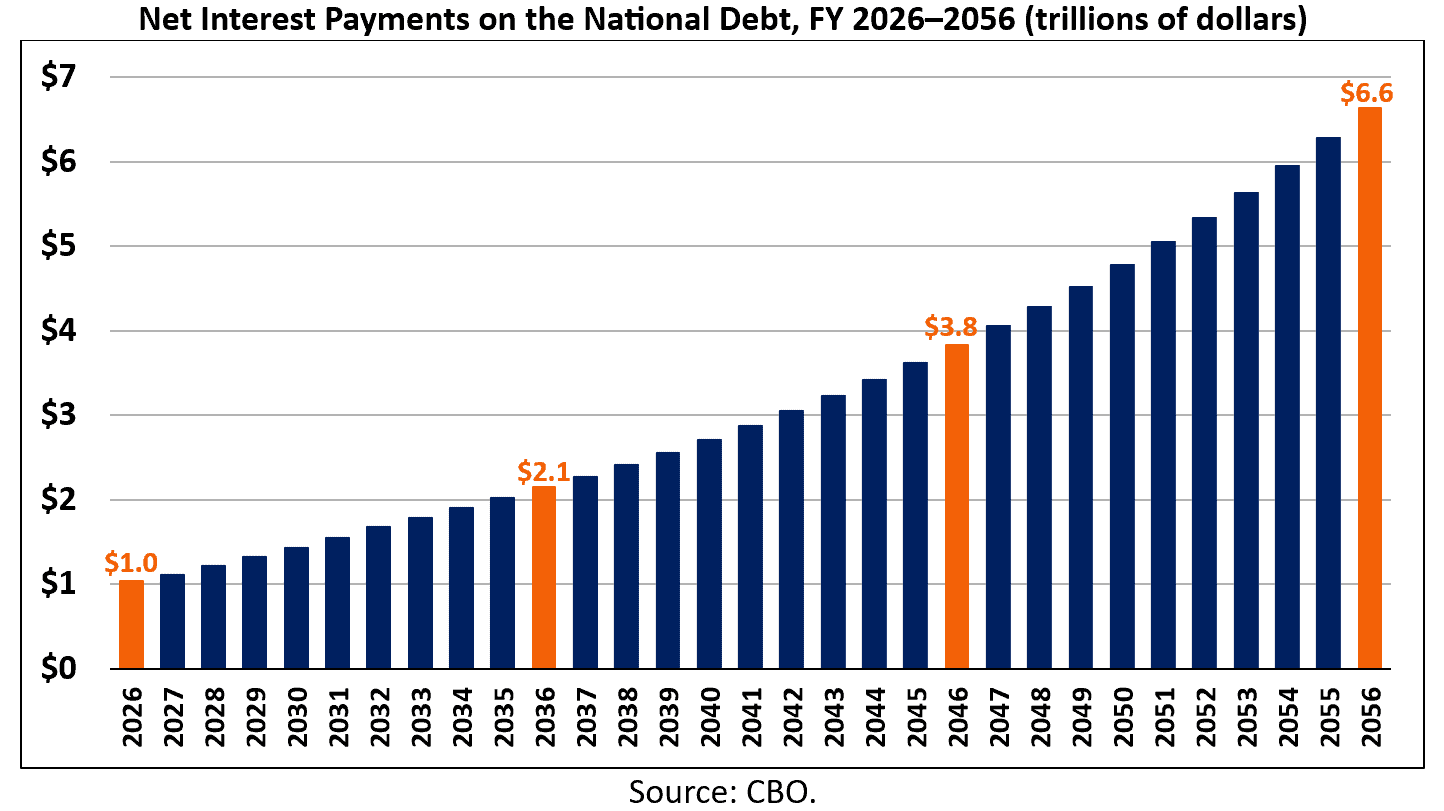
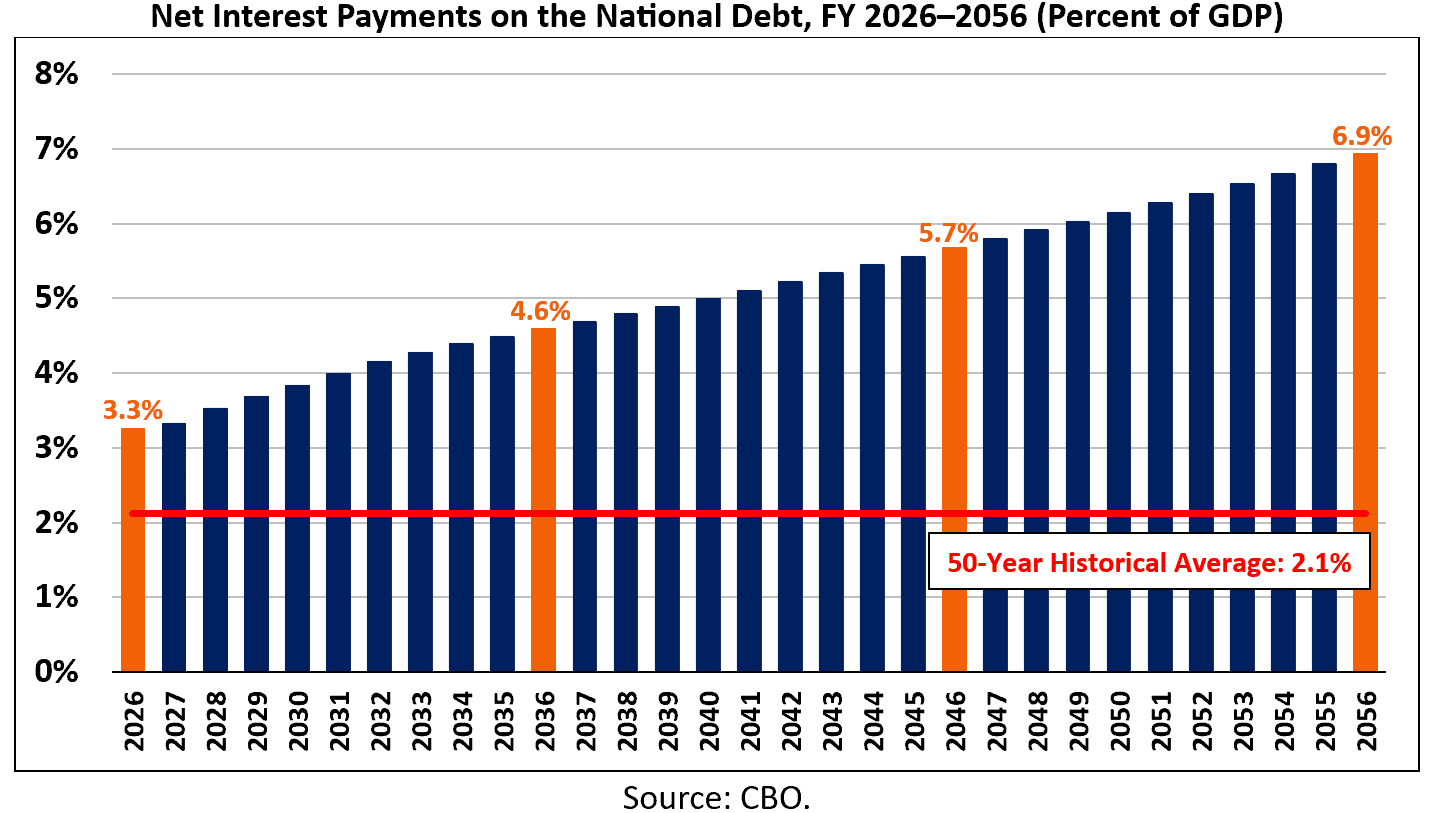
- One key consequence of a high and rising national debt is an increase in the interest payments to service it; the Congressional Budget Office (CBO) projects that interest payments will grow from $1.0 trillion (3.3 percent of gross domestic product (GDP)) in fiscal year (FY) 2026 to $2.1 trillion (4.6 percent of GDP) in FY 2036 and to $6.6 trillion (6.9 percent of GDP) by FY 2056.
- Over the FY 2026–2036 budget window, interest payments will grow faster than any other major budgetary category, increasing by 106 percent; over the FY 2026–2056 period, interest will increase by a staggering 538 percent.
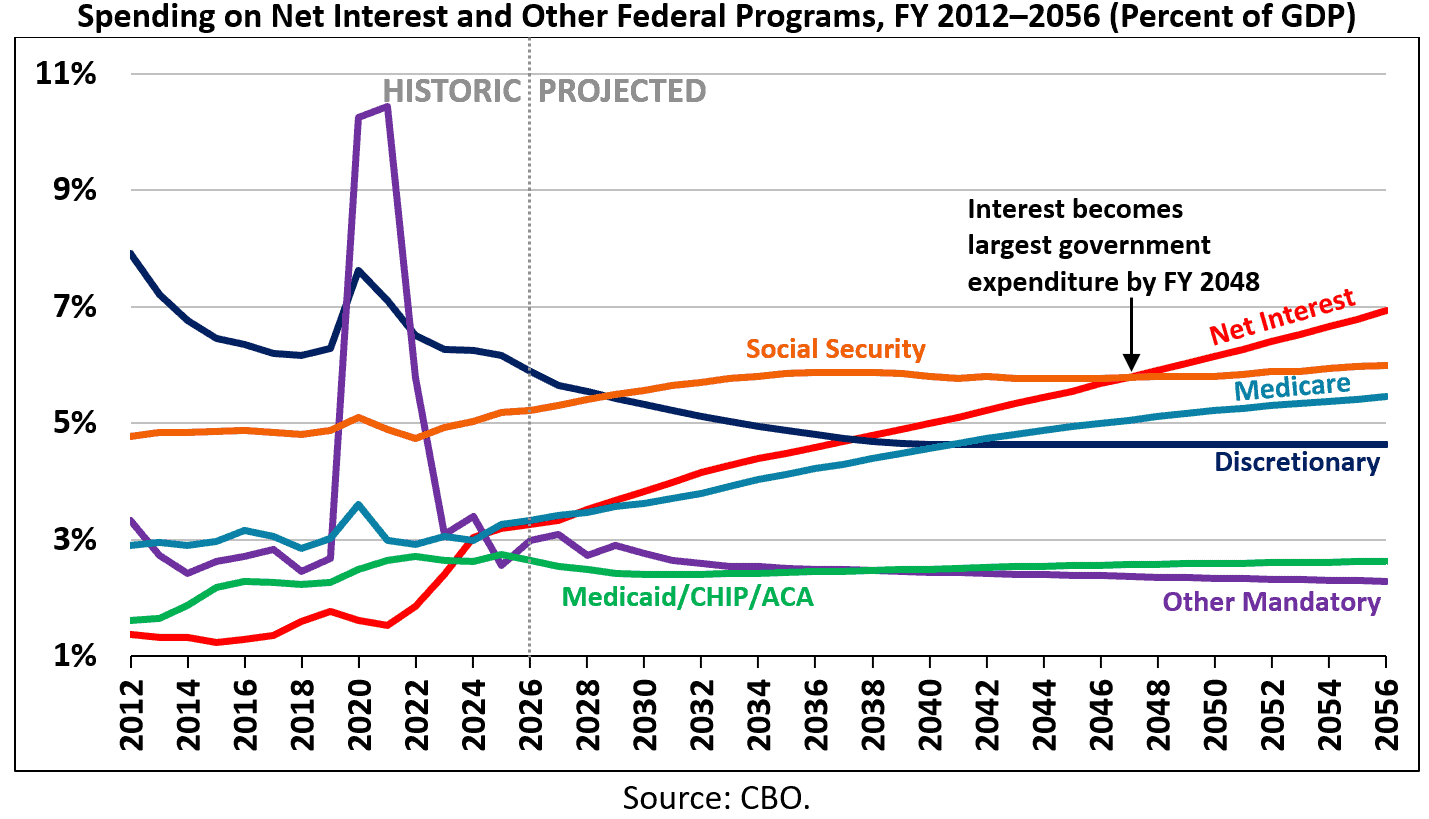
- Interest will exceed Medicare spending by FY 2028, defense and nondefense discretionary spending by FY 2038, and will become the single-largest federal government expenditure by FY 2048 – meaning the federal government will soon be spending more to service the past than to make productive investments in the future.
Introduction
One of the consequences of a high and rising national debt is an increase in the net interest payments to service it. According to the Congressional Budget Office’s (CBO) latest long-term budget projections, the federal government will spend $1.0 trillion (3.3 percent of gross domestic product (GDP)) on interest payments on the national debt in fiscal year (FY) 2026. By FY 2036, interest payments will more than double to $2.1 trillion (4.6 percent of GDP) and will grow further to $6.6 trillion (6.9 percent of GDP) by FY 2056.
Over both the short and long term, interest payments will grow faster than any other major budgetary category. Specifically, interest will increase by 106 percent over the FY 2026–2036 budget window and by 538 percent over the FY 2026–2056 budget window. Interest costs will exceed Medicare spending by FY 2028, defense and nondefense discretionary spending by FY 2038, and will become the single-largest federal government expenditure by FY 2048 – meaning we will soon be spending more to service the past than to make productive investments in the future.
As Interest Rates and Debt Rise, So Will Interest Costs
Under current law, net interest payments will more than double, rising from $1.0 trillion in FY 2026 to $2.0 trillion in FY 2036. Over the long term, interest costs will grow further, to $3.8 trillion by FY 2046 and to $6.6 trillion by FY 2056.
As a share of the economy, interest costs will rise from 3.3 percent of GDP in FY 2026 to 4.6 percent of GDP by FY 2036. Over the long term, interest payments will grow to 5.7 percent of GDP by FY 2046 and to 6.9 percent of GDP by FY 2056. For comparison, the 50-year historical average for interest payments is 2.1 percent of GDP. That means net interest-to-GDP will be more than twice the historical average by FY 2036, and more than three times the historical average by FY 2056.
Over the FY 2026–2036 budget window, interest payments will grow faster than any other major budgetary category. CBO expects spending on net interest to grow by 106 percent, while spending on Medicare will increase by 85 percent and Social Security spending will grow by 65 percent. Other mandatory spending (including income security and veterans’ benefits and services) will increase by 55 percent, spending on other health care (Medicaid, the Children’s Health Insurance Program, and the Affordable Care Act premium tax credits) will grow by 35 percent, and discretionary spending (defense and nondefense) will grow by 19 percent. Interest costs will outpace projected revenue growth of 48 percent more than two times over.
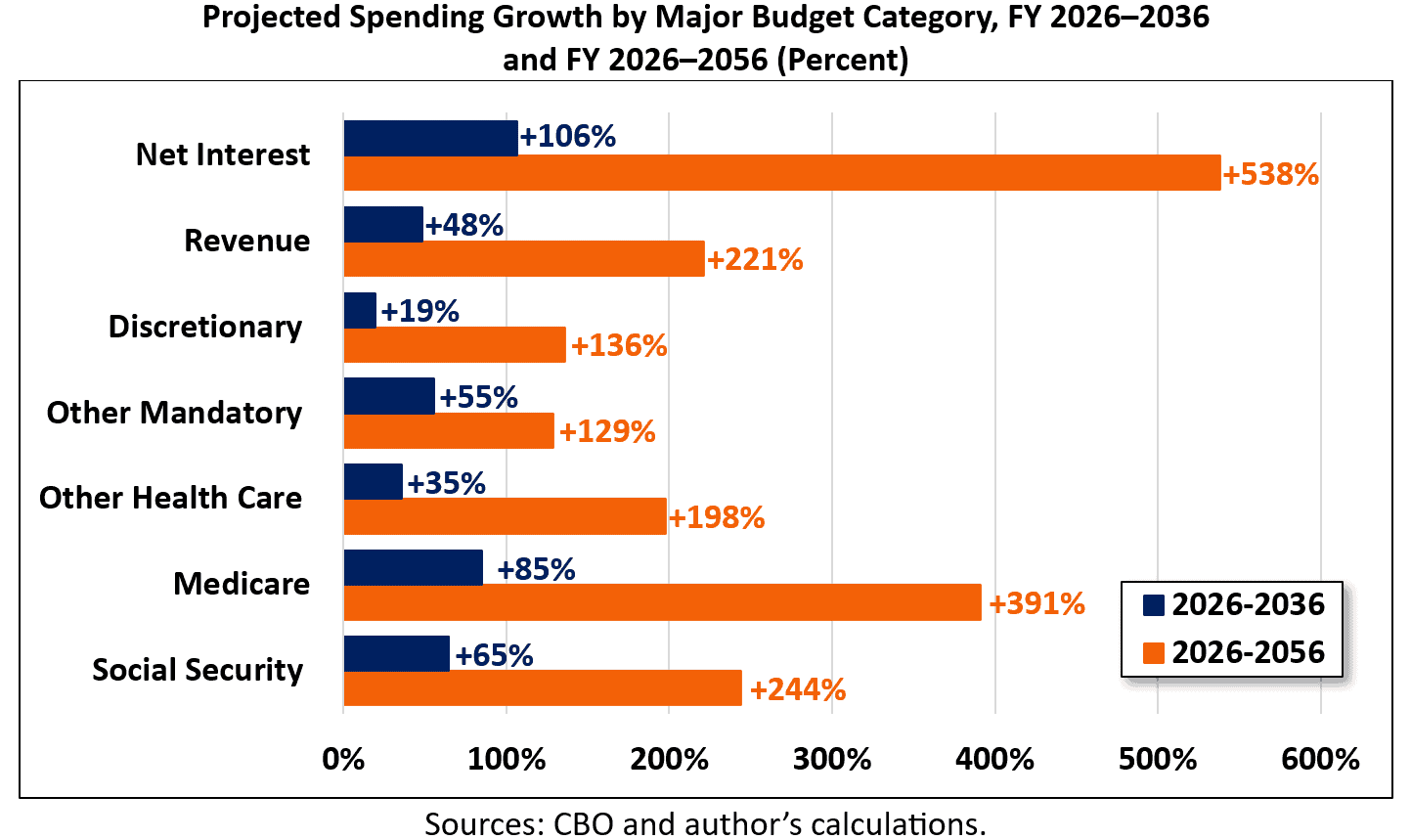
The same is true over the long term. Over the FY 2026–2056 budget window, CBO expects spending on net interest to grow by 538 percent, while spending on Medicare will increase by 391 percent and Social Security spending will grow by 244 percent. Other health care spending will increase by 198 percent, discretionary spending will increase by 136 percent, and other mandatory spending will increase by 129 percent. Interest costs will outpace projected revenue growth of 221 percent more than two times over.
Interest Payments Are an Increasingly Costly Part of the Federal Budget
The more money the federal government spends on interest on the national debt, the less that is available to fund new spending priorities, cut taxes, or reduce budget deficits. Each dollar spent on interest is a dollar unavailable to spend on other national priorities.
The $1.0 trillion the federal government is projected to spend on interest payments this fiscal year is more than it is expected to spend on national defense ($947 billion), Medicaid ($708 billion), veterans’ benefits and services ($435 billion), transportation ($153 billion), food and nutrition services, including the Supplemental Nutrition Assistance Program ($145 billion), education (elementary, secondary, vocational, and higher education) ($112 billion), natural resources and the environment ($73 billion), Supplemental Security Income ($67 billion), international affairs ($47 billion), science, space, and technology ($44 billion), and energy ($23 billion).
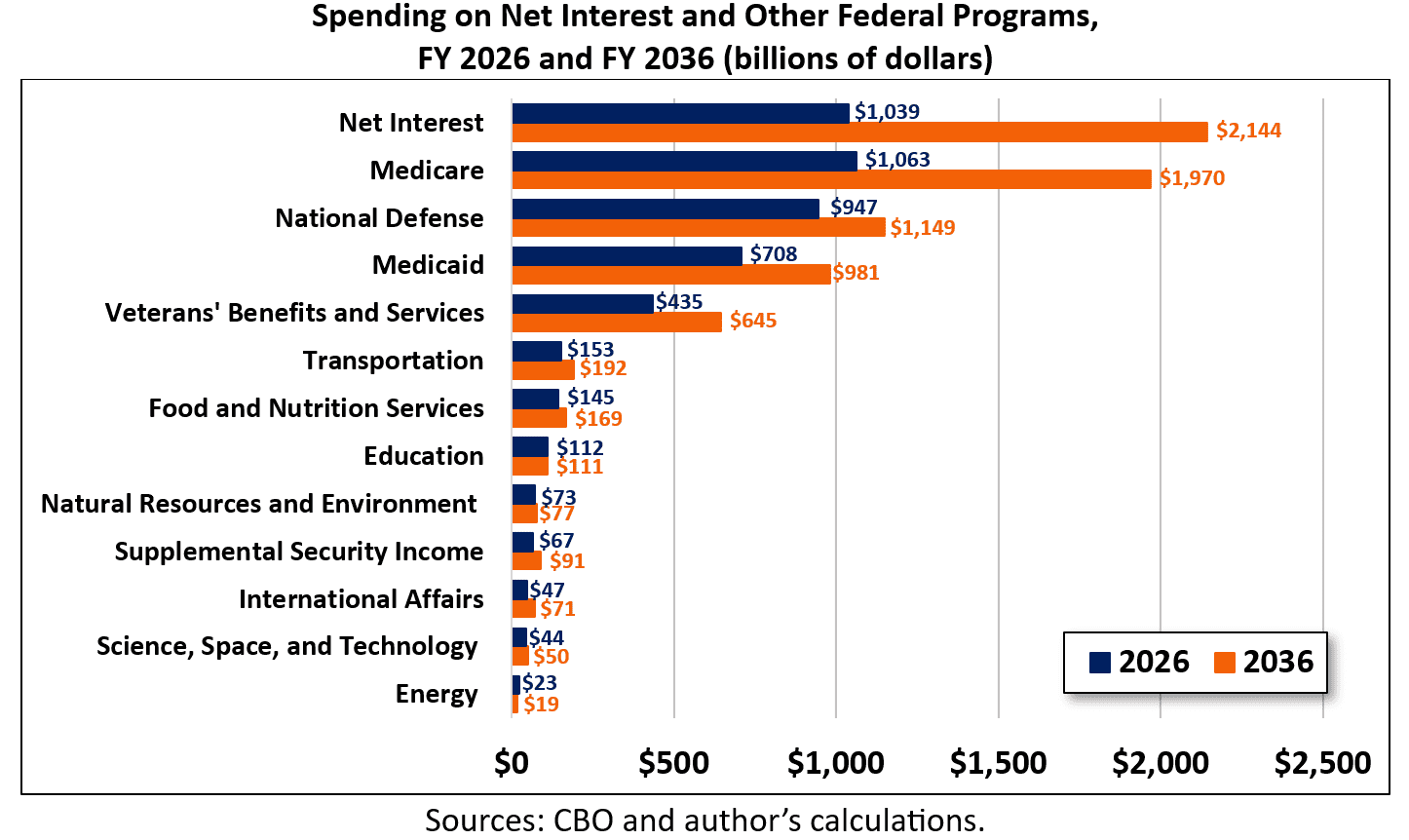
The $1.0 trillion of projected interest costs in FY 2026 equals 14 percent of projected spending or 19 percent of all federal revenue collections. That means for every dollar of taxes and fees the government collects, 19 cents will go to pay interest on the national debt. Interest payments will effectively consume all corporate income tax revenue, 57 percent of all payroll tax revenue, or 38 percent of individual income tax collections.
In FY 2036, the $2.1 trillion of projected interest costs will comprise 19 percent of projected spending or 26 percent of all federal revenue collections. That means in just 10 years, more than one-quarter of every dollar the government collects in taxes and fees will go to pay interest on the national debt. Interest payments will effectively consume 80 percent of all payroll tax revenue or 50 percent of individual income tax collections.
By FY 2056, the $6.6 trillion of projected interest costs will comprise one-quarter of projected spending and 37 percent of all federal revenue collections. Thus, in just three decades, 37 cents of every dollar the government collects in taxes and fees will go to pay interest on the national debt. By then, interest payments will effectively consume all payroll tax revenue collections or 69 percent of individual income tax collections.
Interest costs will continuously outpace growth in other areas of the federal budget. Interest will exceed Medicare spending by FY 2028, defense and nondefense discretionary spending by FY 2038, and will become the single-largest government expenditure by FY 2048.