Insight
November 6, 2025
FTC Challenges Zillow’s Pay-to-Exit Agreement in “Merger” with Redfin
Executive Summary
- On September 30, 2025, the Federal Trade Commission (FTC) sued Zillow and Redfin, alleging they entered into an illegal agreement where Zillow paid Redfin to exit the internet listing services (ILS) advertising market for rental properties.
- The FTC’s complaint alleged that in exchange for a $100 million payment and other compensation from Zillow, Redfin agreed to end contracts with advertising customers, stop competing in the advertising market for multifamily properties, and serve as an exclusive syndicator of Zillow listings.
- This agreement effectively eliminates the head-to-head competition on the merits between the two firms that could result in higher prices and worse terms for multifamily unit advertisers and reduce the incentive for the remaining competition to innovate and provide better services for consumers.
Introduction
On September 30, 2025, the Federal Trade Commission (FTC) sued Zillow and Redfin, alleging they entered into an illegal agreement where Zillow paid Redfin to exit the internet listing services (ILS) advertising market for rental properties.
In exchange for a $100 million payment and other compensation from Zillow, Redfin agreed to end contracts with advertising customers, withdraw from the advertising market for multifamily properties – specifically for buildings with 25 or more units – and serve as an exclusive syndicator of Zillow listings.
The agreement effectively eliminates the head-to-head competition between the two firms in the ILS market for multifamily homes. This, according to the FTC, could result in higher prices and worse terms for multifamily unit advertisers and reduce the incentive for remaining firms to innovate to provide better services for consumers.
The FTC claimed that the agreement violates Section 1 of the Sherman Act, which bars contracts, combinations or conspiracies in restraint of trade; Section 5 of the FTC Act, which outlaws unfair methods of competition; and Section 7 of the Clayton Act, which deems acquisitions that may substantially lessen competition illegal.
The Market
ILS Market
The ILS market serves two customers: 1) property management companies (PMCs), landlords, and other property managers (collectively “PMCs”), and 2) prospective renters.
PMCs use ILSs to advertise their properties, and ILSs compete for these advertising dollars. According to the FTC complaint, a recent Redfin survey found that 88 percent of advertisers included ILS advertising in their budgets, and those advertisers allocated over half of their marketing budget to ILS advertising.
Prospective renters, meanwhile, use ILSs to find available rental units.
ILSs promise PMCs “broad exposure to and engagement from potential renters,” according to the complaint. In turn, ILSs attempt to provide prospective renters with “a broad selection of listings that match their preferences and an experience that provides in-depth property insights, user-friendly tools, and ways to connect with and tour properties.” In other words, ILSs seek to match PMCs with renters.
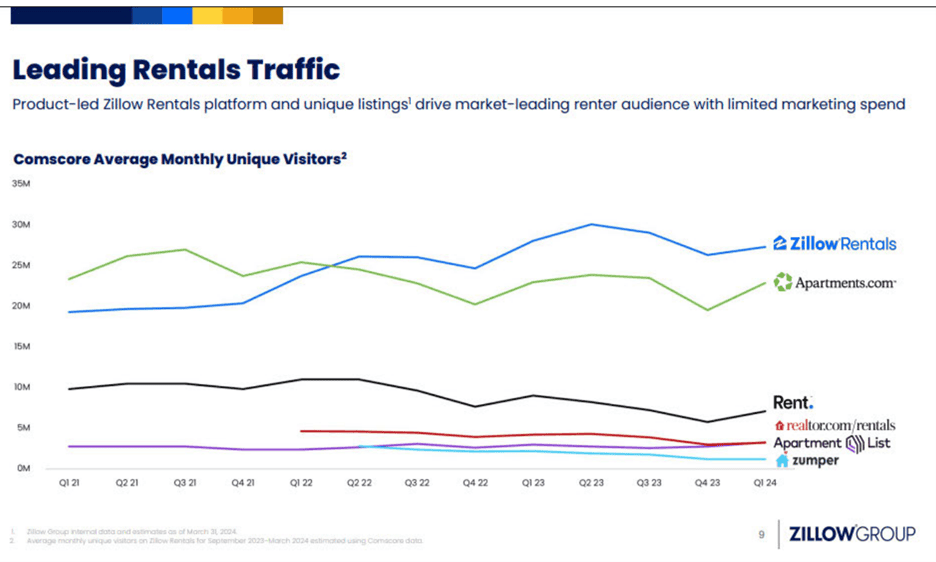
According to the FTC’s complaint, Zillow competed directly with Redfin (shown as “Rent” in Figure 1) and CoStar (which operates Apartments.com) to sell advertising to PMCs looking to rent their units. By 2024, these three firms had captured more than 85 percent of national ILS revenue, with Zillow accounting for more than half of all U.S. rental listings.
Figure 1: Leading Rentals Traffic
*Source: FTC Complaint
The FTC identified two relevant product markets in its lawsuit, the ILS market broadly, and the ILS multifamily advertising market, specifically.
ILS advertising, according to the FTC, has “no reasonably interchangeable substitutes” and describe the market as a “‘tried-and-true’ channel for marketing available rental units.” Moreover, the FTC claimed that other forms of advertising, such as search engines and social media, “do not impose a meaningful competitive restraint on ILSs,” adding that they “more frequently act as complements rather than competitors.”
The agency also specified a segment of the ILS advertising customer – those who manage multifamily rental properties of 25 units or greater – as it makes up a large portion of the broader ILS market, according to the agency.
The Rental Market
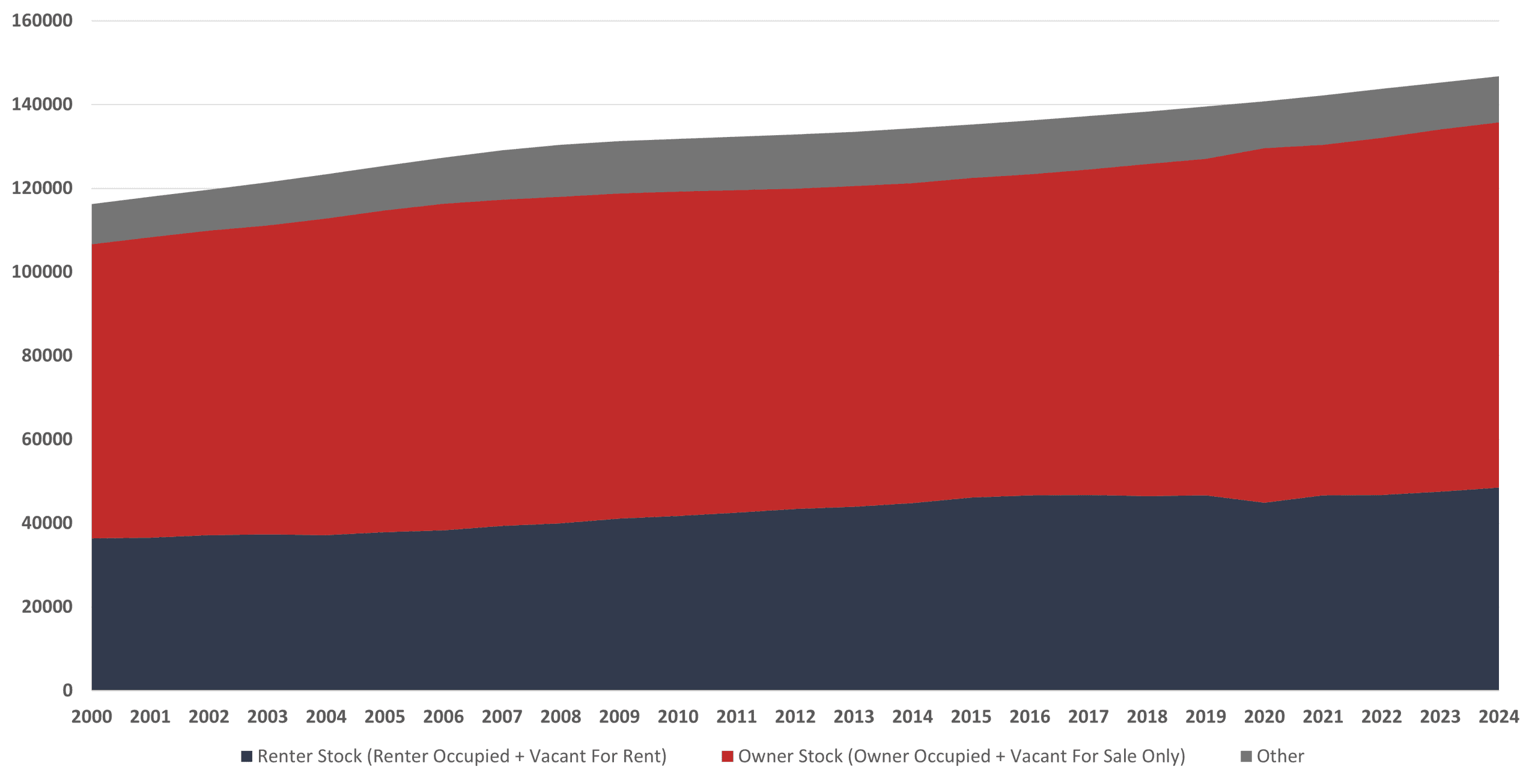
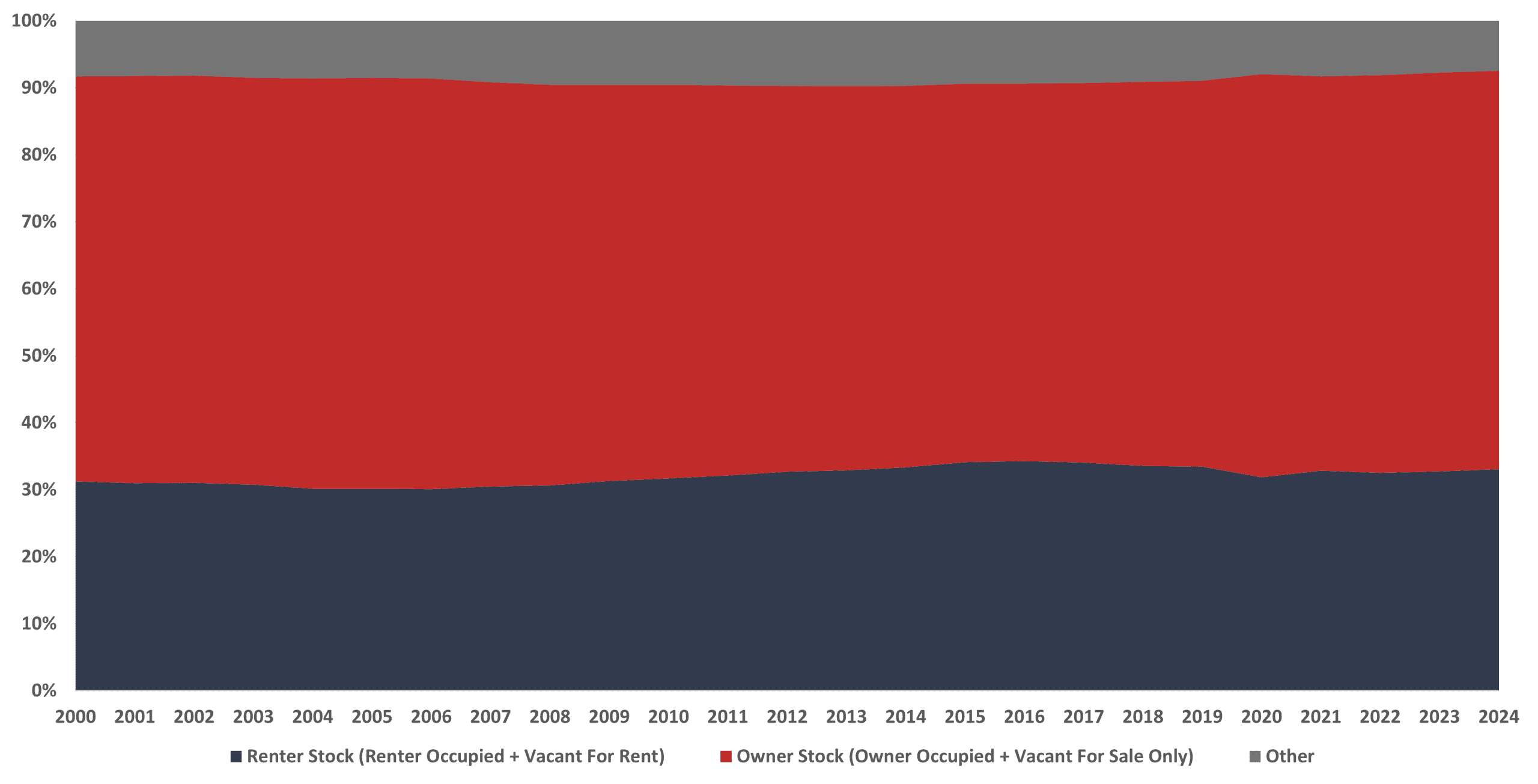
Data from the Census Bureau’s Housing Vacancy Survey showed that at the end of 2024, there were nearly 49 million rental units in the United States, making up over 33 percent of the housing stock.
Figure 2: Housing Stock by Type, Thousands of Units
*Source: Census Bureau Housing Vacancy Survey; author’s calculations
Figure 3: Housing Stock by Type as a Share of Total Housing Stock, %
*Source: Census Bureau Housing Vacancy Survey; author’s calculations
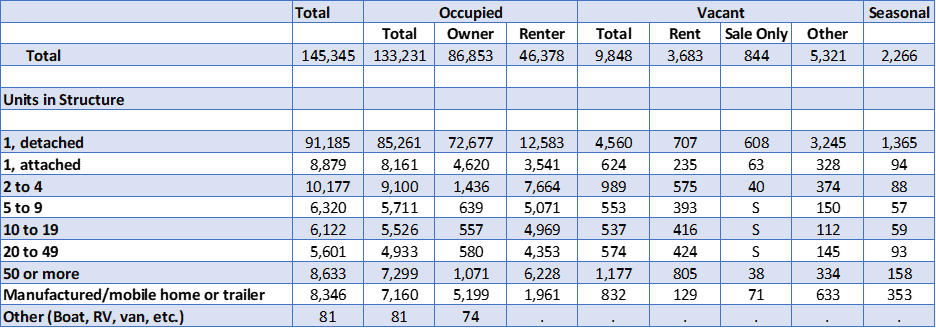
Data from the Census Bureau’s 2023 American Housing Survey showed there were 133 million occupied housing units, split between owner-occupied (65 percent) and renter-occupied (35 percent). While the detailed breakdown does not have a category that directly overlaps with the FTC’s market of 25 or more units, the data showed that 23 percent of renter-occupied housing is in structures with 20 or more units, serving as a reasonable proxy for the magnitude of this market segment. Rental units in structures with 20 or more units represented one-third of rental vacancies.
Figure 4: Multifamily Rental Market, Thousands of Units
*Source: Census Bureau American Housing Survey; author’s calculations
Zillow and Redfin’s Agreements
On February 6, 2025, Zillow and Redfin entered into two agreements: The partnership agreement and the content license agreement.
Under the partnership agreement, Zillow paid Redfin $100 million to stop selling multifamily (25 units or more) ILS advertising to PMCs, terminate its existing multifamily advertising contracts and transition those customers to Zillow. According to the FTC complaint, even if these customers did not sign with Zillow, Redfin was still obligated to cancel the customers’ contracts and remove them from the Redfin network. Moreover, the agreement required Redfin to turn over its competitively sensitive information to Zillow and assist Zillow with the hiring of any Redfin employees and contracts that were terminated because of the agreement.
Under the content license agreement, the FTC explained, Redfin’s website would serve as a syndicate of Zillow listings for a term of up to 10 years. For multifamily properties of 25 units or more, Redfin would display only Zillow listings. Zillow agreed to pay Redfin an undisclosed sum per lead generated from the Zillow-syndicated listings, with a minimum payment of $75 million to Redfin in the first year, according to the complaint. The FTC also explained that the content license agreement makes “Zillow the exclusive provider of multifamily rental listings on the Redfin Network; Redfin has agreed not to display any third-party multifamily listings or to compete for advertising customers of its own,” and not “compete with Zillow for the advertising of multifamily rental properties for up to 9 years.”
The agreements would eliminate any head-to-head competition between the firms in the multifamily ILS advertising market and consolidate Zillow’s dominance in the market. As a result, PMCs would be left with fewer choices, higher prices, and reduced quality in advertising services.
The Alleged Violations
The FTC claimed that the agreement between Zillow and Redfin violated three different antitrust statutes: Section 1 of the Sherman Act, Section 7 of the Clayton Act, and Section 5 of the FTC Act.
Section 1 of the Sherman Act
The FTC alleged that the agreements between Zillow and Redfin violates Section 1 of the Sherman Act, which prohibits contracts or conspiracies in restraint of trade.
Zillow’s $100 million payment to Redin to exit the multifamily ILS advertising market directly eliminates head-to-head competition which leaves advertisers with fewer choices and likely higher prices.
Section 7 of the Clayton Act
The FTC also claimed that the agreements run afoul of Section 7 of the Clayton Act, which outlaws mergers and acquisitions where the effect may be substantially to lessen competition, or tend to create a monopoly.
The agreements, the FTC claimed, function as an acquisition. Zillow obtained several assets from Redfin including “customer relationships, key employees, business information, and a commitment by Redfin to terminate a class of customer contracts.” The FTC claimed that this transfer of assets has “economic significance and an anticompetitive effect.”
And while this may not have been an acquisition of stock, the statute also prohibits the acquisition of “whole or any part of the assets,” not just equity.
The “merger” would leave the market with just two competitors.
Section 5 of the FTC Act
If the FTC is unable to convince the courts that these agreements restrain trade or the acquisition of assets, the agency could still argue that they constitute an unfair method of competition.
Conclusion
The FTC sued Zillow and Redfin, alleging they entered into an illegal agreement where Zillow paid Redfin to exit the market for placing multifamily ILS advertising.
The agreements between Zillow and Redfin effectively eliminate the head-to-head competition on the merits between the two firms in the ILS market for multifamily homes. This could result in higher prices and worse terms for multifamily unit advertisers and reduce the incentive for the remaining competition to innovate and provide better services for consumers.