









Insight
March 2, 2026
Global Oil Market Implications of U.S.-Israel Attack on Iran
Executive Summary
- The U.S.-Israel attacks on Iran and the subsequent Iranian retaliatory strikes have triggered a de facto closure of the Strait of Hormuz—a major oil chokepoint for 20 percent of global petroleum consumption at 20 million barrels per day, flowing from major oil producing countries in the Gulf region to the rest of the world.
- The ultimate impact on global energy markets hinges on the duration and scope of the conflict: If the disruptions in the Strait of Hormuz escalate to a prolonged blockade, the resulting supply void will pose a serious threat to global energy supply and economies; for the United States, there is also significant uncertainty ahead with the geopolitical volatility and domestic energy affordability challenges.
- This insight provides an overview of Iran’s oil and gas exports capabilities, the strategic significance of the Iran-controlled Strait of Hormuz, and the potential impact on the global and U.S. energy markets.
Introduction
The United States and Israel launched military attacks on Iran on February 28, 2026. Subsequently, Iran launched retaliatory strikes against private and public facilities across at least nine countries in the Gulf region. The conflicts have triggered a de facto closure of the Strait of Hormuz, which is a major oil chokepoint that sees 20 percent of global petroleum consumption (20 million barrels per day) flowing from major oil producing countries in the Gulf region to the rest of the world.
The ultimate impact on global energy markets hinges on the duration and scope of the conflict. If the disruptions in the Strait of Hormuz shift from a temporary standoff to a prolonged blockade, the resulting supply void will pose a serious threat to global markets. For the United States, there is also significant uncertainty ahead with the geopolitical volatility and domestic energy affordability challenges.
This insight provides an overview of Iran’s oil and gas exports capabilities, the strategic significance of the Iran-controlled Strait of Hormuz, and the potential impact on the global and U.S. energy markets.
Iran-controlled Strait of Hormuz—A Major Global Oil Chokepoint
Iran, a member of the Organization of the Petroleum Exporting Countries (OPEC), ranked fourth in crude oil production among all the members in 2023. Despite Iran’s large oil and natural gas reserves, its total production has been limited due to international sanctions on its energy exports. Iran produced about 4 million barrels per day (b/d) in 2023, accounting for 4 percent of the world’s total oil production. China is the dominant destination for Iranian oil exports, importing most of Iran’s crude oil at 1.4 million b/d on “shadow ships”—tankers that conceal their activities to avoid sanctions.
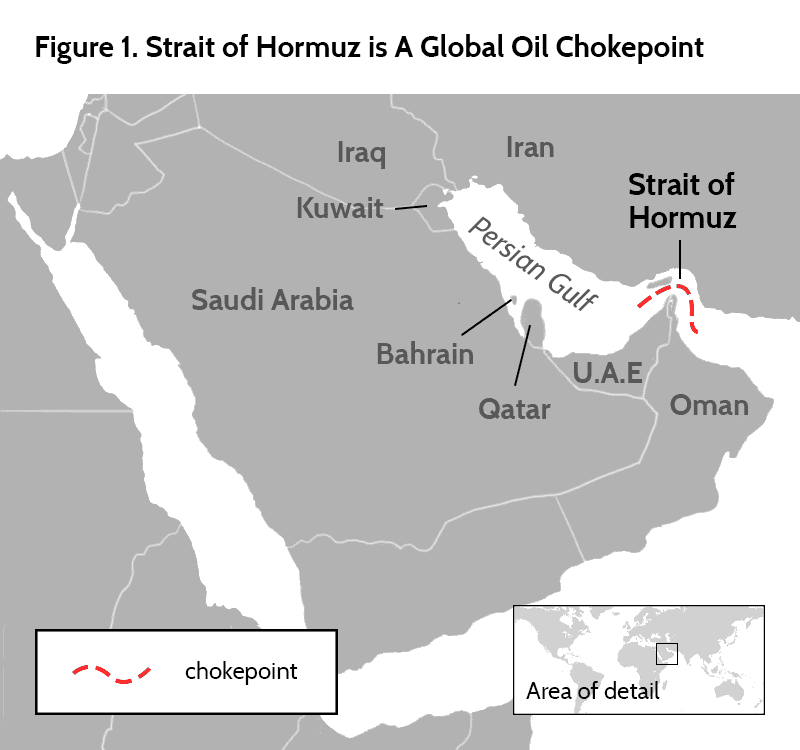
Iran controls the Strait of Hormuz—one of the world’s most important oil chokepoints—which connects the Persian Gulf, the Gulf of Oman, and the Arabian Sea (Figure 1). The strait’s depth and width can accommodate the largest crude oil tankers.
Source: U.S. Energy Information Administration
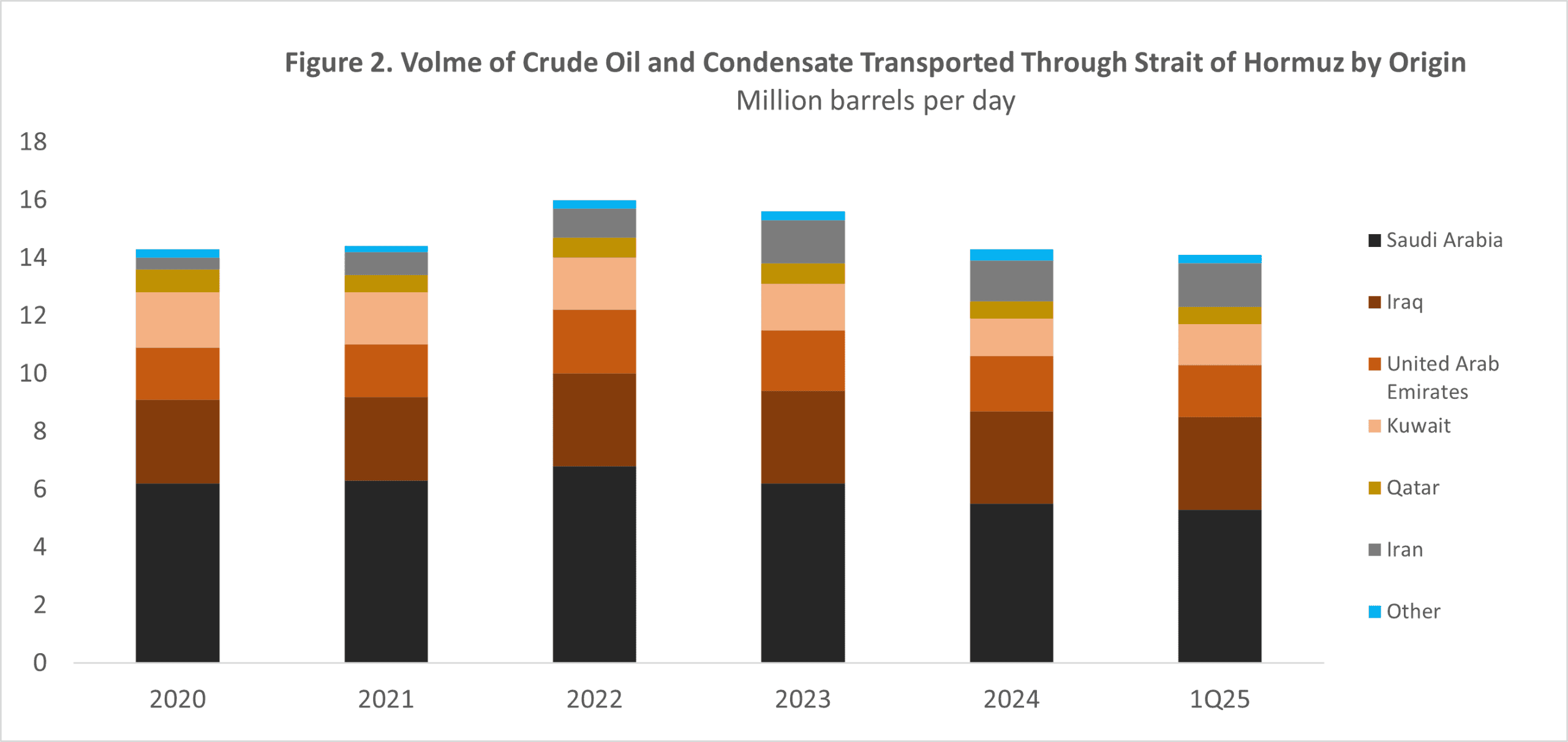
Approximately 20 million b/d were transported through the Strait of Hormuz in 2024, which was about 20 percent of global petroleum liquids consumption. As shown in Figure 2, major oil-producing countries including Saudi Arabia, United Arab Emirates (UAE), Iraq, Kuwait, and Qatar, transport their crude oil exports through the Strait of Hormuz to the rest of the world. Of these countries, Saudi Arabia accounted for 38 percent of total crude flows through the strait at 5.5 million b/d, leading all other countries using the strait.
Source: U.S. Energy Information Administration
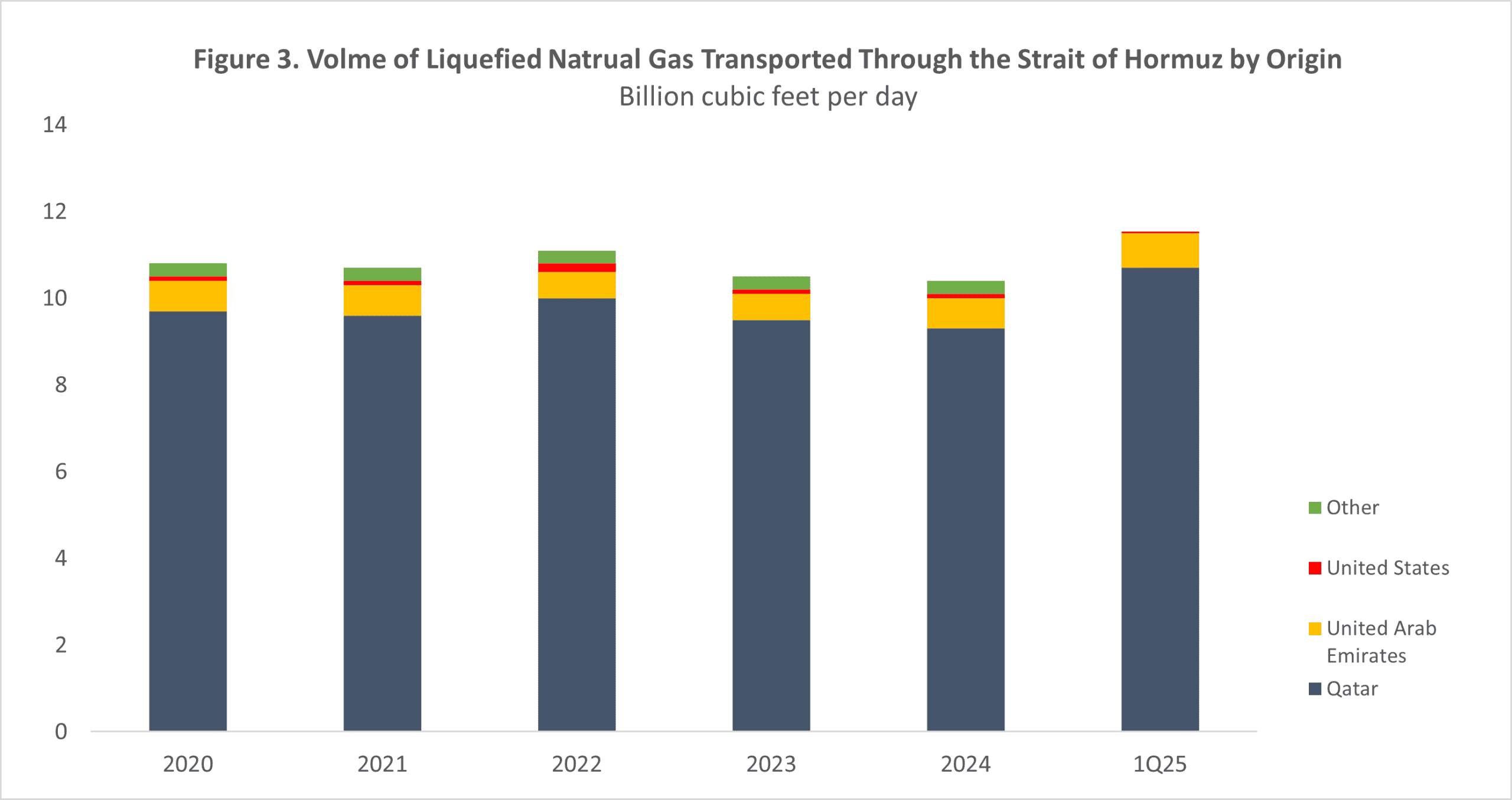
Additionally, about one-fifth of the world’s liquefied natural gas (LNG) trade goes through the strait. As shown in Figure 3, most of the LNG comes from Qatar, at about 9.3 million cubic feet per day in 2024.
Source: U.S. Energy Information Administration
There are very limited alternatives to replace the Strait of Hormuz, with Saudi Arabia and the UAE’s pipelines infrastructure able to accommodate only about 2.6 million b/d to bypass the strait. In other words, about 18 million b/d of crude oil trade through the strait would be disrupted if Iran were to close the strait completely.
Potential Impact on Global Energy Market
The impact on the world energy markets of the U.S.-Israel attacks on Iran will depend on the severity of Tehran’s retaliatory strikes, and the duration and scope of the conflicts.
Outcome 1: Limited and short-lived impact
Provided that gulf states’ energy infrastructures remain intact, any temporary disruption of shipments through the Strait of Hormuz would likely have a limited and short-lived impact on global energy markets due to the world’s current oversupply in crude oil.
Additionally, the OPEC+ cartel (OPEC members and other non-OPEC oil producing nations) have just agreed to boost oil output by a more-than-expected amount of 206,000 b/d starting in April. The countries that will increase oil production include Saudi Arabia, Russia, Iraq, the UAE, Kuwait, Kazakhstan, Algeria and Oman.
Although Iran has not formally announced that it would close the Strait of Hormuz, the strait is de facto closed to commercial shipments. Transits through the strait have essentially ground to a halt, with firms adopting a cautious stance as soaring war-risk premiums drive shipping costs up by $1500 for a standard 20-foot-long shipping container, or $3500 per container for specialty cargos.
The military conflicts across the Middle East have also led to spikes in oil and gas prices in the global market. Brent crude futures, a benchmark for global oil prices, rose by 8 percent to about $79 a barrel, two days after the start of the war. U.S. crude futures increased as much as 11 percent at the same time, reaching as high as $75 a barrel.
Additionally, Europe is seeing natural gas prices surging by roughly 25 percent, escalating the continent’s already high energy costs due to the Russia-Ukraine war. A substantial portion of Europe’s LNG imports are from Qatar via the Strait of Hormuz, making it especially vulnerable to the conflicts in the region.
If the military fights conclude in the Gulf region within the next few days, the disruptions in the shipping industry and the oil and gas markets will ease off, giving the global markets an opportunity to rebound quickly.
Outcome 2: Severe and long-lasting impact
If U.S.-Israel attacks and Iran’s retaliatory strikes lead to a larger regional conflict in the Gulf, or even a full-scale war in the Middle East for a prolonged period of time (weeks or more), it will certainly have a severe impact on the global oil and gas markets and economies.
The primary concern for global energy markets remains the threat of Iranian retaliatory strikes against Gulf oil and gas infrastructure. With incidents already reported in Saudi Arabia and Qatar, further escalation risks severe disruptions to the global oil and gas supply. In a worst-case scenario—with a combination of the closure of the Strait of Hormuz and sustained regional conflict—crude prices could surge past $100 per barrel, particularly if damaged facilities require extensive repairs or reconstruction.
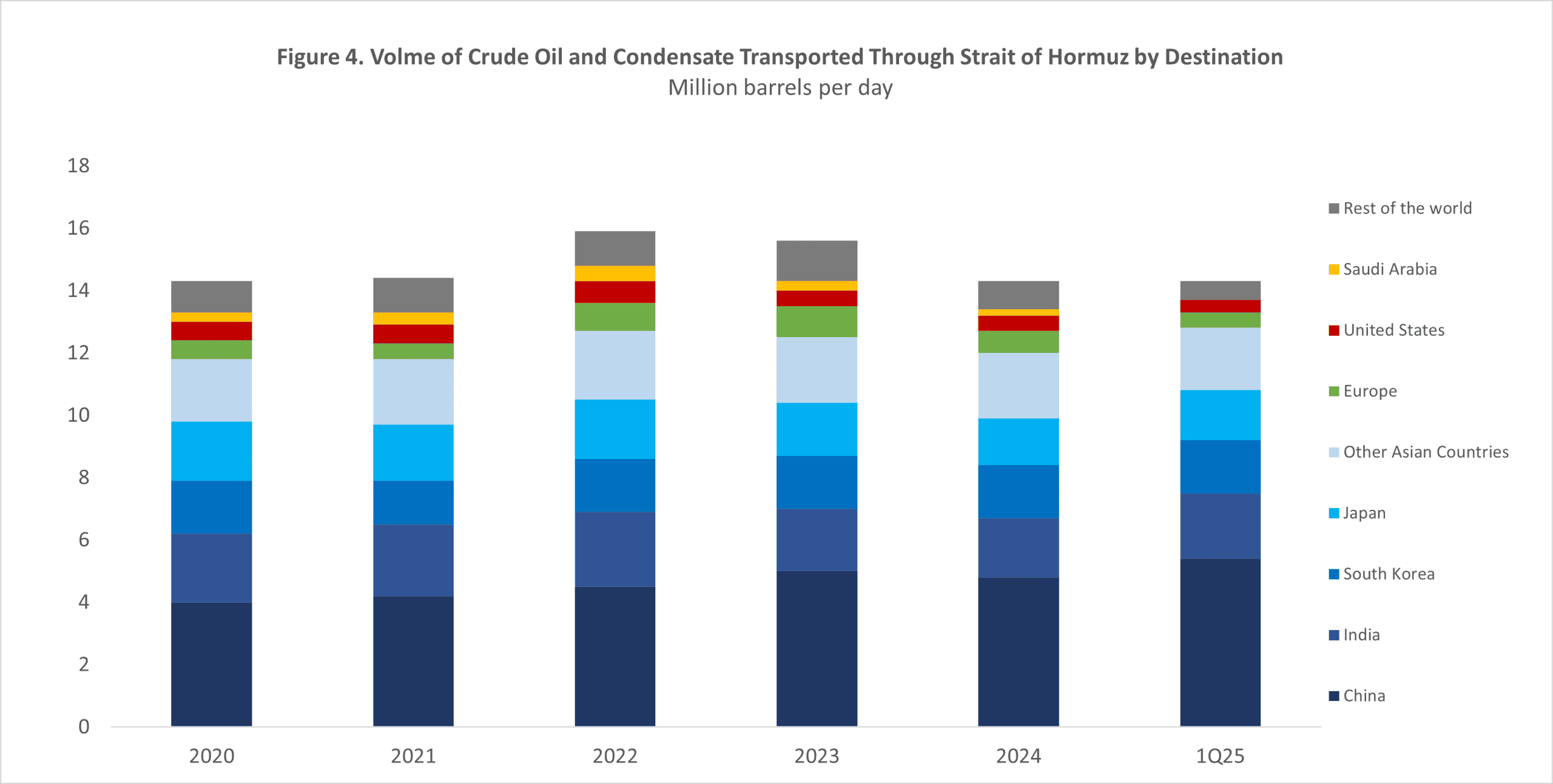
Additionally, prolonged conflicts and closure of the Strait of Hormuz will likely result in a global recession. As shown in Figure 4, major economies of the world such as China, India, South Korea, Japan, Europe, and the United States rely heavily on the crude oil shipping through the Strait of Hormuz, with China importing as much as almost 6 million b/d. In 2025, 17 percent of China’s oil imports came from Iran and Venezuela. The conflicts in the Gulf region and U.S. incursion into Venezuela in early 2026 essentially have cut off close to one fifth of China’s oil supply.
A hypothetical one-month closure of the Strait of Hormuz would lead to a vast gap of 600 million b/d of oil, which would be impossible to replace. Non-OPEC oil producing countries such as the United States does not have spare capacity to ramp up oil production quickly to meaningfully offset the large oil trade disruption in the Strait of Hormuz. Abrupt energy supply shocks to major economies will inevitably destabilize the broader global market, dampening both investment appetite and the economic outlook.
Source: U.S. Energy Information Administration
Implications for the U.S. Energy Market
The impact on the U.S. economy and energy market will depend on how the situation unfold. Several key factors are at play:
- Gasoline prices: It’s difficult to forecast the exact impact on U.S. gasoline prices. Experts estimate that a $100 per barrel of oil would translate into roughly $4 per gallon at the pump. To mitigate the impact of a drastic surge in oil prices, the U.S. government may authorize releases from the Strategic Petroleum Reserve (SPR) to stabilize domestic gasoline prices. As of February 20, 2026, the U.S. inventory in the SPR was approximately 415 million barrels.
- Investments in Venezuelan oil: U.S. military incursion into Venezuela in early January has opened up opportunities for U.S. oil and gas companies to invest in Venezuelan oil, though numerous significant challenges remain as detailed in a previous AAF analysis. Even if companies are going to invest in Venezuelan oil, it will take a long time for oil production to materialize. The Trump Administration is also working with Venezuela to ship between 30 to 50 million barrels of sanctioned oil to the United States, which could help alleviate the negative impact from the disruption in the Gulf.
- Energy affordability: Surging oil prices would significantly complicate the Trump Administration’s push for domestic energy affordability. This challenge is further compounded by the artificial intelligence data center boom, which is driving unprecedented energy demand across the country.
Looking Forward
While the U.S.-Israel military campaign against Iran is in its early stages, its ultimate impact on global energy markets hinges on the duration and scope of the conflict. If the disruptions in the Strait of Hormuz shift from a temporary standoff to a prolonged blockade, the resulting supply void will pose a serious threat to global markets. For the United States, there is also significant uncertainty ahead with the geopolitical volatility and domestic energy affordability challenges.
