Insight
January 17, 2025
Highlights of CBO’s January 2025 Budget and Economic Outlook
Executive Summary
- The Congressional Budget Office (CBO) has released its January 2025 Budget and Economic Outlook, which projects that federal debt held by the public will rise from 98 percent of gross domestic product (GDP) at the end of fiscal year (FY) 2024 to 100 percent of GDP by 2025, reach a new record of 107.2 percent of GDP by 2029, and continue to grow to 119 percent of GDP by 2035.
- Budget deficits will total 5.8 percent of GDP ($21.8 trillion) over the FY 2026 to 2035 budget window and will total 5.8 percent of GDP ($2.5 trillion) in 2035; spending will total 23.9 percent of GDP ($89.3 trillion) and revenue will total 18.1 percent of GDP ($67.5 trillion) over the next decade.
- Since CBO’s last baseline in June, the net effect of legislative, economic, and technical changes decreased projected deficits by $991 billion over the FY 2025 to 2034 period.
- CBO projects that economic growth and inflation will slow through 2026 and remain moderate thereafter.
Introduction
The Congressional Budget Office (CBO) has released its January 2025 Budget and Economic Outlook, which updates its June 2024 Budget and Economic Outlook to account for subsequent legislation and executive actions, recent trends in inflation, economic growth, interest rates, demographics, and other factors. Overall, the budget outlook has improved since June due entirely to economic changes, particularly an increase in individual income tax receipts that’s driven by higher estimates of taxable income in CBO’s economic forecast.
CBO’s projection of budget deficits over the fiscal year (FY) 2025 to 2034 period is $991 billion lower than CBO estimated in June and federal debt held by the public is projected to reach 117 percent of gross domestic product (GDP) by the end of 2034, over 5 percentage points lower than CBO’s June projection of 122 percent of GDP.
What’s Changed?
The budget outlook has improved since CBO’s June 2024 Budget and Economic Outlook. CBO now projects deficits to total $21.1 trillion over the FY 2025 to 2034 period, which is $991 billion below its June projection of $22.1 trillion. This improvement is the net effect of a $271 billion increase in projected deficits from legislative changes and a $1.3 trillion increase from technical changes that’s more than offset by a $2.5 trillion decrease in projected deficits from economic changes.
Legislative Changes
Of the $271 billion in projected deficit increases from legislative changes, $173 billion stems from an increase in projected mandatory spending. This includes the effect of the recently enacted Social Security Fairness Act that repealed the Windfall Elimination Provision (WEP) and the Government Pension Offset (GPO) for Social Security benefits. Under prior law, the WEP and the GPO would reduce Social Security benefits for retired or disabled workers and their spouses with fewer than 30 years of significant earnings from employment covered by Social Security if they also received pensions from employment not covered by Social Security. Repeal of the WEP and the GPO increased Social Security benefits for these beneficiaries and thus led CBO to increase its projections of mandatory spending. The temporary rescission of $20 billion of increased Internal Revenue Service (IRS) funding in the continuing resolution (CR) that’s currently funding the federal government partially offset this increase.
CBO revised its projection of discretionary spending down by $17 billion over the FY 2025 to 2034 period. This revision is the net result of a $958 billion decrease in projected defense discretionary spending and a $941 billion increase in projected nondefense discretionary spending. CBO’s projection of total defense spending was revised down to account for the interaction of the CR that’s currently funding the federal government (through March 14) and the statutory caps on discretionary spending established by the Fiscal Responsibility Act of 2023, as well as the fact that emergency defense funding for FY 2025 is much less than CBO projected in June. On the nondefense side, CBO increased its projection of total spending to reflect higher base and emergency nondefense funding. \
CBO reduced its projection of federal revenues by $70 billion due to legislative changes. This includes the temporary rescission of $20 billion of increased IRS funding in the current CR. CBO assumes the IRS will continue the enforcement activities that yield the largest returns, so as additional funds are rescinded, the amount of revenues lost from each dollar of rescinded funds increases. CBO also lowered its projection of revenues to account for a provision in the Federal Disaster Tax Relief Act of 2023 that eased limitations on deducting certain losses from federally declared disasters.
The remaining $44 billion of projected deficit increases from legislative changes is debt service costs.
Technical Changes
Of the $1.3 trillion in projected deficit increases from technical changes, $817 billion is due to higher projections of Medicaid spending. CBO revised its FY 2025 projection of Medicaid spending upward by $57 billion to reflect higher-than-anticipated Medicaid spending thus far. The $759 billion increase in projected Medicaid spending over the 2026 to 2034 period is driven by greater expected program spending due to an increase in the number of disabled people that are eligible for Supplemental Security Income (these people automatically qualify for Medicaid), higher use of prescription drugs, an uptick in expected coverage expansions under the Affordable Care Act, and projected growth in directed payments in Medicaid managed care. Another $66 billion comes from higher projections of Social Security spending due to an upward revision in CBO’s estimate of people over age 65, which in turn increased its estimate of Social Security beneficiaries. An additional $80 billion stems from increased projections of spending on the Supplemental Nutrition Assistance Program and child nutrition programs due to higher-than-anticipated enrollment in 2024. Spending on veterans’ services and benefits was revised upward by $35 billion to reflect the incorporation of actual outcomes in 2024 into CBO’s estimates. CBO decreased its estimate of Medicare spending by $194 billion and discretionary spending by $57 billion due to technical changes. It also decreased its estimate of revenues by $217 billion due to technical changes.
Other technical changes added $222 billion to projected deficits, largely due to the debt service effects of the technical adjustments CBO made to its projections.
Economic Changes
CBO expects economic changes to reduce projected deficits by $2.5 trillion over the FY 2025 to 2034 period. Of this amount, $2.2 trillion comes from higher revenue collections due to economic changes. This largely stems from higher projections of economic output and the components of taxable income in CBO’s economic forecast. In addition, higher asset values increased anticipated capital gains realizations, which increased CBO’s projections of individual and corporate income tax receipts, as well as the projected account balances and distributions from taxable retirement accounts. An upward revision in CBO’s projection of Federal Reserve remittances – due to lower projected near-term interest rates in CBO’s economic forecast – also reduced projected deficits. The remaining reduction in projected deficits comes from lower net projections of mandatory and discretionary spending and debt service costs.
The Budget Outlook by the Numbers
Revenues
CBO projects that total federal revenue collections will rise from 17.1 percent of GDP ($5.2 trillion) in FY 2025 to 18.3 percent of GDP ($8.0 trillion) by 2035. For comparison, the 50-year historical average for revenue is 17.3 percent of GDP. Over the 2026 to 2035 period, revenue will total 18.1 percent of GDP ($67.5 trillion). Specifically, individual income tax revenue will total 9.9 percent of GDP ($36.9 trillion), payroll tax revenue will total 5.9 percent of GDP ($22.1 trillion) corporate tax revenue will total 1.3 percent of GDP ($4.5 trillion), and other revenue collections (including excise taxes and customs duties) will total 1.0 percent of GDP ($3.8 trillion).
Spending
CBO estimates that total federal spending will rise from 23.3 percent of GDP ($7.0 trillion) in FY 2025 to 24.0 percent of GDP ($10.6 trillion) by 2035. For comparison, the 50-year historical average for spending is 21.1 percent of GDP. Over the 2026 to 2035 period, spending will total 23.9 percent of GDP ($89.3 trillion). Entitlement, or mandatory, spending, will total 14.6 percent of GDP ($54.4 trillion), or 61 percent of all federal spending. Discretionary (defense and nondefense) spending, meanwhile, will total 5.7 percent of GDP ($21.1 trillion), or 24 percent of all federal spending.
Deficits
CBO projects that the United States will run a unified federal budget deficit of $1.9 trillion in FY 2025, or 6.2 percent of GDP (in June, CBO projected the 2025 deficit would total $1.9 trillion, or 6.7 percent of GDP). This follows the $1.8 trillion (6.4 percent of GDP) deficit recorded in 2024 and the $1.7 trillion (6.3 percent of GDP) deficit recorded in 2023. CBO expects deficits to total $21.8 trillion (5.8 percent of GDP) over the 2026 to 2035 period, eclipsing $2 trillion by 2030 and ultimately growing to $2.5 trillion (5.8 percent of GDP) by 2035.
Interest Payments
Interest payments on the national debt will nearly double, rising from $952 billion in FY 2025 to $1.8 trillion by 2035. Interest payments are projected to increase by roughly one-quarter as a share of federal outlays, rising from about 14 percent of total federal spending in 2025 to nearly 17 percent of federal spending by 2035. And at a projected cost of $952 billion in 2025, interest payments are projected to surpass the $942 billion the federal government is projected to spend on Medicare this year and the $859 billion it’s projected to spend on national defense. As a share of the economy, interest will reach a new record of 3.16 percent of GDP in 2025 (the prior record was 3.10 percent in 1991) and grow further to 4.1 percent of GDP by 2035.
Debt Held by the Public
Borrowing from the public is projected to increase as a share of the economy under current law, reaching 118.5 percent of GDP by the end of FY 2035. In 2029, debt is expected to reach its highest level as a share of GDP – 107.2 percent – in U.S. history, surpassing the 106.1 percent of GDP from 1946 following the end of World War II (in June, CBO projected debt-to-GDP would surpass the prior record two years earlier, in 2027). In nominal dollars, debt held by the public will increase by $23.2 trillion, from $28.8 trillion today to $52.1 trillion by the end of 2035.
Comparing CBO’s January 2025 and June 2024 Budget Projections
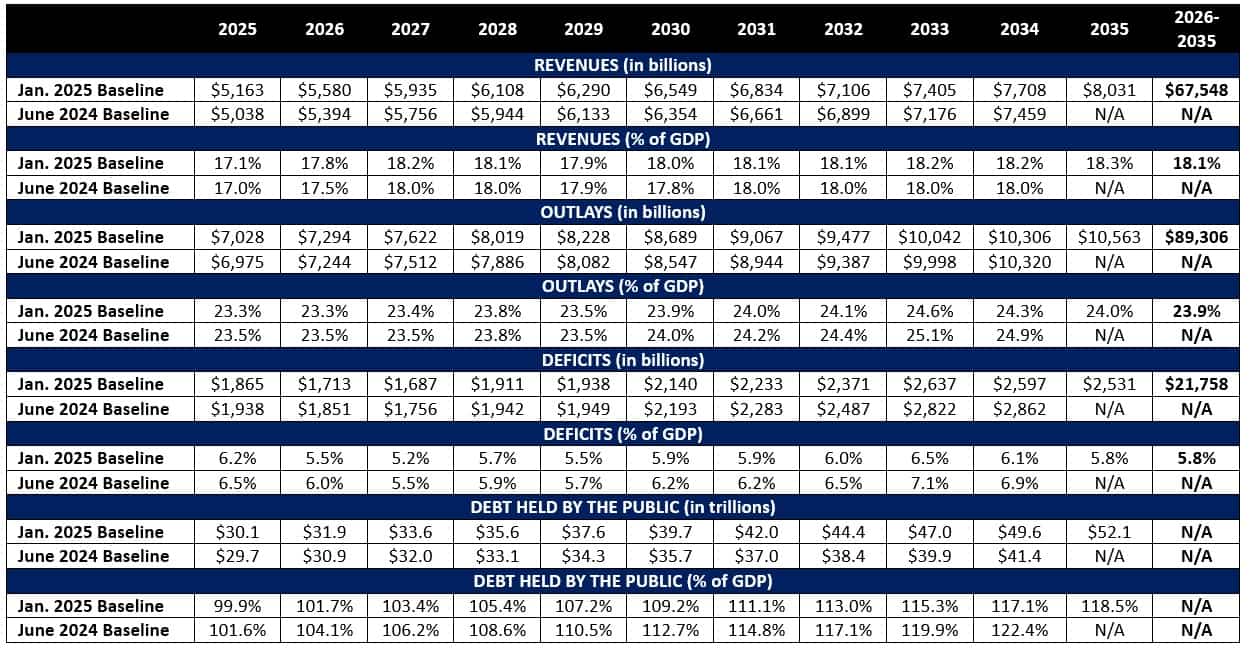
Source: Congressional Budget Office.
The Economic Outlook by the Numbers
CBO expects Consumer Price Index (CPI) inflation on a fourth-quarter over fourth-quarter basis to total 2.3 percent this year, rise slightly to 2.4 percent in 2026, and then fall to 2.3 percent in 2027 and further to 2.2 percent in 2029. Over the next decade, CBO expects inflation to average 2.3 percent per year. CBO expects its projected slowdown in inflation to be accompanied by an increase in the unemployment rate, from 4.2 percent today to 4.3 percent by the end of 2025, and to 4.4 percent through the end of 2032. From there, CBO expects the unemployment rate to fall slightly back to 4.3 percent by the end of 2033 and beyond.
CBO forecasts that real GDP growth on a fourth-quarter over fourth-quarter basis will slow to 1.9 percent this year, 1.8 percent in 2026 and 2027, dip to 1.7 percent in 2028, and then tick slightly back up to 1.8 percent in 2029 and remain at that level through 2024. CBO expects real GDP growth to dip to 1.7 percent again in 2035. CBO forecasts that the average interest rate on 10-year Treasury notes will total 4.1 percent this year, fall to 3.9 percent and remain there through 2030, and then decline slightly to 3.8 percent in 2031 and beyond. In its forecast, CBO assumes that the Federal Reserve will continue cutting interest rates through the end of 2026.
Comparing CBO’s January 2025 and June 2024 Economic Projections

Source: Congressional Budget Office.