Insight
March 27, 2025
Highlights of CBO’s March 2025 Long-term Budget Outlook
Executive Summary
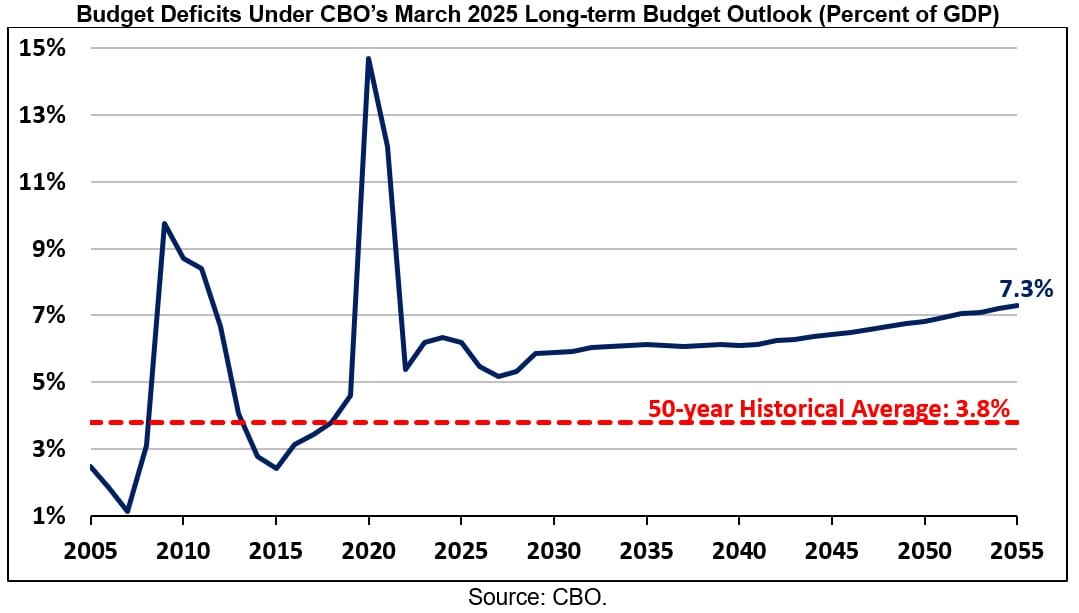
- The Congressional Budget Office has released its March 2025 Long-term Budget Outlook that projects federal debt held by the public will rise from 100 percent of gross domestic product (GDP) at the end of fiscal year (FY) 2025 to 156 percent of GDP by the end of 2055 under current law; meanwhile, budget deficits will grow rapidly, rising from 6.2 percent of GDP in FY 2025 to 7.3 percent of GDP by 2055.
- Spending will continue to outpace revenue, rising from 23.3 percent of GDP in 2025 to 26.6 percent of GDP by 2055, while revenue will grow from 17.1 percent of GDP to 19.3 percent of GDP.
- The long-term budget outlook has improved only mildly since March, largely due to a combination of lower spending and higher revenue projections.
Introduction
The Congressional Budget Office (CBO) has released its March 2025 Long-term Budget Outlook, which updates its March 2024 Long-term Budget Outlook to account for subsequent legislation and executive actions and recent trends in inflation, economic growth, interest rates, demographics, and other factors.
CBO’s projected 7.2 percent of gross domestic product (GDP) deficit in fiscal year (FY) 2054 is 1.3 percentage points lower than its March estimate of 8.5 percent of GDP. Federal debt held by the public is projected to reach 154 percent of GDP by the end of 2054, 12 percentage points lower than CBO’s March projection of 166 percent of GDP.
Overall, however, the long-term budget outlook has only mildly improved, largely due to a combination of lower spending and higher revenue projections.
The Long-term Budget Outlook by the Numbers

Revenue
CBO projects that total federal revenue collections will rise from 17.1 percent of GDP ($5.2 trillion) in FY 2025 to 18.3 percent of GDP ($8.0 trillion) in 2035, 18.9 percent of GDP ($11.9 trillion) in 2045, and 19.3 percent of GDP ($17.1 trillion) in 2055. For comparison, the 50-year historical average for revenue is 17.3 percent of GDP.
Spending
CBO projects that total federal spending will rise from 23.3 percent of GDP ($7.0 trillion) in FY 2025 to 24.4 percent of GDP ($10.7 trillion) in 2035, 25.3 percent of GDP ($15.9 trillion) in 2045, and 26.6 percent of GDP ($23.5 trillion) in 2055. For comparison, the 50-year historical average for spending is 21.1 percent of GDP.
The projected growth in long-term spending is driven by rising interest payments on the national debt and growing Social Security and health care spending. CBO estimates that interest costs will increase by more than two-thirds over the next three decades, growing from 3.2 percent of GDP ($952 billion) in FY 2025 to 5.4 percent of GDP ($4.8 trillion) by 2055. Meanwhile, spending on Social Security and the major health care programs (Medicare, Medicaid, the Children’s Health Insurance Program, and Affordable Care Act premium tax credits) will grow from 11.0 percent of GDP ($3.3 trillion) in 2025 to 14.2 percent of GDP ($12.5 trillion) by 2055. Other spending, including smaller mandatory programs and defense and nondefense discretionary programs, will fall as a share of the economy, from 9.1 percent of GDP in 2025 to 7.0 percent of GDP by 2055.

Deficits
CBO projects that the budget deficit will grow from 6.2 percent of GDP ($1.9 trillion) in FY 2025 to 6.1 percent of GDP ($2.7 trillion) in 2035, 6.4 percent of GDP ($4.0 trillion) in 2045, and 7.3 percent of GDP ($6.4 trillion) in 2055. For comparison, the budget deficit has averaged 3.8 percent of GDP over the past 50 years.
At 7.3 percent of GDP, the deficit in FY 2055 will be nearly double the 50-year average and higher than at any time in modern history outside of World War II, the Great Recession, and the COVID-19 pandemic.
Debt
CBO projects that federal debt held by the public will rise from 100 percent of GDP at the end of FY 2025 to a new record of 107 percent of GDP by 2029. It will continue to rise to 118 percent of GDP by the end of 2035, 136 percent of GDP by 2045, and 156 percent of GDP by 2055. For comparison, debt held by the public has averaged 50 percent of GDP over the past 50 years, so debt-to-GDP in FY 2055 will be over three-times the historical average.
Between 2025 and 2055, debt will increase by $108.1 trillion, from $30.1 trillion to $138.2 trillion.

Trust Funds
CBO projects that the Highway Trust Fund will exhaust its reserves by FY 2028, the Social Security Old-Age and Survivors Insurance (OASI) trust fund by 2033, and the Medicare Hospital Insurance trust fund by 2052. The Social Security Disability Insurance (SSDI) trust fund will remain solvent at least through FY 2055. Assuming dedicated revenue is reallocated in the years between OASI and SSDI insolvency, CBO projects that the theoretically combined Social Security trust funds will be insolvent by 2034.
What’s Changed?
The long-term budget outlook has only mildly improved since CBO’s March 2024 Long-term Budget Outlook. CBO now projects the budget deficit to grow to 7.2 percent of GDP by the end of FY 2054, which is 1.3 percentage points below its March projection of 8.5 percent of GDP. Meanwhile, federal debt held by the public is projected to rise to 154 percent of GDP by the end of 2054, 12 percentage points below the 166 percent of GDP that CBO projected in March.

CBO’s lower projections of long-term deficits and debt are largely due to a combination of lower spending and higher revenue projections. CBO estimates that in FY 2054 spending will be 0.9 percentage points lower and revenue 0.5 percentage points higher. The lower spending projection is driven by a 0.2 percentage point reduction in spending on the major health care programs, a 0.1 percentage point decrease in spending on other mandatory programs, and, most significantly, a 1 percentage point decrease in net interest payments. These figures are slightly offset by a 0.2 percentage point increase each in projected Social Security and discretionary spending.