Insight
July 2, 2021
Highlights of CBO’s Update to the Budget and Economic Outlook for 2021-2031
Executive Summary
- According to new projections from the Congressional Budget Office (CBO), the debt will eclipse the highest levels in U.S. history by the end of fiscal year 2031.
- Since CBO’s last baseline update in February, Congress enacted the American Rescue Plan, a $1.8 trillion fiscal package, while rising vaccinations rates have allowed for substantial reopening of the U.S. economy.
- The CBO outlook reflect both developments: the federal budget has worsened in nominal terms (inclusive of 2021), but since the economy has improved to a greater degree relative to CBO’s previous estimate, the fiscal outlook has slightly improved when measured as a share of gross domestic product.
Introduction
The Congressional Budget Office (CBO) released an update to its periodic budget and economic outlook, which provides Congress with 10-year budget and economic projections. These updates reflect the budgetary and economic effects of the American Rescue Plan (ARP), a $1.8 trillion policy initiative, as well as the improved pace of economic activity following increased uptake and proliferation of vaccines. The outlook reflects a clear picture for both the U.S. fiscal and economic trajectory: While poised to see an increasingly rapid economic recovery, the United States is grappling with fiscal challenges that will see it become more indebted than ever before in its history.
What’s Changed?
The July 2021 CBO budget outlook is, in nominal terms, worse than CBO’s projections released in February, primarily due to the ARP, which CBO estimated would add $1.8 trillion to baseline deficits. CBO has improved its economic outlook, however. Stronger economic growth, all else equal, leads to higher tax collections, and lower expenditures on many transfer programs. CBO has also marked up its inflation projections, which is reflected in its estimates for interest rates. Given the size of the U.S. debt, the federal budget is increasingly exposed to interest rate risk, which is reflected in growing debt service costs. While CBO typically decomposes economic, legislative, and technical changes in its baseline updates, the agency will release those details in a follow-on update later this month.
The Budget Outlook: By the Numbers
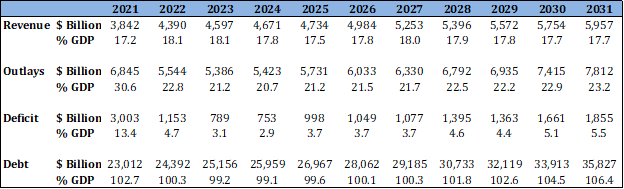
Taxes: By the end of the 10-year budget window, tax revenues will amount to 17.7 percent of gross domestic product (GDP). Tax revenues will average 17.8 percent of GDP over the next 10 years, well above the 17.3 percent historical average. CBO previously estimated that tax revenues in 2021 would amount to 16 percent of GDP, but as CBO notes, tax collections were significantly more robust.
Spending: CBO estimates that, by the end of the budget window, overall spending will total 23.2 percent of GDP, over 2.5 percentage points higher than the historical average of 20.6 percent. Entitlement, or mandatory, spending will continue to remain roughly two-thirds of federal outlays over the next decade. It comprised 70 percent of federal outlays in 2021, up from 56 percent in 2011 and 35 percent in 1971.
Deficits: The federal budget deficit is estimated to be $3 trillion in 2021, or 13.4 percent of GDP. Prior to the $3.1 trillion deficit record in 2020, the highest nominal deficit ever previously recorded was $1.4 trillion in 2009. As a share of GDP, the 2021 deficit of 13.4 percent of GDP would be the highest observed other than last year and those of World War II. The deficit will average 4.1 percent of GDP over the 2022-2031 period and will fall below $1 trillion in only one of those years.
Interest Payments: Interest payments on the debt will reach $910 billion in 2031. Interest payments are projected to more than double as a share of federal outlays, rising from 5 percent of total federal spending in 2021 to over 11 percent of federal spending in 2031.
Debt Held by the Public: Borrowing from the public is projected to increase as a share of the economy under current law, reaching 106.4 percent of GDP in 2031. The debt surpassed 100 percent of the economy in 2020, the first time since 1946. By the end of the budget window, the debt is expected to reach the highest level as a share of GDP in U.S. history – surpassing the 106.1 percent record from 1946 following the end of World War II.
The Economic Outlook: By the Numbers
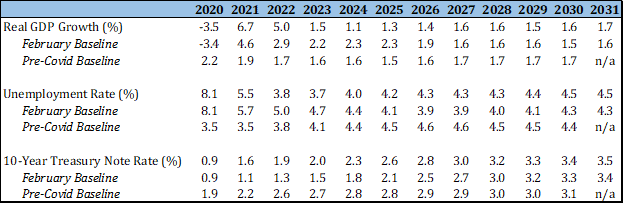
CBO projects real GDP growth to average 2.0 percent over the budget window. It forecasts that unemployment will return to pre-pandemic levels in 2022 decade, although it estimates that unemployment will be slightly elevated by the end of the decade compared with its prior forecast. CBO has significantly increased its projections for interest rates compared to its prior forecast.
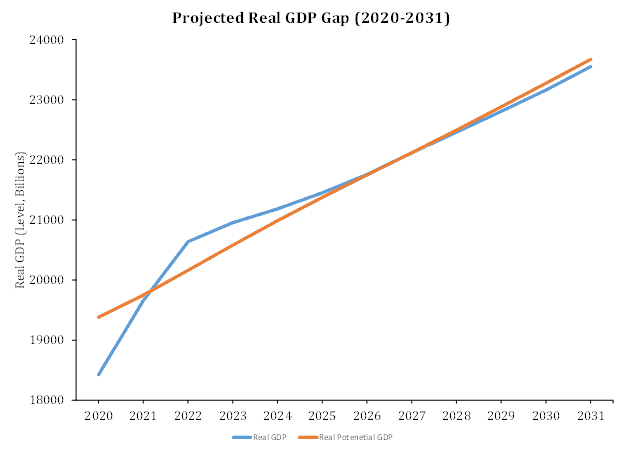
Under CBO’s most recent projections, real GDP is projected to exceed pre-pandemic levels in mid-2021 and to remain higher than that projected prior to the pandemic and in CBO’s most recent prior outlook.
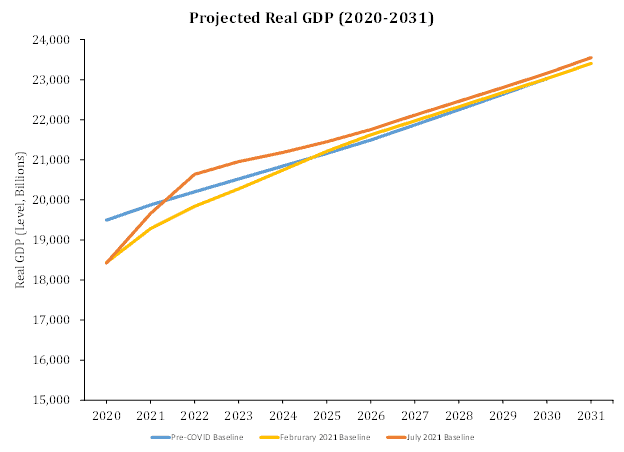
CBO also projects that real GDP is currently in excess of potential GDP and will remain so until 2026. In CBO’s prior estimate, CBO estimated that the economy would remain below potential until 2025 – at which point it forecast that real GDP would exceed potential GDP until 2029 before declining.
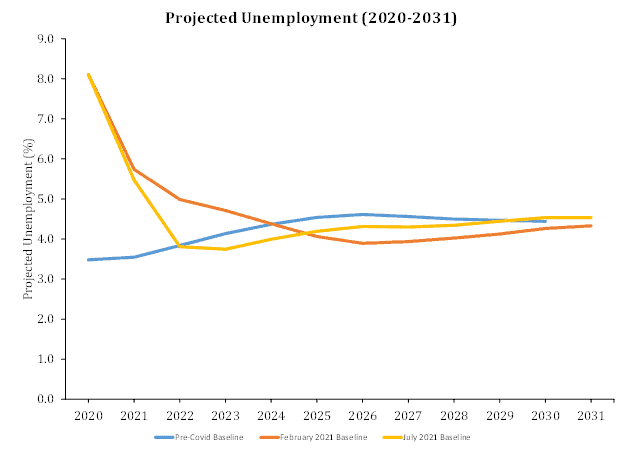
The most recent CBO forecast reflects an improved near-term outlook for unemployment. According to CBO, unemployment will decline to levels forecast prior to the pandemic by 2022 and, importantly, remain below its pre-pandemic forecast until the end of the decade. By 2024, however, CBO estimates that unemployment will exceed levels forecast in its most recent prior estimates.