Insight
April 6, 2026
Highlights of President Trump’s FY 2027 Budget
Executive Summary
- The Trump Administration has released the president’s budget for fiscal year (FY) 2027 budget, which details its proposals for defense and nondefense discretionary spending for FY 2027; the budget does not include any proposed changes to mandatory spending or revenue, nor does it include any estimates about how its proposals would affect federal deficits or debt over the next decade.
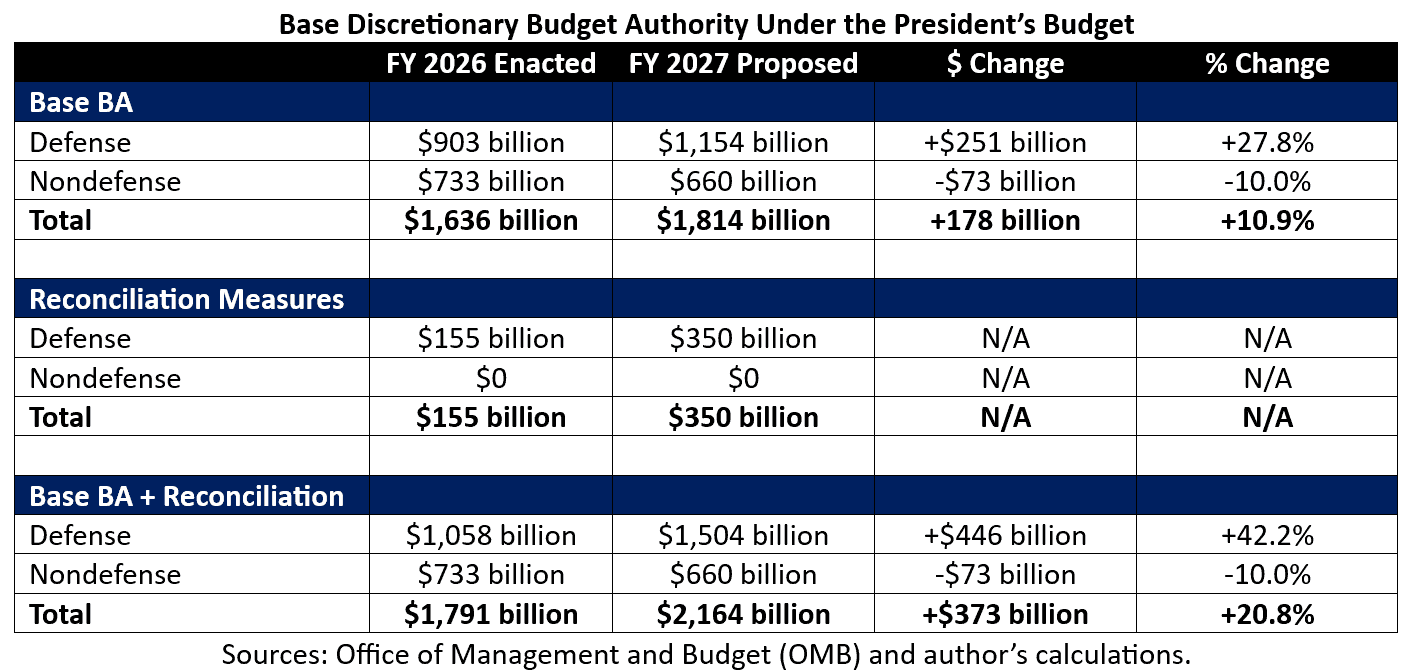
- The budget proposes $1.81 trillion of base discretionary budget authority (BA) for FY 2027, including $1.15 trillion of base defense BA and $660 billion of base nondefense BA.
- After including the effects of $350 billion of defense funding the administration assumes will be enacted by Congress through a budget reconciliation package, the budget proposes $2.16 trillion of base discretionary BA, including $1.5 trillion of base defense BA and $660 billion of base nondefense BA.
- The proposed spending increases are concentrated in the Departments of War, Energy, Justice, Transportation, and Veterans Affairs; most other departments and agencies would see their funding decreased relative to their FY 2026 enacted levels.
- The budget also includes a set of economic projections that are more optimistic than those from other forecasters.
Introduction
The Trump Administration has released the president’s budget for fiscal year (FY) 2027 which details its proposals for defense and nondefense discretionary spending for FY 2027. The budget does not include any proposed changes to mandatory spending or revenue, nor does it include any estimates about how its proposals would affect federal deficits or debt over the next decade.
The president’s budget proposes $1.81 trillion of base discretionary budget authority (BA), which is a $178 billion (10.9 percent) increase from the FY 2026 enacted level of $1.64 trillion. The budget proposes $1.15 trillion of base defense BA and $660 billion of base nondefense BA. The base defense request is $251 billion (27.8 percent) larger than the FY 2026 enacted level of $903 billion and the base nondefense request is $73 billion (10.0 percent) smaller than the FY 2026 enacted level of $733 billion.
The president’s budget requests that $350 billion of supplemental base defense funding for FY 2027 be enacted by Congress in a budget reconciliation package. In FY 2026, the One Big Beautiful Bill provided $155 billion of supplemental defense funding. As a result, total base defense funding is $1.06 trillion for FY 2026 and the president’s budget proposes $1.50 trillion for FY 2027 – a $446 billion (42.2 percent) increase.
The proposed spending increases are concentrated in the Departments of War, Energy, Justice, Transportation, and Veterans Affairs, which get 43.7 percent ($440.9 billion), 1.8 percent ($0.9 billion), 13.0 percent ($4.7 billion), 6.2 percent ($1.6 billion), and 8.7 percent ($11.7 billion) increases, respectively. The increased Department of War funding would go toward developing the Golden Dome, expanding U.S. shipbuilding capacity, funding the F-47 fighter jet, boosting servicemember pay by 5-7 percent depending on rank, and making investments in critical munitions, critical minerals, and artificial intelligence, among other things. The additional Department of Energy funding would go toward refilling the Strategic Petroleum Reserve, strengthening nuclear and energy-water security, and boosting domestic production of critical minerals, among other things. The increased Department of Justice funding would be used to combat violent crime in the nation’s cities (efforts have already been undertaken in Washington, D.C. and Memphis), hire 300 additional Drug Enforcement Administration agents, support the newly established National Fraud Division, fund the rebuilding of Alcatraz, and provide additional resources to the Federal Bureau of Investigation, among other things. The additional Department of Transportation funding would go toward enhancing Federal Aviation Administration facilities and operations, Nationally Significant Multimodal Freight and Highway Projects grants, and enhanced shipbuilding and port infrastructure. Finally, the increased Department of Veterans Affairs funding would go toward health care services and facilities for veterans and electronic health record modernization at Veterans Affairs.
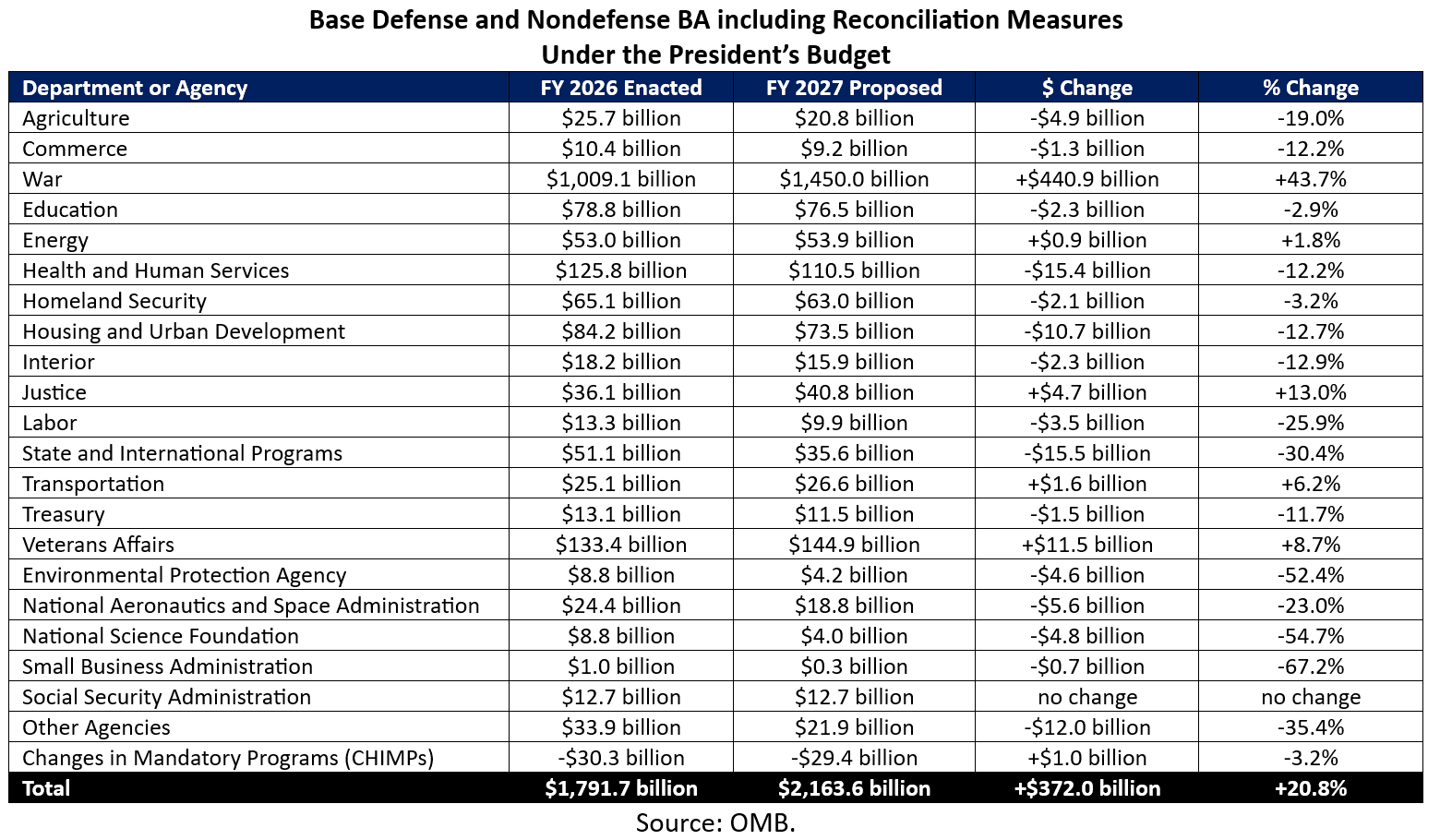
Almost all other departments and agencies would see their funding decreased relative to their FY 2026 enacted level due to consolidations and the elimination of programs within the agency or department. For example, the 30-percent reduction in Department of State and international programs funding would come from eliminating Food for Peace and cutting funding for the National Endowment for Democracy, international disaster assistance, migration and refugee assistance, global health programs, and international organizations. The nearly 26-percent reduction in Department of Labor funding would come from eliminating Job Corps, the Senior Community Service Employment Program, and reforming worker protection agencies and other entities within the department.
The 19-percent decrease in Department of Agriculture funding comes from reducing National Institute of Food and Agriculture Formula Grants, eliminating the Rural Business Service, the Agricultural Marketing Service, the McGovern-Dole Food for Education Program, and reforming Community Facilities Grant Earmarks.
The nearly 13-percent reduction in Department of Housing and Urban Development funding would come from transitioning federal rental assistance programs to state-based formula grants, eliminating the Community Development Block Grant program, the HOME Investment Partnerships Program, the Continuum of Care program, the Housing Opportunities for Persons with AIDS program, the Native Hawaiian Housing Block Grant program, the Fair Housing Initiatives Program, and the Pathways to Removing Obstacles Housing Program, among other changes.
The more than 12-percent decrease in Department of Health and Human Services funding would come from eliminating the Low-Income Home Energy Assistance Program and the Community Services Block Grant program, reducing and reforming spending for the Refugee and Unaccompanied Alien Children Programs, and restructuring the National Institutes of Health, among other changes.
On the agency front, the over 67-percent reduction in Small Business Administration funding would come from eliminating several entrepreneurial development programs, including the Service Corps of Retired Executives program and the Community Navigator Pilot Program, as well as imposing an administrative fee on lenders participating in the agency’s guaranteed business lending programs.
Economic Assumptions in the President’s FY 2027 Budget
A budget’s economic assumptions underscore every estimate it provides. While the president’s budget does not propose any changes to mandatory spending or revenues, it does propose changes to FY 2027 discretionary spending. The budget’s projections of discretionary spending over the subsequent nine years (FY 2028–2036) are based on a set of economic assumptions that are overall more optimistic than those of other forecasters.
On a fourth-quarter over fourth-quarter basis, the budget forecasts 3.5-percent real gross domestic product (GDP) growth in 2026, 3.1 percent in 2027 through 2029, 3.0 percent in 2030, and 2.9 percent thereafter. Meanwhile, the Congressional Budget Office (CBO) estimates 2.2-percent real GDP growth in 2026 and 1.8 percent growth each year thereafter, and the Federal Reserve forecasts 2.4-percent growth in 2026, 2.3 percent in 2027, 2.1 percent in 2028, and 2.0 percent each year thereafter.
The budget estimates inflation, as measured by the Consumer Price Index (CPI) on a fourth-quarter over fourth-quarter basis, would fall from 2.4 percent today to 2.3 percent by the end of the year. CPI inflation would remain at 2.3 percent in 2027 before declining to 2.2 percent in 2028 and remaining at that level each year thereafter. CBO forecasts 2.8-percent CPI inflation in 2026, 2.4 percent in 2027, and 2.3 percent in 2028 and beyond. The Federal Reserve’s preferred measure of inflation – the Personal Consumption Expenditures (PCE) price index – is projected to be 2.7 percent in 2026 and 2.2 percent in 2027. The Federal Reserve expects PCE inflation to fall to its 2.0 percent target in 2028 and remain at that level thereafter.
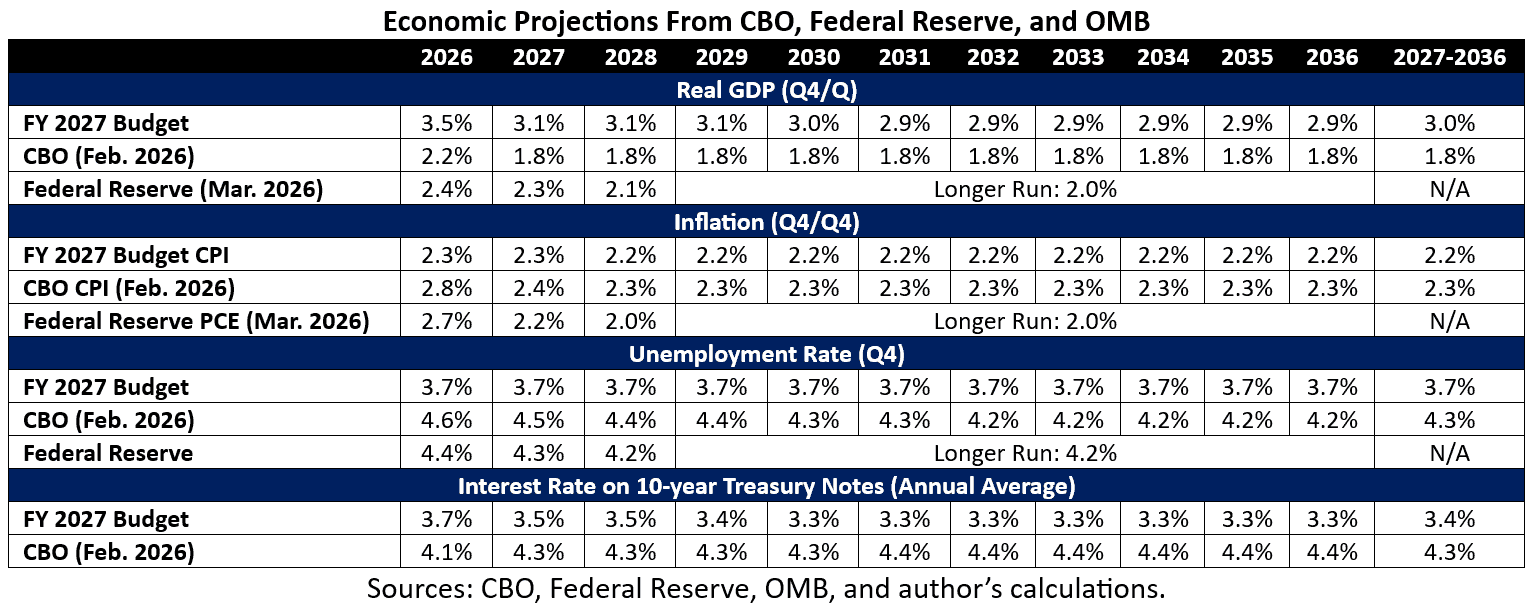
OMB expects the unemployment rate to fall from 4.3 percent today to 3.7 percent by the end of this year and remain at that level each year thereafter. CBO expects unemployment to tick up to 4.6 percent by the end of this year, fall to 4.5 percent in 2028, and then stabilize at 4.2 percent by the end of 2032.
Last, under the president’s budget, the average interest rate on 10-year Treasury notes is projected to average 3.7 percent in 2026 and average 3.4 percent over the subsequent decade. CBO estimates an average interest rate of 4.1 percent in 2026 and 4.3 percent over the 2027–2036 period.