









Insight
April 8, 2026
Lessons From the EU CBAM: Challenges of Measuring Product-level Carbon Emissions
Executive Summary
- To comply with the European Union’s (EU) Carbon Border Adjustment Mechanism (CBAM)—an import tax aimed at equalizing carbon costs for domestic and foreign producers—U.S. exporters can choose to either 1) measure and report their products’ actual emissions, a complex and costly process; or 2) use the default carbon-intensity values provided by the EU, for which they are charged a premium.
- To help ensure U.S. exporters are treated fairly, Congress recently directed the Department of Energy (DOE) to conduct in one year a carbon-intensity study on U.S. and foreign products; notably, the EU took more than two years to produce a similar report, yet it has multiple shortcomings including methodological complexity and a significant data gap with more than 60 percent of the country-product specific data missing.
- This insight outlines the likely challenges DOE will face in attempting to produce a credible carbon-intensity study in the directed time frame, thus putting in question whether U.S. exporters will be able to reference these results before the next tax deadline.
Introduction
To comply with the European Union’s (EU) Carbon Border Adjustment Mechanism (CBAM)—an import tax aimed at equalizing carbon costs for domestic and foreign producers—U.S. exporters can choose to either 1) measure and report their products’ actual emissions, a complex and costly process; or 2) use the default carbon-intensity values provided by the EU, for which they are charged a premium.
To help ensure U.S. exporters are treated fairly, Congress recently directed the Department of Energy (DOE) to conduct in one year a carbon-intensity study on U.S. and foreign products.
Notably, the EU took more than two years to produce a similar report, yet it has multiple shortcomings including methodological complexity and a significant data gap with more than 60 percent of the country—product—specific data missing.
This insight outlines the likely challenges DOE will face in attempting to produce a credible carbon-intensity study in the directed time frame, thus putting in question whether U.S. exporters will be able to reference these results before the next tax deadline.
Overview of the EU CBAM
The EU CBAM is a key regulatory component of the “Fit for 55” package, a suite of policies designed to reduce EU emissions by 55 percent below 1990 levels by 2030. As an extension of the EU Emissions Trading System (ETS)—a carbon pricing policy designed to encourage emissions reduction in the bloc, the CBAM is designed to ensure that imported goods over a threshold of 50 metric tons (the total mass of imports within a year) face the same carbon price as domestic products do under the ETS. The goal is to level the playing field between EU and foreign producers competing to sell goods to EU consumers. The policy covers specific goods under six sectors: cement, aluminum, fertilizer, iron and steel, hydrogen, and electricity.
The CBAM policy is aimed at replacing the existing free allowances under the ETS, which exempt some EU producers from paying the ETS carbon price to preserve their competitiveness. The CBAM policy will be phased in as the free allowances are phased out. After a 2023—2025 transitional phase, the EU CBAM started its operational phase in 2026. American Action Forum’s previous insight provides a detailed analysis of the policy.
Measuring product-level emissions associated with the imported goods is critical for importers to calculate the levy they should pay to comply with the regulation.
Challenges of Measuring Product-level Emissions Under the EU CBAM
To calculate the total costs an importer of covered goods would be subject to under the EU CBAM, at least three data points are required:
- Total volume of the imported goods.
- Carbon emissions associated with the goods.
- Qualified free allowances if the imported products were produced within the EU.
A highly simplified formula to derive the value of the required emissions certificates is as follows:
Total imports costs under CBAM = (A* B) – C
The covered carbon emissions associated with an imported product are arguably the most challenging data required to comply with the EU CBAM. This is because unlike the volume of imported goods, carbon emissions are not easily measurable or readily observable.
The EU regulator gives importers two options to estimate the emissions embedded in the imported goods:
- Actual emissions: Importers work with their suppliers in foreign jurisdictions to measure and report the covered emissions, which are subject to verification by independent entities certified by the EU regulator.
- Default emission values: Importers can use the default emissions values published by the European Commission if “the actual emissions cannot be adequately determined.” Yet the default values are designed to be phased-in and have punitive mark-up, aimed at encouraging importers to report actual emissions. The mark-up rate is 10 percent in 2026, 20 percent in 2027, and 30 percent in 2028.
The EU published a 2400-page official document of default product-level carbon-intensity values on December 31, 2025, one day before the operational phase of the regulation started. The large file includes 260 products under the classification of the European Combined Nomenclature (CN) code across five of the covered sectors: cement, fertilizer, hydrogen, aluminum, and iron and steel. Electricity imports were excluded from this file despite being a covered sector, because embedded emissions for electricity imports were calculated by a separate method. The values cover 119 jurisdictions for direct emissions (generated directly on a manufacturing facility) and indirect emissions (embedded in purchased electricity for onsite production).
The European Commission undertook an ambitious task to assign product-level emission values to the covered goods produced in non-EU jurisdictions. There are several problems with the published default values:
- Methodological complexity: The default values represent the average emission intensity of each exporting country for a particular covered product. Various factors are considered in calculating the values, such as prevailing energy sources and industrial processes. For example, coal-fired power is significantly more carbon intensive than solar-based electricity. Steel produced through an electric arc furnace is much cleaner than via a traditional blast furnace. It’s a massive task to estimate the direct and indirect carbon emissions generated in the production processes for hundreds of products across dozens of countries.
- Data availability: According to the CBAM legislation, reliable and publicly available data is required to determine the values. Among the 30,940 possible jurisdiction-product crosstabs (260 products * 119 jurisdictions), 19,547 crosstabs are not listed in the data. In other words, more than 60 percent of the total jurisdiction-product crosstabs are missing from the official default values document. This speaks to the immense challenges of assigning product-level carbon–intensity values to numerous origins of jurisdictions. Notably, this does not count the cases where product codes are listed under a specific jurisdiction, but the default values are missing. Particularly, 95 out of the 119 jurisdictions have at least one product that has a missing default value. Based on the document, if a default value of a product from a specific jurisdiction is missing, it can be substituted by the corresponding product value under the “Other Countries and Territories” section.
- Discrepancy compared to actual emissions: Some experts believe that default values are intentionally designed to be higher than actual emission values to encourage importers to measure and report actual emissions. Politico reported, however, that some EU industries argue the default values are too low for some countries: “some steel products from China, Brazil and the United States have much lower assumed emissions than equivalent products made in the EU.”
- No product-level emissions data for EU products: The published default values do not include any data for EU member states. This is because EU CBAM does not require EU producers to measure, report, or verify their product-level emissions data. While the data is not necessary for collecting the import levy, the lack of EU product-level data makes it difficult to compare domestic producers’ carbon performance against foreign producers. This makes the default values seem opaque, as the regulation uses the carbon-intensity data of the worst performing EU ETS manufacturing facilities for a particular product in cases where reliable data for an exporting country cannot be determined for the same product.
Table 1 shows a weighted index of the five EU CBAM industries’ carbon intensity across the United States, Organisation for Economic Co-operation and Development (OECD) member countries, top U.S. trading partners, and the rest of the world.
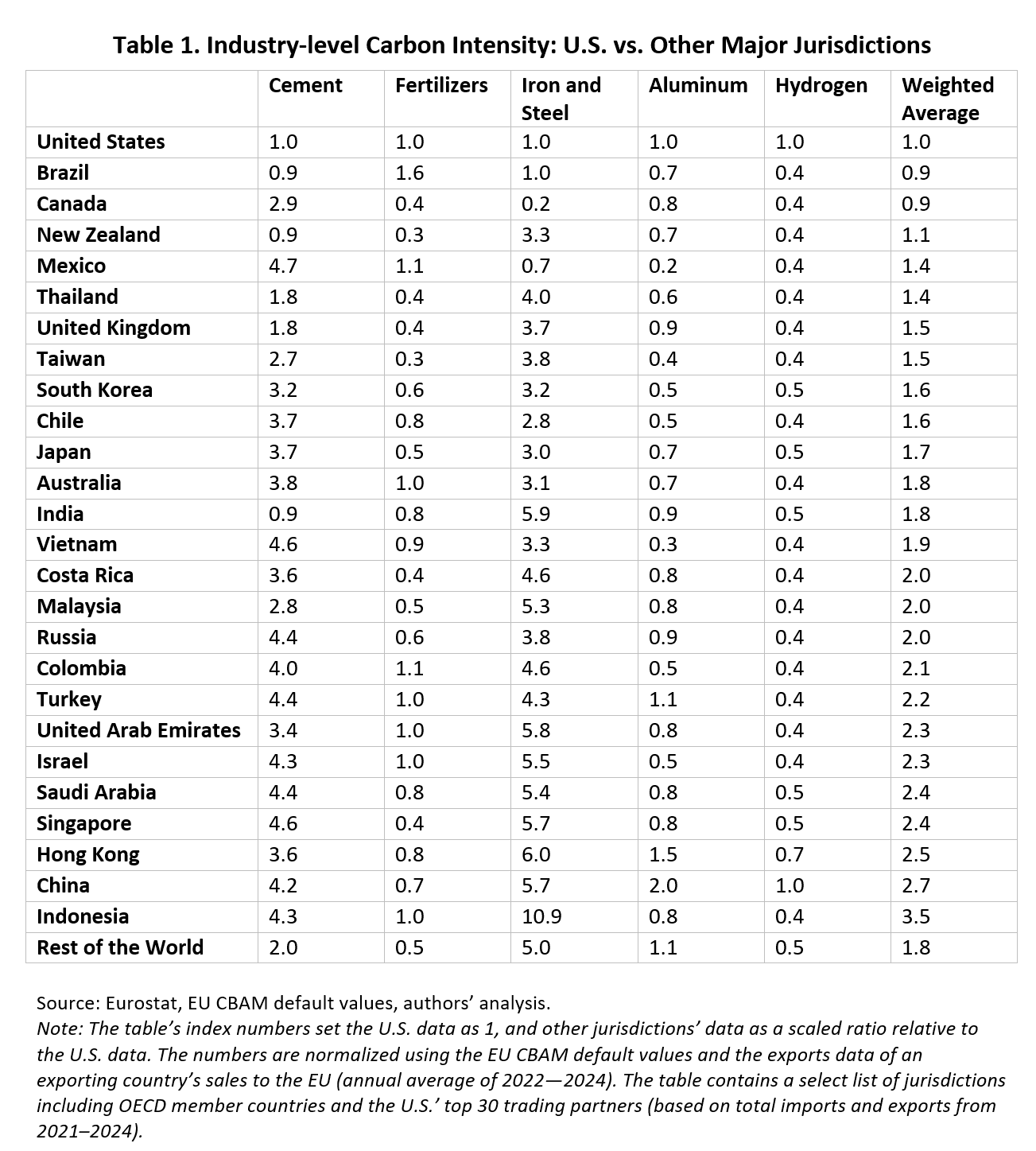
The table includes some surprising results, which may indicate that the default values could benefit from further research and improvement. For example, both Brazil (0.9) and Thailand (1.4)— developing countries— have lower overall weighted average values than Australia, a developed country (1.8). Developed countries typically should have lower carbon-intensity values than developing countries, however, as wealthier countries tend to use less carbon-intensive technologies and cleaner energy sources.
Additionally, U.S. hydrogen carbon-intensity value (1.0) is significantly higher than most other jurisdictions with values of either 0.4 or 0.5. China is the only other country that has a high hydrogen-intensity value at 1.0. Russia, as a carbon-intensive hydrogen exporter, has a relatively low value at 0.4. Some other U.S. values seem surprisingly higher than other countries’ values. For example, the weighted average U.S. fertilizer carbon-intensity value is twice as high as the value of the rest of the world.
Conclusion
The complexities surrounding the EU CBAM default values underscore the challenges facing the DOE’s study. Given that it took the EU several years to finalize its emissions data, a one-year timeline for the DOE to complete its carbon-intensity study appears ambitious. Should the DOE proceed, it must account for the significant methodological and logistical difficulties inherent in such a massive data undertaking. The results of the U.S. carbon-intensity study may also have significant ramifications for U.S.-EU trade relationship, as U.S. exporters follow the CBAM rules.
