








Insight
October 14, 2026
Private Equity’s Growing Role in U.S. Life Insurance
Executive Summary
- Private equity (PE) firms have taken an increasingly large share of the life insurance market, with 139 PE-owned life insurers collectively managing about 8 percent of U.S. life insurance assets, roughly $700 billion, as of 2024, up from about $1 billion in 2010.
- This growth has been driven by opportunities for PE firms to profit from owning life insurers and by the period of low interest rates that followed the 2008 financial crisis, which reduced traditional life insurers’ profits, incentivized them to wind down less profitable business lines, and spurred them to increase investment in alternative assets with the potential for higher returns.
- Although the rise in PE-owned life insurers may offer economic benefits, such as more affordable policies and cheaper corporate financing, these insurers’ increased investments in more opaque alternative assets and use of complex offshore reinsurance could create new channels through which risk might propagate across the financial system; because of these possible vulnerabilities, policymakers should remain aware of developments in the life insurance market, where total assets stand at about one-third of U.S. gross domestic product.
Introduction
Life insurers strive to earn more from their assets than they pay out to policyholders. The 2008 financial crisis made this business model more challenging: During the extended period of low interest rates following the crisis, it became difficult for life insurers to maintain profitability as the return on many of their traditional assets were correlated with the level of interest rates. Consequently, some life insurers chose to divest portions of their less profitable life insurance offerings, such as annuities. Others, however, decided to shift an increasing portion of their funds into alternative assets – a broad category that includes investments in hedge funds, private equity, and, notably, private credit – that offer potentially higher returns, albeit with greater opacity and reduced liquidity that could make it difficult to quickly sell these assets at fair value.
In response to these developments, private equity (PE) firms have rapidly expanded their footprint in the life insurance market, with a total of 139 PE-owned life insurers collectively managing about 8 percent ($700 billion) of all U.S. life insurance cash and assets in 2024. By contrast, in 2010, PE-owned life insurers only managed about 1$ billion in cash and assets. PE firms have become particularly large players in the annuities sector of life insurance, with “private-equity-backed insurers [controlling] an estimated 25 percent of U.S. individual-annuity liabilities” as of 2024. The key drivers of PE’s expansion into life insurance are that: (1) unlike banks, PE firms were not subject to post-2008 regulatory changes, enabling them to assume ownership of capital intensive life insurers; (2) PE firms have experience in alternative asset selection, allowing them to (potentially) enhance returns for their insurance affiliates; (3) PE firms can earn significant asset management fees from life insurers, especially those owned by the PE firm itself; (4) in contrast to PE firms’ typical funding structure, which operates in 7-10 year cycles, insurance premium, especially those from annuities, are relatively permanent, giving PE firms access to stable capital with which to make longer-term investments; and (5) PE firms can take advantage of regulatory differences across national borders to boost profits by shifting insurance liabilities to offshore affiliated reinsurance firms, thus reducing their capital constraints and enabling increased policy underwriting.
PE’s increasing footprint in the life insurance market comes with potential tradeoffs for U.S. consumers and the economy. On the one hand, PE’s investment in the life insurance industry may give consumers more options and better prices for insurance and annuity products. PE-owned life insurers’ increased investment in alternative assets could also reduce the cost of funding for some corporate borrowers, potentially generating increased economic growth. On the other hand, these increased investments in alternative assets could expose insurers, their policyholders, and PE firms to the risk that, because these assets are opaque and hard to value, it may be difficult to sell them at a fair price in a time of stress. The use of offshore reinsurance could potentially introduce a vulnerability to the broader financial system if the complex interconnections between – and extent of risk across – affiliated life insurers, reinsurers, and PE firms cannot be properly understood. Considering the potential consequences if these possible new vulnerabilities materialize, and the role of insurers in previous periods of financial instability such as the 2008 financial crisis, policymakers should remain aware of PE-related developments in the life insurance market, where total assets stand at about one-third of U.S. GDP.
Life Insurance Overview
To understand the footprint of PE in the life insurance industry, it is important first to review that industry, which includes both traditional insurance policies that pay out upon the policyholder’s death and annuity policies that pay a fixed amount at regular intervals. Because annuities are integral to PE’s life insurance business, the following section will provide a specific overview of annuities. As of Q2 2026, life insurers’ total financial assets stood at about $11.5 trillion, or about one-third of U.S. gross domestic product.
The business model of life insurance is to invest policyholders’ premiums in assets deemed likely to earn higher returns than what is owed to policyholders. This business model is constrained by state regulations (the insurance industry is regulated almost exclusively at the state level) that require life insurers to maintain certain capital buffers to protect policyholders against the effects of poor asset selection by the insurer.
Insurers’ profits (and the prices they pass on to consumers) are thus dependent on asset selection and performance. Traditionally, life insurers invested a significant portion of their cash into traditional debt securities such as publicly traded corporate and government bonds. Prior to the 2008 financial crisis, these assets provided high enough returns to ensure profitability. In the years following the crisis, however, the return on these traditional assets plummeted as interest rates remained low (at least until 2022). Declining returns put a strain on life insurers, some of whom decided to step back from offering some of their less profitable policies, such as annuities.
Other life insurers, however, responded to declining returns by broadening the scope of their investments to include alternative assets, which refers to non-traditional investment opportunities in, among other things, private equity, real estate, infrastructure, hedge funds, and private credit. According to the U.S. Treasury Financial Stability Oversight Council (FSOC), “life insurer holdings of [alternative assets] stood near $368 billion as of 2024, up approximately 130 percent from 2016.” Relative to life insurers’ traditional assets, alternative assets may offer higher returns, enabling insurers to better maintain profitability and continue offering legacy policies. For consumers, this could have the effect of expanding the selection and lowering the cost of life insurance and annuity policies. Alternative assets, however, may also pose greater risks than traditional assets because their opacity could make it difficult to value and sell them at a fair price in a time of stress. As is discussed below, this balance between potentially higher returns and possible increased risk is central to the potential implications of PE’s expansion into life insurance because PE-owned life insurers have assumed greater exposure to some types of alternative assets than their non-PE-owned counterparts.
Annuities Overview
Annuities are a type of insurance wherein a consumer pays an insurance company an upfront premium (either as one lump sum amount or as a sequence of payments) in exchange for future payments at regular intervals. Although different from traditional life insurance policies, annuities are still considered part of the broader life insurance sector.
The annuities sector has experienced recent growth, in part because, as will be explained below, it has been central to PE’s life insurance expansion. Annuities have also become more attractive to consumers as rising interest rates have put upward pressure on the return consumers can get from annuities. Indeed, a McKinsey report estimates that “U.S. individual annuity sales are estimated to have exceeded $450 billion in 2025, up from $426 billion in 2024 and nearly double 2021 levels.” The percentage of U.S. households owning an annuity increased by more than 30 percent from 2012 to 2024, according to RFI Global.
For insurers, annuities offer a much more predictable cost structure than regular life insurance policies: Annuities payouts have regular dates, while a traditional life insurance policy could require a payout at any time. The predictability of annuities gives insurance companies more confidence in the safety of investing annuity premiums into alternative assets, which, in addition to offering potential higher returns, can be illiquid, or difficult to quickly sell at fair value.
Private Equity in the Life Insurance Industry
Since the 2008 financial crisis, private equity firms have rapidly expanded their footprint in the life insurance market. In 2009, for instance, PE life insurance industry investment totaled only $23 billion. By the end of 2024, however, “139 life insurers directly owned by PE firms…collectively held about $700 billion in assets, as well as another $300 billion [in assets owned by] life insurers held as portfolio companies within PE funds.” According to a McKinsey report, this growth in the life insurance industry has even resulted in “insurers backed by private-capital firms,” which include PE firms as well as other private markets focused financial institutions, “command[ing] 13 percent market share in the insurance industry, up from 1 percent in 2012.”
PE’s growth in the annuities sector of life insurance has been particularly striking. For example, using data from insurance ratings firm A.M. Best, The Wall Street Journal reported in December 2025 that “private-equity companies control about 20% of annuity reserves…up from 2% in 2011,” and that Athene, the life insurance arm of Apollo, which operates private equity funds alongside other business lines, has become the world’s largest seller of annuity policies.
There are five primary drivers of PE’s expanding life insurance footprint. Four of these will be discussed in this section, while the final driver, offshore reinsurance, will be discussed in the following section. The first driver of PE’s life insurance boom is the effect of post-2008 regulatory changes on banks. Specifically, as the Financial Times explains, these changes made it “incredibly expensive for US banks to own insurance companies,” as the amount of capital that banks would be required to hold was increased. Consequently, many bank-owned life insurers were put up for sale. Because PE firms were not subject to these more stringent regulations, had sufficient capital to deploy, and saw an opportunity to benefit from owning insurers, PE firms purchased many of these life insurers (in addition to starting their own de novo insurers because of the reasons explained below).
The second and third drivers are the result of the extended period of low interest rates that followed the 2008 financial crisis, which incentivized insurance companies to invest more of their assets into higher earning alternative assets to maintain profitability. Given their experience in alternative asset selection and management, PE firms saw the life insurance industry’s move toward alternative assets as an opportunity to put their expertise to use to boost returns and profits. An analysis by the Bank for International Settlements found that, during a period of low interest rates, “the mean returns of shares of PE-linked insurers were more than twice as large as those of their peers.”
PE firms also realized that they could earn significant fees from taking on the role of asset manager for life insurers looking to invest in alternative assets. Notably, PE firms could charge these fees to both insurance companies they simply work with and those they directly own. In the latter case, PE firms often simply direct their insurance subsidiary to contract with their asset management arm for a large fee. As the Financial Times reported, for example, “Global Atlantic Group paid [parent company] KKR $536mn in 2024, while Athene Annuity and Life Company paid $1.3bn in management fees to Apollo.”
The fourth driver of PE’s life insurance expansion is the benefits that stable insurance premiums – especially from annuities payments – provide as funding relative to traditional private equity funding. Indeed, traditional private equity funding is cyclical, as firms fundraise from investors through individual funds, each with a lifetime of about 7-10 years. After that time elapses, a PE firm closes its fund, returns money to its investors, and then restarts the funding cycle. Although this cycle worked well for PE firms when their focus was leveraged buyouts (LBO) – a debt-driven purchase of a company followed by a restructuring and sale within the 7–10-year lifetime of a fund – PE firms expansion beyond LBOs into originating, investing in, and managing long-term, illiquid assets, such as private credit, makes the short-term, cyclical nature of this funding impractical. Consequently, PE firms needed a more stable source of funding to fuel their asset origination and management businesses.
PE firms eventually found such sources of stable funding in the life insurance industry, and particularly the annuities sector, wherein premiums are permanent and payouts are relatively predictable. For a PE firm with an insurance subsidiary or an asset management contract with an independent insurer, this funding could be used for investments in their preferred longer-term, illiquid alternative assets. PE firms could also use their new insurance funding to, as a report from the Bank for International Settlements explains, invest in assets they originate, thereby generating for themselves “fixed income from fees related to originating and managing the assets.”
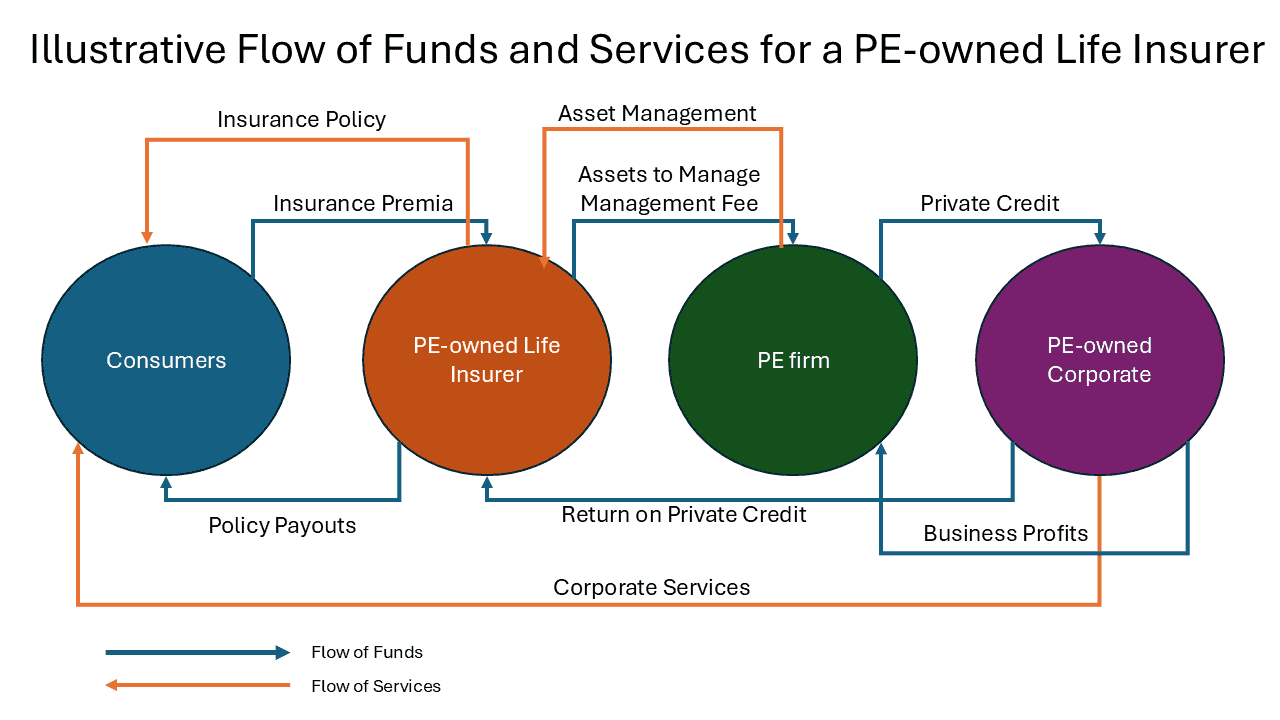
To visualize these drivers of PE firms’ growing interest in life insurance, Figure 1 below shows an illustrative example of the flow of funds and services across consumers, PE-owned life insurers, PE firms, and PE-owned corporates.
Figure 1
Reinsurance
The fifth driver of PE firms’ growing life insurance business is the ability to use reinsurance, especially offshore reinsurance in Bermuda and (to a lesser extent) the Cayman Islands, to maximize profits. Put simply, reinsurance is insurance for insurance companies. An insurer may purchase a reinsurance policy to protect itself against the risk that policyholders’ claims rise to a level that they cannot cover with existing assets. (More details on reinsurance can be found here.) An insurer may also take out a reinsurance policy with the express purpose of reducing total liabilities and, therefore, how much capital it must hold against these liabilities. With reduced capital requirements, insurers can underwrite more policies and increase potential profits.
While reinsurance exists within the United States, the offshore reinsurance industry has been booming because of the opportunity to use regulatory differences across international borders to minimize required capital buffers and maximize profits. Bermuda has seen particularly significant growth in offshore reinsurance – from $205 billion in 2014 to $928 billion in 2024 – as its capital requirements for insurers and reinsurers are less stringent than those of the United States but still treated with legal reciprocity in the United States. What this means in practice is that an insurer in the United States can reinsure its policies in Bermuda by transferring the liabilities to that reinsurer, thereby freeing up existing capital to underwrite more policies in the United States.
PE life insurers have been especially large users of reinsurance. Indeed, while the Financial Times reports that U.S. offshore reinsurance has risen above $1 trillion in value, Moody’s notes that “much of the offshore growth has been driven by companies such as Athene or Global Atlantic,” Apollo and KKR’s life insurance companies, respectively. Such growth has likely enabled these insurance companies to boost their underwriting of policies in the United States.
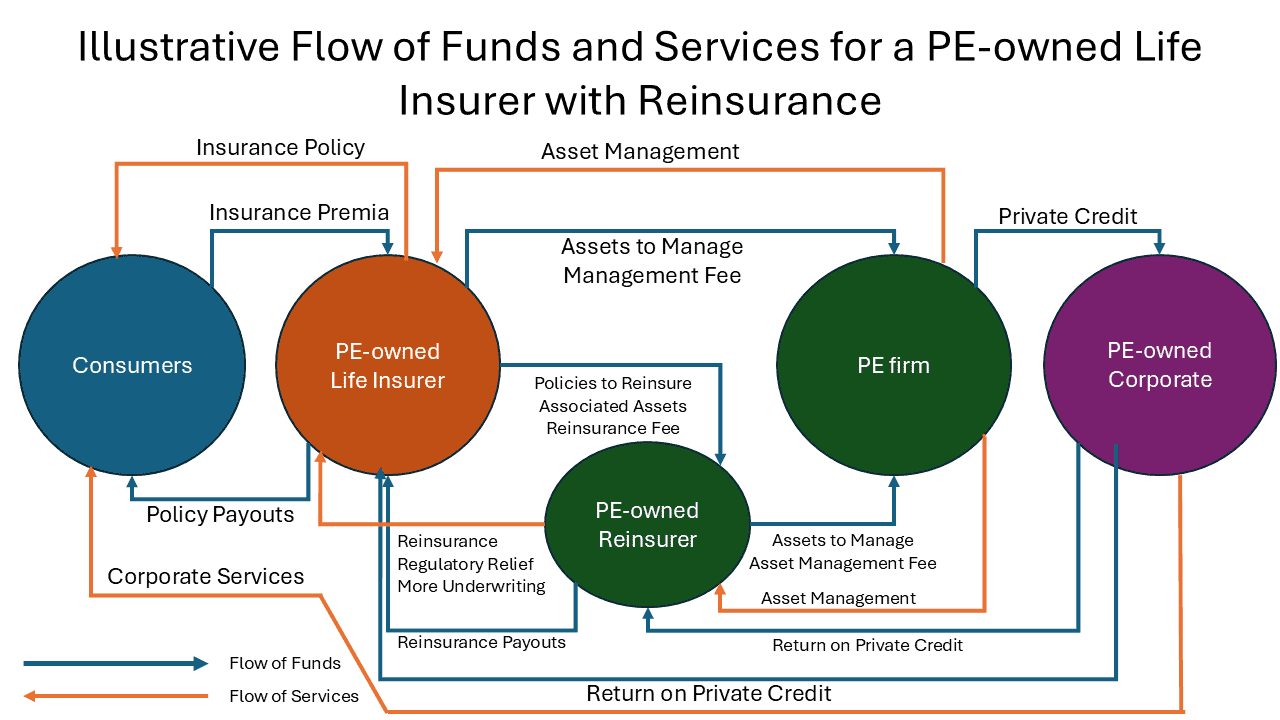
The growth in offshore reinsurance by PE companies has also been fueled by PE companies’ use of affiliated reinsurers, or reinsurers owned or backed by these PE companies. Using affiliated reinsurers enables PE firms to not only reduce their onshore insurers’ capital requirements but also allows them to keep the assets held by their reinsurer available for investment into assets they originate. For instance, a PE firm’s reinsurer could invest its assets into that PE firm’s private credit operation, enabling the PE firm to boost its private credit provision and profits. Figure 2 builds on Figure 1 above to show how the use of an affiliated reinsurer affects PE firms and their subsidiaries.
Figure 2
What Does Warren Buffet Have to Do With This?
Before discussing the potential consequences – both positive and negative – of the growing role of private equity in the life insurance industry, it is useful to remember that PE firms are not the first financial firms to use insurance firms as a source of capital. Indeed, Warren Buffett’s Berkshire Hathaway used the premiums from the many insurance companies, such as GEICO, within its portfolio to fund its investments. This similarity highlights how the links between PE and life insurance should not reflexively be seen as “unprecedented” or “scary.” That said, PE-owned and -linked life insurers have in recent years invested in assets considerably more varied and possibly more risky than had previously been the case.
Potential Benefits of PE in Life Insurance
Nevertheless, the growth of PE investment into life insurance and annuities could generate some benefits for consumers and the U.S. economy. The first is that, by investing significant capital into the life insurance industry and increasing returns through alternative asset investments, PE firms may have “mitigated the impact on policyholders of traditional life insurers’ divestment by allowing insurers to offer their policies at more attractive prices.” This means that consumers who wished to purchase life insurance or annuity policies may have seen reduced prices.
The second benefit is that by gaining cheaper, more stable funding through insurance premiums, PE firms may have been able to increase their provision of credit to corporations. As the corporations that receive this direct lending are often those that cannot easily obtain credit through bank lending and other more traditional channels, increased corporate financing by PE firms could benefit the overall economy through enhanced corporate growth and productivity.
Potential Risks of PE in Life Insurance
As with almost any financial innovation, there are potential risks from PE’s increased life insurance exposure that could hypothetically materialize. None of these risks is inherent to the connection between PE, life insurance, and alternative asset investments, but is instead the result of how this connection has developed and been implemented.
There are two classes of potential risk to consider here: those that could affect PE firms, their insurance companies, and their policyholders, and those that could affect the economy and financial system more broadly. With respect to the former, there are two main risks to consider. The first stems from investing in alternative assets, which might result in higher returns, but also might have greater risk than traditional assets because their relative opacity and lack of transparency could make them more difficult to value and sell quickly at a fair price. In a period of financial stress, an insurer with significant exposure to alternative assets may therefore be unable to properly meet its obligations to policyholders as its assets cannot be sold at values consistent with these obligations. In extreme cases, this could potentially lead an insurer to fail and enter resolution proceedings.
The second conceivable risk for PE firms derives from the interconnected nature of PE’s investments in life insurance and reinsurance. As a Bank of England Financial Stability Report explains, “PE-controlled life insurance subsidiaries are increasingly holding PE-sponsored corporate debt including that of corporates sponsored by the same PE firm that owns the insurer. This is creating concentrated and potentially correlated exposures” that could spread financial risk from alternative asset investments in a broader PE ecosystem back to the life insurer or reinsurer. The hypothetical materialization of such risks – which could, for example, occur if the assets originated by or invested in by a PE firm using its insurance subsidiary’s premiums go bad – might have a negative impact on life insurers and their ability to meet policyholder claims.
PE’s growing life insurance business also raises the possibility of new vulnerabilities in the overall financial system. One potential vulnerability is that the interconnections of PE, insurance, and offshore reinsurance mentioned above could become so complex that it is difficult for regulators and policy officials to understand which parties are assuming risk and what the extent of this risk is. Considering the further interconnection between these three industries and alternative assets, which stood at a total value of about $15 trillion in 2022 and are expected to further grow as class of financial assets according to a report from KKR, the potential inability to understand the location and size of financial risk (such as counterparty exposures, asset valuations, and reinsurance recaptures and recoverables) could make preparing for and responding to possible future financial instability more challenging.
Conclusion
As traditional life insurers’ profitability waned in the wake of the 2008 financial crisis, PE firms stepped up their involvement in the industry – especially in the annuities sector – to take advantage of profitable opportunities. At year-end 2024, 139 PE-owned life insurers in the United States collectively managed about 8 percent ($700 billion) of U.S. life insurance total cash and assets. While PE’s increasing involvement in the life insurance industry may yield benefits for consumers and the economy, such as more affordable insurance policies, greater corporate productivity, and increased economic growth, PE-linked life insurers’ investments in more opaque alternative assets and use of complex corporate structures and reinsurance networks could create new vulnerabilities in the financial system that are worth tracking.