Insight
March 31, 2026
Sports Broadcasting: Market Shifts and Policy Questions
Executive Summary
- As streaming platforms reshape the distribution of live sports, the Federal Communications Commission (FCC) is seeking public comments on the effects of streaming on broadcasters and consumers.
- The FCC has long regulated broadcast licenses to protect local broadcasters, but while cable television moved some sports programming outside of FCC authority, the rise of streaming has greatly increased fragmentation of the sports viewing market; while streaming has increased consumer choice, fragmentation is making access more complex and costly, raising questions about how traditional rules apply in today’s sports media landscape.
- This insight examines the impact of streaming on the sports broadcasting market, and considers the possibility of regulatory or legislative action by the FCC or Congress.
Introduction
As streaming platforms reshape the distribution of live sports, the Federal Communications Commission (FCC) has opened an inquiry into the evolving sports broadcasting marketplace. In a public notice released last month, the FCC is seeking comments on whether recent changes in sports distribution are affecting broadcast stations’ ability to meet their public interest obligations and how this is impacting consumers’ ability to find and afford live game telecasts.
The FCC has long regulated broadcast licenses to protect localism – ensuring local broadcasters serve their communities by providing access to local news, weather, and events. The agency also set rules, such as carriage obligations that support the economic viability of local broadcasters to sustain that programming. But the advent of cable television moved some sports programming outside of FCC authority, and now streaming platforms have shifted audiences even further. This increased fragmentation is making access to sports more complex and costly, raising questions about how traditional rules apply in today’s sports media landscape.
This insight examines current market dynamics and their impact on broadcasters and consumers, assesses the FCC’s limited authority to regulate streaming and the possibility of congressional action.
The FCC’s Statutory Authority in Sports Broadcasting
The Communications Act of 1934 gave the FCC jurisdiction to regulate traditional over-the-air television. Instead of controlling who gets sports media rights, the FCC regulates licenses that allow stations to use a specific portion of the public spectrum. In exchange, the FCC has long required broadcasters to act in the public interest of the communities, also known as localism, guaranteeing they have access to local news, weather, and events, including local sports. To reinforce this framework and ensure continued viewer access, the Cable TV Consumer Protection and Competition Act of 1992 required cable providers to carry the signal of local commercial television stations.
Streaming platforms, however, are further reshaping the distribution of live sports, reducing dependence on traditional stations. Currently, the FCC has no direct jurisdiction over streaming platforms, and its public notice is fueling debate about whether the rules should change.
The Evolving Sports Media Marketplace
Streaming platforms have completely changed the distribution of sports broadcasting. While sports were traditionally distributed through free over-the-air television on popular networks including ABC, CBS, NBC, and Fox, as well as through paid television packages (cable and satellite), these broadcasters now compete with technology companies including Amazon and YouTube. As shown in Figure 1, among the 43 percent of Americans who consider themselves “sports viewers,” approximately 70 percent watch via streaming platforms – with 40 percent watching sports exclusively through streaming. Just 19 percent only watch sports over broadcast or cable.
Figure 1: U.S. Sports Viewers by Source in 2025

Source: Parks Associates and InterDigital Survey
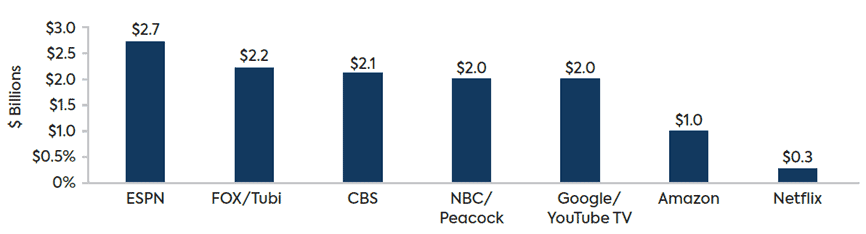
In this context, media rights are increasingly more valuable. The National Football League (NFL) exemplifies how leagues are selling their rights. As shown in Figure 2, in 2025, the NFL sold its media rights across seven deals, with pure streaming services such as Amazon, YouTube TV, and Netflix accounting for 25 percent of the NFL’s broadcast revenue. Also, the NFL divided its games across platforms by time slot and exclusivity, for example, Sunday night on NBC, Monday night on ESPN, Thursday night on Amazon, and select games exclusively on streaming services such as two Christmas games on Netflix.
Figure 2: NFL Media Rights in 2025
Source: Parks Associates and InterDigital Survey
This market shift is changing competition and access to sports. As professional leagues sell their media rights, broadcasters, pay TV operators, and streaming platforms compete for these rights to grow their audiences and increase advertising and subscription revenue. In this landscape, traditional broadcasters have increasingly experimented with hybrid arrangements, sharing rights with streaming partners or placing their own games on proprietary direct-to-consumer platforms such as Peacock or Paramount+ to remain competitive, while also adapting to new content strategies.
The Impact on Local Broadcasters and Localism
As major broadcasters, pay TV operators, and streaming platforms pay higher licensing fees for exclusive sports rights, local broadcast stations risk losing a key source of revenue. Regional sports networks – television channels dedicated to broadcasting local professional and collegiate sports within specific geographic areas – are collapsing due to the transition of viewers to streaming and the bankruptcy of major stations. That includes the Main Street Sports Group which is set to close at the end of this season. Traditionally, sports programming has delivered large audiences and advertising revenue, sustaining local stations and helping to fund local news and public programming. But as distribution keeps moving toward traditional pay TV and digital systems, the local broadcasters’ revenue is shrinking, weakening their competitive position. The decline of local broadcasters, however, does not necessarily imply a decline in local content, independent news sites, social media and online creators now produce local content and distribute it through digital platforms.
Fragmentation and Impact on Sports Fans
The market shift and expanded options give consumers more choice and flexibility, as fans can now watch their favorite sports events on tablets and phones rather than just TV. They can view more sporting events than when broadcasters aired only those games considered of interest to a specific geographic market. Streaming replay options allow them to view matches whenever it’s convenient. The downside of this shift is that consumers are losing free access as an increasing number of games are now behind paywalls. Also, the fragmentation makes it harder for fans to find the games they want to watch, while also potentially increasing the costs to access them as they may have to pay for multiple subscriptions. In 2025, for example, watching all NFL games could cost a consumer over $1,500.
Regulatory Outlook
As live sports move across broadcast and streaming platforms, the policy question has been whether to respond to a market that is completely disrupting traditional distribution models. A review of the market suggests that the shift is not inherently harmful or beneficial, but rather a response to consumer preferences and technological change.
For the FCC and Congress, this distinction is important. As the FCC’s legal authority lies in traditional broadcasting, efforts to address the distribution of sports across streaming platforms could face significant constraints. While the FCC might try to rely on its public interest authority to discourage stations from shifting games to streaming – even linking such decisions into license renewals – these actions would likely face legal challenges, because, under the major questions doctrine, courts would require clear congressional authorization for the FCC to take on an issue of this scale. In addressing the shift to streaming, Congress will be best positioned to act. Congress currently regulates sports broadcasting through the Sports Broadcasting Act (SBA), which gives antitrust immunity to allow professional leagues to collectively license the sponsored telecasts – broadcasts financed by advertisers that are then available free to the public – of their games to national broadcast networks. By granting these exceptions, leagues can redistribute media revenues, helping ensure financial stability, and allowing leagues to package their games for nationwide, free distribution which further expands access for viewers.
Legislators have flagged the need to review the SBA to determine whether it adequately addresses the current market and the extent to which it serves competition and consumer welfare. Yet Congress has not taken significant steps to either protect broadcast stations or regulate the streaming market. The FCC’s public notice could, however, lead to a request for legislation and apply public pressure for Congress to act. Ultimately, any legislative proposal to address concerns about the changing sports media market should focus on preserving competition and innovation across distribution technologies rather than privileging a single distribution model.