








Insight
October 22, 2026
State AGs Go on Antitrust Offensive
Executive Summary
- Amid increased state-level antitrust enforcement, House Judiciary Committee Subcommittee Chairman Scott Fitzgerald (R-WI) introduced a discussion draft of legislation giving the Federal Trade Commission and Department of Justice exclusive authority to review or challenge certain mergers and acquisitions of interstate or international interest.
- State attorneys general are increasingly enforcing federal and state antitrust and consumer protection laws independently, while state legislatures are passing policies to fill perceived gaps in federal law.
- The proposed federal preemption legislation aims to balance the complexity of multi-jurisdictional merger investigations with the states’ authority to preserve local competition.
Introduction
House Judiciary Committee Subcommittee Chairman Scott Fitzgerald (R-WI) introduced a discussion draft of legislation that would grant the Federal Trade Commission (FTC) and Department of Justice (DOJ) exclusive authority to review or challenge certain mergers and acquisitions of interstate or international interest. The proposal comes amid a sharp rise in state-level antitrust enforcement.
State attorneys general (AGs) are taking a more active role enforcing federal and state antitrust and consumer protection laws. State AGs have challenged mergers independent of federal regulators including Paramount’s acquisition of Warner Bros. Discovery despite the merger being approved by 68 national competition authorities, including the U.S. Department of Justice. At the same time, state legislatures are adopting new policies to fill perceived gaps in federal law, specifically those related to personalized pricing and the use of common pricing algorithms.
The proposed federal preemption legislation aims to balance the complexity of multi-jurisdictional merger investigations with the states’ authority to preserve local competition.
The Rise of State Enforcement
State AGs have intensified competition enforcement and merger challenges during the second Trump Administration. Multi-state AG coalitions have taken action to challenge several transactions including Paramount’s acquisition of Warner Bros. Discovery and Nexstar Media Group’s merger with Tegna, and have even intervened in the Tunney Act proceedings that sought to unwind Hewlett Packard Enterprises’ approved purchase of Juniper Networks.
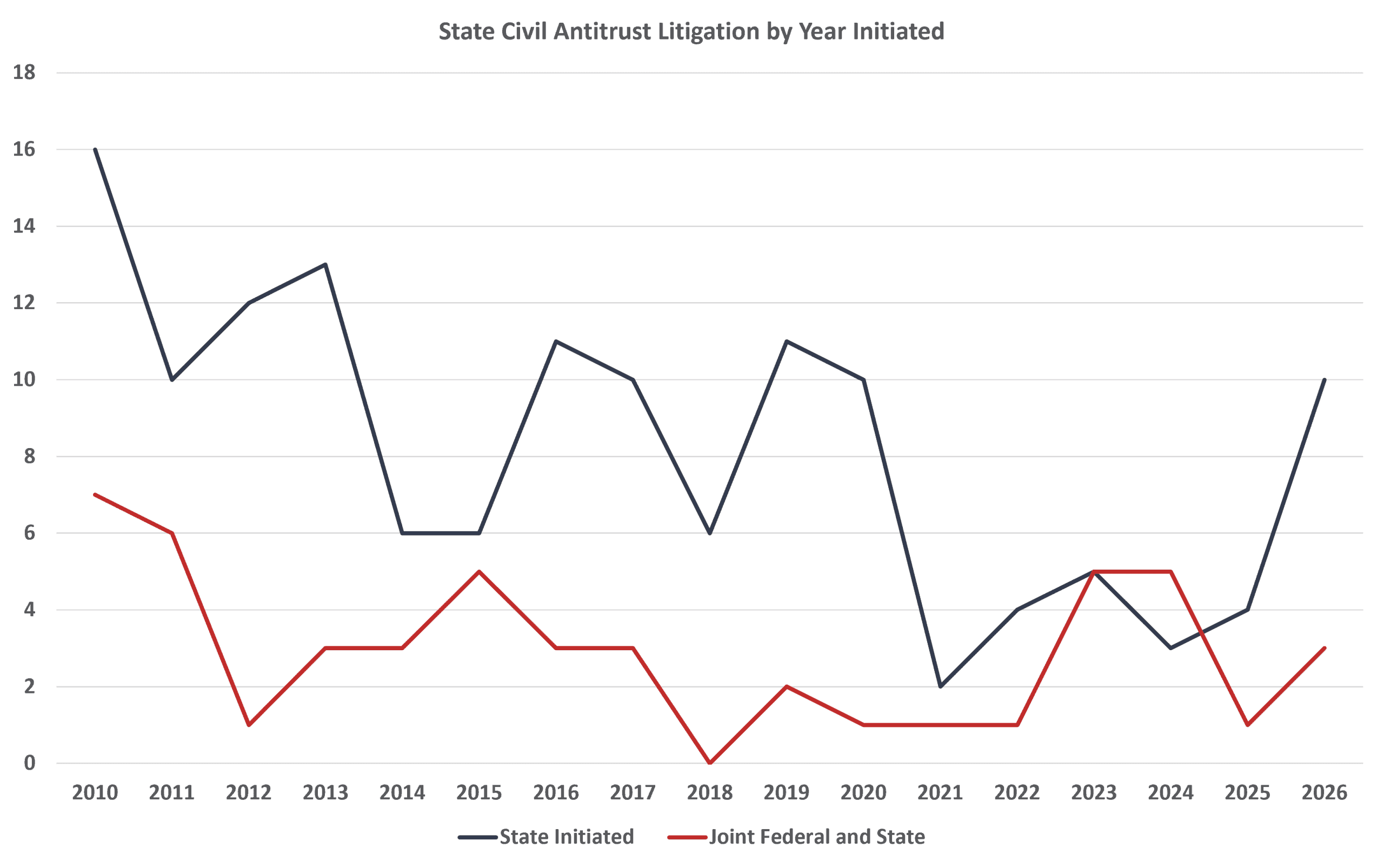
Data from the National Association of Attorneys General underscores the uptick in state-level antitrust enforcement.
Figure 1
*Source: National Association of Attorneys General
The rise in state enforcement stems, in part, from allegations of impropriety at the federal antitrust enforcement agencies involving the merger between American Express Global Business Travel and CWT Holdings, Hewlett Packard Enterprises’ acquisition of Juniper Networks, and the “forced resignation” of DOJ Antitrust Division Assistant Attorney General Gail Slater. Additionally, state AGs from Washington, California, Nevada, New York, and Oregon released a joint statement announcing that they are stepping up enforcement of “illegal” mergers “as the federal government has pulled back on corporate oversight.”
The division between federal and state policy extends beyond enforcement actions to include legislation. A growing number of states have implemented or proposed legislation targeting personalized pricing – sometimes called surveillance pricing – which is a strategy in which sellers use detailed individual customer data to charge a price based on what the data suggest the customer is willing to pay. In November 2025, New York began enforcing a law that required companies to disclose their use of personalized pricing. Since then, Maryland, Connecticut, and New Jersey have gone further, prohibiting the use of surveillance prices under certain conditions. Meanwhile, the FTC has moved more slowly, having only published a preliminary enforcement policy document that remains under review.
Federal Preemption
Representative Scott Fitzgerald (R-WI), Chairman of the House Judiciary Committee Subcommittee on the Administrative State, Regulatory Reform, and Antitrust, released a discussion draft of legislation, the National Merger Uniformity and Federal Exclusivity Act. The draft follows multiple attempts by Democratic state attorneys general to challenge mergers and acquisitions that had been approved by multiple federal and foreign regulators. The proposed legislation would provide the FTC and DOJ with exclusive authority to review or challenge certain mergers and acquisitions that are:
- reasonably likely to have substantial direct economic effects in five or more States;
- reasonably likely to have substantial direct effects on international commerce, foreign markets, international supply chains, imports, exports, or trade between the United States and one or more foreign nations
“Substantial direct economic effects,” according to the text, include those that have a “material effect on competition, prices, output, employment, wages, innovation, investment, production, distribution, consumer welfare, and commerce.”
The discussion draft would also prohibit states from initiating, maintaining, intervening in, joining, or continuing any judicial or administrative proceeding that would prevent delay, condition, or unwind a covered transaction. Moreover, the discussion draft expressly preempts all state antitrust laws and state-level merger notification requirements that apply to covered transactions.
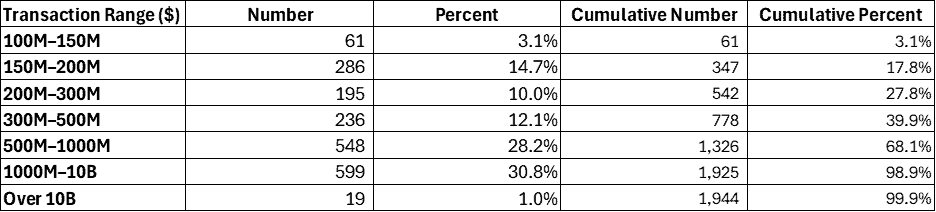
The confidential nature of merger prenotification makes it difficult to estimate the share of transactions that would be covered by this legislation. Transaction value data from the annual Hart-Scott-Rodino report for fiscal year 2025 could serve as a proxy, assuming low-value transactions are more likely to involve companies that have “substantial direct economic effects” in fewer than five states. For example, the data show that just over 70 percent of transactions have a value of more than $300 million. The FTC and DOJ are more likely to have exclusive authority to review or challenge these mergers under the draft legislation. In other words, states would be prohibited from seeking relief in a large swath of cases.
Figure 2. Acquisitions by Size of Transaction
*Source: Hart-Scott-Rodino Annual Report Fiscal Year 2025
Under this proposal, states are reduced to a mere advisory role. State AGs can submit comments, evidence, economic analysis, or recommendations to the DOJ or FTC. They can also participate in any review process, but doing so requires an invitation from the federal antitrust enforcers.
The Pros and Cons
The Pros
Regulatory Risk: Paramount’s acquisition of Warner Bros. Discovery is instructive in the risks firms face when multiple jurisdictions reach different conclusions. A coalition of 12 attorneys general led by California reached a settlement with the merged firm even after federal enforcers at the DOJ determined that the transaction was not likely to result in harm to competition. The settlement included a five-year commitment to increase film output, a minimum of $1.5 billion commitment to bolster domestic film production, and a $47.5 million fund for workers impacted by the merger.
This risk acts as an economic drag. Restricting state involvement for mergers that span across several states or have international implications reduces the regulatory costs and risks associated with a transaction. In an extreme, although unlikely scenario, firms would no longer have to navigate merger reviews in potentially 50 states, the District of Columbia, and by two federal regulators.
State Politicization: Limiting state involvement can also reduce the potential for politically motivated litigation. State AGs, who are often elected (and therefore have a strong incentive to respond to political pressures), could use their power to challenge competitively benign mergers of politically unpopular targets. Even if a particular state AG does not initiate the case, the ability to join cases can make the same political statement.
The Cons
Federal Politicization: Contrary to the potential for state-level politicization of merger cases, the recent rise in state enforcement stems from, in part, similar allegations at the federal level. Removing states as an independent check on federal regulators – who can be equally persuaded by politics – could allow competitively harmful mergers to escape review.
Local Harms: A uniform standard for merger review may fail to account for local economic harm that affects a specific state or region of states than evaluating national markets. While states would still be permitted to submit comments and economic analysis, it is unclear if federal regulators will consider such local concerns.
Resource Allocation: Merger litigation is costly and weighs on the decision by a federal agency to challenge a transaction. Reducing the role states play in merger enforcement puts added pressure on limited federal resources to conduct investigations. States can help defray these costs if they are able to join cases and pool resources.
Conclusion
In response to rising state-level antitrust enforcement, Chairman Fitzgerald’s draft legislation to grant the FTC and DOJ exclusive authority over certain merger transactions seeks to balance the complexity of multi-jurisdictional merger investigations with the states’ authority to preserve local competition.
Proponents will argue that eliminating the multi-jurisdictional costs and risks would reduce economic drag while critics warn the legislation would strip states of its ability to put a check on federal enforcers and sufficiently address concerns of localized harm.