







Insight
November 24, 2026
Inflation Reduction Act IPAY 2028 Maximum Fair Prices Have Been Published
Executive Summary
- The Centers for Medicare & Medicaid Services (CMS) has published maximum fair prices (MFPs) for 13 drugs under the Medicare Drug Price Negotiation Program for initial price applicability year 2028, including the first drugs payable under Medicare Part B and the first drug selected for renegotiation.
- CMS estimates that the newly negotiated MFPs would have reduced net Medicare drug spending by $9.2 billion, or 45 percent, had they applied in 2025; accounting for existing manufacturer discounts reduces the estimated savings to $5.5 billion, or 33 percent.
- Although the announced prices could produce Medicare savings, their projected impact on beneficiaries is considerably more modest; the results also demonstrate the importance of competition, raise new questions about Part B implementation, and warrant continued scrutiny of the broader effects of government-directed price negotiations.
Introduction
On November 23, the Centers for Medicare & Medicaid Services (CMS) announced the latest round of negotiated drug prices under the Medicare Drug Price Negotiation Program established by the Inflation Reduction Act (IRA). This third round, covering initial price applicability year (IPAY) 2028, establishes maximum fair prices (MFPs) for 13 medications beginning January 1, 2028. Notably, it is the first round to include drugs payable under Medicare Part B, expanding the program beyond the pharmacy-dispensed products traditionally covered under Part D.
The 13 MFPs encompass 12 newly negotiated drugs and one previously negotiated medication, Tradjenta, selected for renegotiation. CMS initially selected 15 additional drugs, but three will not have an MFP following developments involving generic and biosimilar competition (Xeljanz/Xeljanz XR and Xolair) and federal litigation (Botox).
According to CMS, the selected drugs accounted for approximately $25.6 billion in combined Part B and Part D spending in 2025. The agency estimates $9.2 billion in net savings, representing a 45-percent reduction in aggregate spending had these prices been effective that year. Yet, as with the previous negotiations, the magnitude of the government’s announced savings requires closer examination, particularly when existing manufacturer discounts, benefit design, and the different payment structures of Medicare Parts B and D are considered.
CMS IPAY 2028 Announcement
The following table summarizes the selected drugs for negotiation and their discounts – originally identified in February 2026 – including their total Medicare spending from calendar year 2025.
The reductions range from 34 percent for Entyvio to 84 percent for Trulicity. Several products, particularly those treating diabetes and chronic inflammatory conditions, received substantial reductions from their historical gross prices. Of course, a reduction from a gross price is not necessarily equivalent to the incremental savings Medicare will realize.
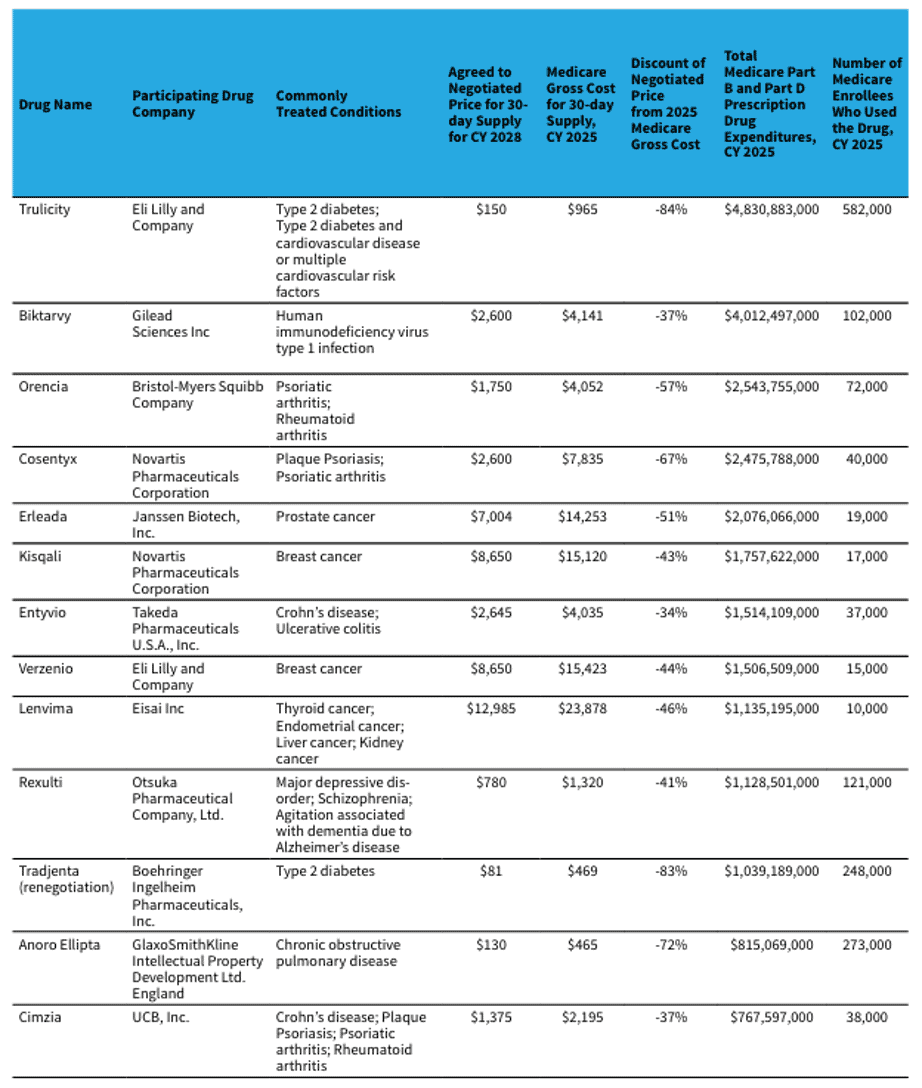
Source: CMS IPAY 2028 fact sheet
The final list is also notable for what it excludes. CMS determined that Xeljanz and Xolair no longer qualified for negotiated prices because of bona fide marketing of a generic and biosimilar, respectively. Botox remains outside the program following a federal district court ruling in AbbVie v. HHS concerning the statutory exclusion for plasma-derived biological products. That litigation remains ongoing, but in October the court granted judgment to AbbVie, blocking Botox’s participation under the IRA.
These developments are consequential and demonstrate the overzealous nature of CMS drug selection. Generic and biosimilar competition remain among the most effective mechanisms for reducing pharmaceutical prices, and two products initially selected for administrative negotiation have now exited the process precisely because competitors entered the market.
Headline Savings and Comparison to Previous Negotiations
CMS estimates that the IPAY 2028 MFPs would have reduced net Medicare drug spending by $9.2 billion, or approximately 45 percent, had they been in effect during 2025. This calculation accounts for existing manufacturer rebates and certain other fees and payments but excludes spending associated with the Manufacturer Discount Program (MDP), which already requires manufacturers to provide discounts on applicable Part D drugs.
When MDP spending is incorporated, the estimated savings fall to approximately $5.5 billion, or 33 percent. That $3.7 billion difference represents roughly 40 percent of the initially advertised savings. The difference is important because the MDP already imposes manufacturer discounts under the redesigned Part D benefit. Thus, some of the savings reflected in the larger estimate overlap with discounts manufacturers are already obligated to provide under the redesigned Part D benefit.
A similar distinction arose in the previous negotiation cycle. For IPAY 2027, CMS projected approximately $12 billion in savings, a 44-percent reduction in net Part D spending, which fell to $8.5 billion and 36 percent when spending under the former Coverage Gap Discount Program was included. In IPAY 2026, CMS estimated approximately $6 billion in net savings, or 22 percent.
The third round therefore produces a slightly higher headline percentage reduction than IPAY 2027, but a smaller dollar savings estimate. Once existing manufacturer discount obligations are included, the estimated reduction is also proportionately smaller: 33 percent compared with 36 percent in the preceding round. These figures are not perfectly comparable, given differences in the selected products, baseline years, manufacturer discount programs, and the inclusion of Part B. Still, the comparison underscores why headline savings percentages warrant scrutiny and why existing statutory discounts must be considered when evaluating the additional benefits of negotiation.
Government-ordered price reductions appear to generate substantial near-term savings for Medicare, and the adjusted $5.5 billion estimate is not insignificant. But these figures remain retrospective simulations rather than realized savings. The MFPs will not take effect until 2028, when utilization, negotiated market prices, and existing manufacturer discounts may differ from their 2025 levels. The larger question is whether these savings represent an efficient improvement over existing market arrangements or broader, negative consequences for pharmaceutical competition and innovation.
Medicare Part B and Beneficiary Implications
The inclusion of Part B medications introduces a new dimension to Medicare drug negotiations. Unlike Part D, where beneficiaries generally obtain medications through pharmacies, Part B commonly covers drugs administered in physicians’ offices, infusion centers, and other clinical settings.
CMS estimates that approximately 120,000 Part B beneficiaries used the four selected medications with Part B spending in 2025, accounting for roughly $3.3 billion in drug expenditures. The agency projects that Part B beneficiaries will save approximately $395 million in out-of-pocket costs when the negotiated prices take effect. By comparison, CMS projects just $69 million in out-of-pocket savings for Part D beneficiaries, despite approximately 1.4 million enrollees using the selected medications under that benefit in 2025. Combined, the projected beneficiary savings total $464 million.
Approximately 85 percent of these projected savings would occur under Part B, and this distribution is revealing. Part D beneficiaries already benefit from an annual out-of-pocket spending cap and other structural changes enacted under the IRA. Accordingly, lower prices do not necessarily translate into equally substantial additional savings for patients. The projected $69 million in Part D savings is also substantially smaller than the $685 million estimated for IPAY 2027, although differences in drug selection and usage complicate direct comparisons.
Part B presents different challenges. Medicare traditionally reimburses most separately payable Part B drugs at average sales price (ASP) plus 6 percent, but selected drugs will instead be reimbursed at the MFP plus 6 percent. Even if providers can acquire the drugs at their negotiated prices, the reduced reimbursement benchmark will diminish the dollar value of the add-on payment. This could affect the financial incentives for providers, particularly smaller physician practices, to purchase and maintain inventories of expensive medications.
How manufacturers make the MFP available presents another unresolved issue. Under CMS’ proposed implementation framework, manufacturers may offer the negotiated price upfront or provide retrospective refunds to providers purchasing drugs at higher prices. CMS is considering several methods for calculating these refunds because determining a provider’s actual acquisition cost is not always straightforward. Depending on the methodology adopted, refunds could fall short of acquisition costs, while delays in reimbursement could create additional cash-flow pressures. These concerns do not negate the potential savings for Medicare and its beneficiaries, but they demonstrate why successfully extending negotiations into Part B requires more than establishing a lower reimbursement rate. CMS must ensure that the payment structure does not inadvertently discourage providers from administering the very medications the program is intended to make more affordable.
Renegotiation
IPAY 2028 also marks the first renegotiation of an existing MFP. Tradjenta, originally negotiated for IPAY 2027 at $78 per 30-day supply, now has a renegotiated MFP of $81 for 2028 – an increase of approximately 4 percent. This is a noteworthy outcome for a program designed to lower drug prices, particularly given that renegotiation ostensibly provides CMS another opportunity to secure additional savings. While the new price remains below the drug’s gross Medicare cost, it is nevertheless higher than the initially negotiated MFP.
There are important qualifications to this comparison. Under the IRA, MFPs are adjusted annually for inflation, meaning that the appropriate benchmark for assessing renegotiation is the price that would otherwise have applied in 2028, rather than the original $78 figure. CMS has not yet released its explanation of how it arrived at the renegotiated price, which is expected by March 1, 2027. Until then, it would be premature to attribute the increase to any particular negotiating factor. Nevertheless, the result raises questions about the renegotiation process if prices instead are rising rather than CMS securing additional price concessions.
The Future of the Program
The program’s scope and regulatory framework are also continuing to expand. On November 5, CMS finalized regulations governing the negotiation program for IPAY 2029 and beyond, replacing much of the guidance-based framework used for the first three rounds.
Several provisions are particularly consequential. The rule extends the guidance-based temporary MFP floor for qualifying small biotechnology drugs in 2029 and 2030, providing some protection against particularly steep negotiated price reductions. It also modifies how certain fixed-combination drugs are treated, permitting CMS to group products with different active ingredients when an additional ingredient enables a new route of administration. Although CMS characterizes this change as necessary to prevent manufacturers from circumventing negotiations, it could also discourage investment in improved drug formulations that offer meaningful clinical or administrative benefits. The rule also formalizes the renegotiation process, including consideration of previously negotiated MFPs.
Although these provisions do not govern the newly announced 2028 prices, they establish a more permanent regulatory structure for government-directed pharmaceutical pricing. Codification may provide some procedural predictability, but it also entrenches a system in which CMS exercises considerable discretion over drug selection and pricing. As negotiations extend to more medications each year, the program’s implications for competition, product development, and pharmaceutical investment will become increasingly consequential.
Conclusion
The latest round of Medicare drug price negotiations produces substantial advertised discounts and a potential reduction in federal spending. The program’s first inclusion of Part B medications may also provide more direct financial impact to some beneficiaries than previous rounds.
Nevertheless, the headline figures remain incomplete measures of the program’s value. Existing manufacturer discounts account for a sizable portion of the difference between the government’s advertised and adjusted savings estimates, while projected direct beneficiary savings are comparatively modest. The removal of two drugs following generic and biosimilar competition further demonstrates that market forces remain important mechanisms for reducing pharmaceutical costs.
As Medicare’s negotiation program expands, CMS should be judged not simply on how deeply it can reduce selected drug prices, but on whether the resulting policy improves affordability without compromising competition, access, or the incentives necessary to develop future treatments. A lower government-determined price is an outcome; it is not, by itself, evidence of an improved pharmaceutical market.