Insight
September 1, 2026
The Long and the Short of It: The Term Structure of Interest Rates
Executive Summary
- While the Federal Reserve (Fed) is often described as setting interest rates – or the price of borrowing money – it in fact only controls a single short-term interest rate and does not directly control the longer-term rates that matter for economic activity, such as mortgage, credit card, and auto loan rates.
- Nonetheless, the Fed is able to influence these longer-term interest rates by changing its short-term rate; the relationship between short- and long-term interest rates that explains this influence is known as the term structure of interest rates.
- The important question for the economy is therefore to what extent short-term interest rates can influence longer-term rates; this insight reviews the main schools of thought on the term structure of interest rates that attempt to answer this question.
Introduction
Interest rates function as the price consumers, businesses, and the government pay to borrow money. While the Federal Reserve (Fed) is often described as controlling interest rates, it in fact controls only a single short-term interest rate, the federal funds rate, which dictates the cost banks face when borrowing money from other banks overnight. By contrast, the Fed does not control the longer-term interest rates that matter for real economic activity, such as those for mortgages, car loans, and credit cards.
Even though the Fed cannot directly control these longer-term rates, it can still influence them by changing its short-term rate. When the Fed raises the federal funds rate, for instance, longer-term rates tend to rise in response. The relationship between short- and long-term interest rates that explain this influence is called the term structure of interest rates.
The important economic question is therefore to what extent movements in short-term interest rates can induce changes in long-term rates. There are multiple schools of thoughts that aim to explain the term structure of interest rates, including the expectations hypothesis, market segmentation, and the preferred habitat theory. First, however, it reviews interest rates, the role of the Fed in setting them, and how they affect consumers. It concludes by reviewing a historical case study from the 2008 global financial crisis (GFC).
Interest Rates, Consumers, and the Federal Reserve
Interest rates may seem complicated; articles and stories discussing them often use financial jargon. For instance, rates are often quoted in basis points, which is just another way of saying 1/100 of a percentage point. (25 basis points, a typical interest rate change from the Fed, is, therefore, .25 percentage points).
Interest rates, however, are just another price in the market, albeit in the money market. Indeed, from the borrower’s (buyer’s) perspective, they are the cost of borrowing money. From the lender’s (seller’s) point of view, they are the price charged for lending money. So, for example, if a lender offers to loan $1 to a borrower on the condition that the borrower pays back $1.03 in a year’s time, the interest rate (or price) on that loan is 3 percent.
Media reports regarding the Federal Reserve often convey the impression that it wields total control over interest rates; if the Fed raises rates, borrowing money becomes more expensive, and vice-versa if it lowers interest rates. In many ways, this view of the Fed’s power is accurate: When the Fed raises rates, borrowing money usually does become more expensive. Unfortunately, this view misses some important details. For starters, there is no single interest rate in the economy. There are mortgage related interest rates (more on these soon), car loan interest rates, and even buy-now-pay-later interest rates that dictate the cost of buying a Chipotle burrito using borrowed money.
One of these many interest rates, the federal funds rate, is the rate that the Fed controls. While the details surrounding the rate changed significantly in the wake of the global financial crisis, it is, for the purposes of this paper, useful to consider the federal funds rate as an extremely short-term – “overnight – interest rate.
Almost all other interest rates correspond to much longer periods than just overnight. Mortgages, for instance, are often made with 30-year timelines, making the associated interest rate a 30-year interest rate. Yet given the role of the Federal Reserve in the country’s financial system, the federal funds rate still plays a role in influencing other interest rates in the economy. This influence, however, is not uniform across all interest rates, with longer-term rates often being less influenced by the federal funds rate.
The following two figures can help to visualize the disparate influence of the federal funds rate on long-term interest rates.
Figure 1
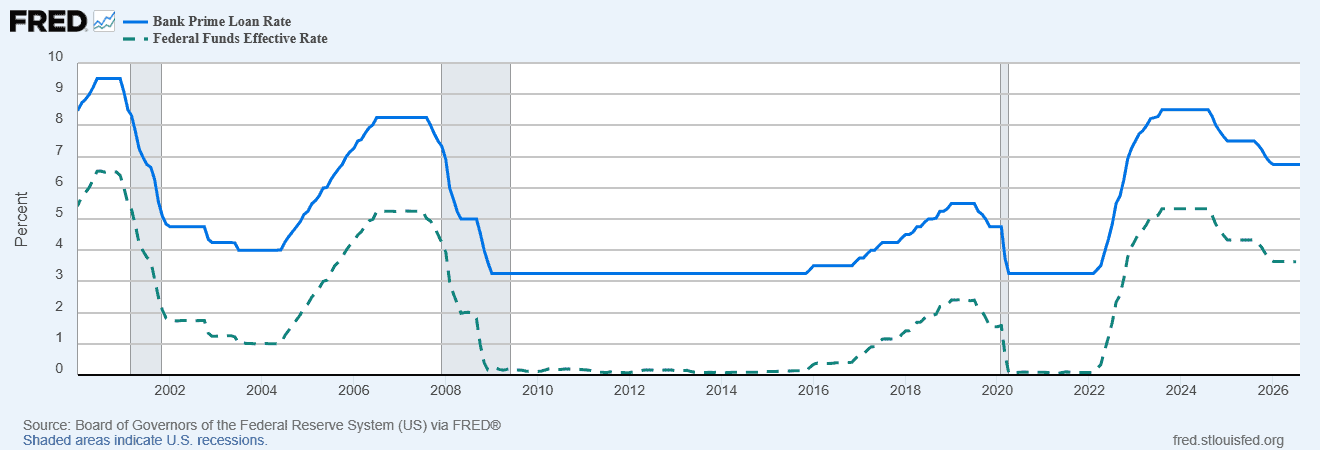
Figure 2
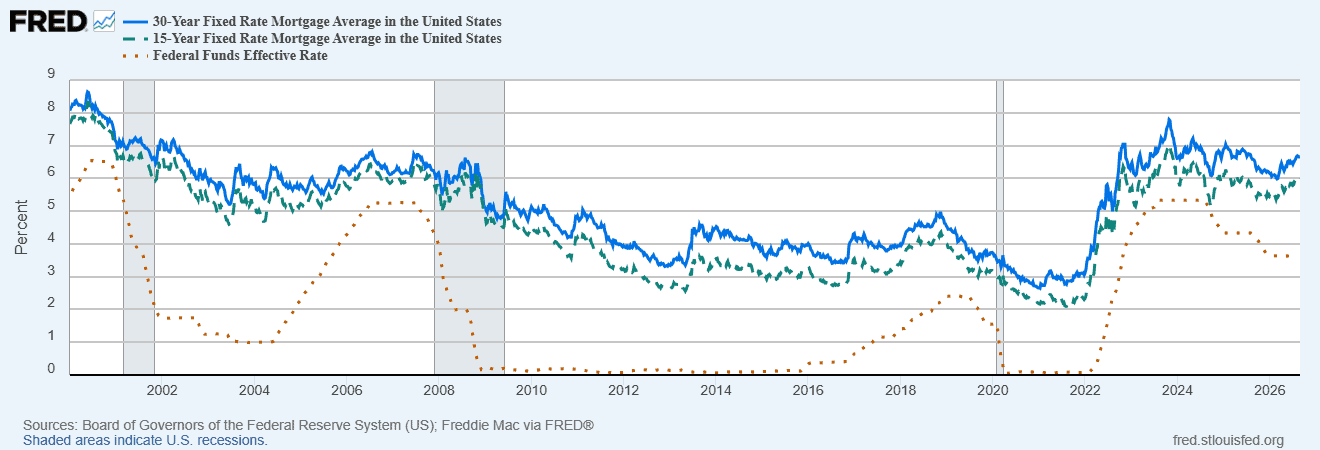
Figure 1 shows the federal funds rate and the bank prime loan rate, which is the average interest rate charged by the country’s largest banks to their top customers for short-term business loans. Figure 1 highlights two important realities. First, these two rates move together almost in lockstep (indeed, the correlation between the two in Figure 1’s sample period is .99993). And second, the level of the bank rate is always higher than the federal funds rate. This gap highlights how the federal funds rate serves only as a baseline for other interest rates, guiding, but not controlling, their values.
Figure 2 plots the federal funds rate, 30-year mortgage rates, and 15-year mortgage rates. Like with the bank rate in Figure 1, there is some co-movement between these three rates. Unlike in Figure 1, however, the three rates clearly do not move in lockstep. Sometimes, they even diverge. For instance, at the end of 2013, mortgage rates spiked even as the federal funds rate was kept near 0. As economists at the Dallas Fed note: “the difference between the 30-year primary mortgage rate and the fed funds target has been as tight as [.7 percentage points] and as wide as” 6 percentage points.
The reduced influence of the federal funds rate on mortgage rates reflects the time and risk difference between borrowing priced by the overnight rate and borrowing priced by decades-long mortgage rates. Economists at the Atlanta Fed explain that, “because the average life of a mortgage is around seven to 10 years,” mortgage interest rates “are more strongly linked to longer-term rates such as the [interest rates on] 10- or 20-year” U.S. Treasury debt. While these Treasury debt rates are, in turn, also influenced by the federal funds rate, mortgage markets also factor in “the market’s expectation for economic growth, the federal government’s fiscal policies on spending and taxation, inflation expectations, lender capacity as homeowners refinance their mortgages, borrowers’ credit risk, and so forth.” Beyond mortgages, many of these same factors will influence interest rates for all types of lending, such as car loans, municipal debt, and, yes, Chipotle burrito loans.
The Term Structure of Interest Rates and the Yield Curve
If the Fed is limited to changing one short-term interest rate, an important issue for policymakers to understand is the relationship between this short-term rate and the longer-term interest rates (such as mortgages, cars, capital investment by firms) that price the credit that drives economic growth. Economists have come up with multiple frameworks about how short-term interest rates can affect long-term rates.
In developing and understanding these frameworks, economists first look to compare short-term and long-term interest rates for loans that are the same in every way (amount, tax applications, etc.) except for how long the borrower has to repay the loan. This mapping of interest rates to the length of their loan is known as the “term structure.”
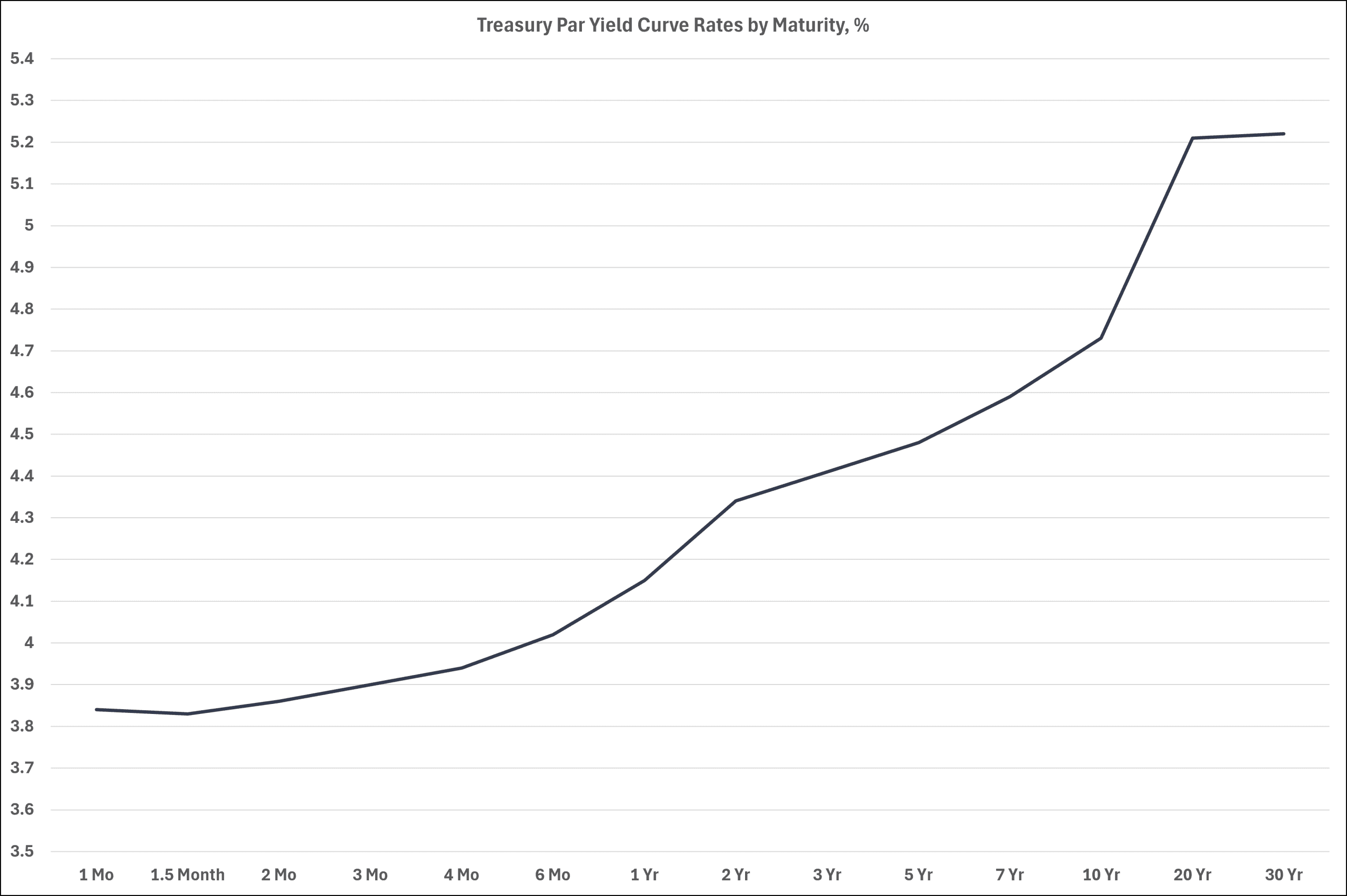
To visualize the term structure, economists and financial market participants use a yield curve, which is a plot of interest rates for similar loans with different maturities. In their analysis, these individuals typically use the yield curve for U.S. Treasury debt, which, as the most important financial asset, often sets a benchmark for interest rates for other financial assets. Because of this outsized importance, the U.S. Treasury yield curve is typically known as “the yield curve.” The plot below shows the yield curve as of August 28, 2026.
*Source: U.S. Department of the Treasury Daily Treasury Par Yield Curve Rates
Frameworks of the Term Structure: The Expectations Hypothesis
The first view of the term structure is the expectations hypothesis. There are two forms of this hypothesis: pure and unpure. Both forms begin with the same assumptions: (1) every potential loan for a specific type of borrowing is exactly the same except for the length of the loan; (2) the goal of an investor is to maximize profits; and (3) investors, without knowing what short-term interest rates will be in the future, develop expectations of these future rates.
The pure expectations hypothesis further assumes that investors behave as if their expectations are 100 percent going to come true. In other words, investors believe that interest rates in a year, or two, or three, will be exactly what they expect them to be today. The implication of this rock-solid expectation is that the interest rate on a long-term bond “of a given maturity is an average of the current short-term rate and all future expected short rates over the term to maturity.” The reason for this implication is that if the interest rate of a bond with maturity of 5 years differed from the average short-term interest rate over the next 5 years, then rock-solidly confident investors could buy the bond with a higher return while selling the bonds with lower interest rates, making off with a huge profit. In buying and selling bonds in this way, however, investors would bid up the price of the bond with higher returns and bid down the price of the bond with lower returns until there is no profit to be made. And since interest rates move inversely with a bond’s price, doing this would equalize long-term returns with the average of short-term returns.
The following simple example of the pure expectations hypothesis should further clarify how this framework works. Consider an investor who wants to invest money in bonds for two years and has the choice of investing in 2 1-year bonds or 1 2-year bond. The 1-year interest rate currently stands at 3 percent. The investor expects that next year’s 1-year interest rate will rise to 4 percent. If the investor invests in these 2 1-year bonds, he or she can expect to make a total return of 7 percent over two years. (Compounded interest means the return will differ slightly from 7 percent, but this can be abstracted away for simplicity.) On an annual basis, then, the investor will make a 3.5 percent return over 2 years. Consequently, according to the pure expectations hypothesis, the 2-year bond should have an annual interest rate of 3.5 percent to give the investor the same 7 percent return over 2 years.
The unpure expectations hypothesis assumes that investors do not have complete confidence in their interest rate expectations but instead believe there to be some uncertainty around whether their predictions of future short-term interest rates will come true. This version of the hypothesis also assumes that investors are risk averse, meaning that they must be compensated with an extra return for taking on the risk that changes in future interest rates may not be what they currently expect and, therefore, the return they receive may change. The implication of these two assumptions for the term structure is that future interest rates are the sum of the weighted average of current and future short-term interest rates expectations (the pure expectations hypothesis) and a positive risk premium that compensates investors for the risk that their long-term bonds lose value.
To further clarify the implications of the unpure expectations hypothesis, it is worthwhile to return to the simple example above. Previously, the investor expected that next year’s 1-year interest rate would be 4 percent and invested money as if that was going to happen no matter what. Now, while the investor still expects that next year’s 1-year interest rate will be 4 percent, he or she neither believes nor behaves as if a 4 percent interest rate is an absolute certainty. The investor realizes, for example, that interest rates could in fact rise to 4.1 percent, making the 2-year average interest rate 3.55 percent rather than 3.5 percent. Given this uncertainty, the investor is no longer willing to invest in a 2-year bond at a 3.5 percent interest rate – if next year’s 1-year rate rises to 4.1 percent, then a 2-year bond at a 3.5 percent interest rate will be worth less. Instead, even though the investor still expects that next year’s interest rate will be 4 percent, he or she is only willing to invest in a 2-year bond if they receive some extra return to compensate for the risk that next year’s interest rate is not 4 percent. Consequently, the interest rate on a 2-year bond might be 3.53 percent, which can be decomposed into the 3.5 percent implied by the pure expectations hypothesis and the .03 percent extra return required by the investor to assume the risk that future interest rates might turn out differently from expectations.
It is important to note that there are multiple possible risks that the risk premium could be compensating for, including credit, liquidity, and duration risk. Credit risk is the risk that the borrower does not repay the loan. Liquidity risk represents the fact that longer-term bonds cannot be sold as quickly at face value relative to short-term bonds, meaning that long-term bondholders may be forced to sell their bond holdings at a discount if they need to raise cash quickly. Duration risk is the susceptibility of the market value of longer-term bonds to changes in the term structure, which can affect the price at which investors can resell their longer-term bonds on the market.
Framework of the Term Structure: Market Segmentation
A second framework of the term structure is market segmentation. This hypothesis posits that the markets for bonds of different maturities are entirely separate (i.e. bonds of different maturities are not substitutes for each other), with different investors active in each market according to their need. For example, money market funds are active in the short-term bond market to limit duration risk while life insurance companies buy and sell long-term bonds to ensure a steady, long-term stream of income that can be used to pay out long-lasting insurance claims.
The interest rate implication of assuming that bonds are not substitutable across different maturities is that the term structure of interest rates will be determined solely by supply and demand dynamics in the market for each different maturity. In other words, short-term interest rates have no impact on long-term rates, as the interest rate on 10-year bonds rises if, and only if, demand declines or supply increases for these bonds. Similarly, this rate will decline only if demand increases or supply declines.
Framework of the Term Structure: Preferred Habitat Theory
A final view of the term structure, which combines much of the unpure expectations hypothesis with some of market segmentation, is the preferred habit theory (PHT). This theory begins with the market segmentation assumption that investors have preferred maturities. It continues, however, by agreeing with the unpure expectations hypothesis that investors are willing to substitute their investment into other, less preferred maturities if they are compensated for doing so. PHT also implies that some investors may be willing to pay a premium (accept a lower interest rate) to invest in their preferred security rather than making this substitution. The theory further agrees with the expectations hypotheses that expectations of future short-term interest rates do play a role in determining current long-term interest rates
The implications of PHT regarding the term structure are threefold. First, as just mentioned, long-term interest rates are in part determined by expectations of future short-term interest rates. Second, long-term interest rates do include a risk premium that, unlike in the expectations hypothesis, can be either positive (to compensate investors for substituting across maturities) or negative (to reflect investors’ willingness to accept lower returns to remain in their preferred maturity). And third, long-term interest rates for a given maturity can be impacted by supply-demand dynamics in that maturity market, as investors cannot wholly internalize changes in supply or demand by substituting into other maturities.
Policy Implications of the Term Structure
At this point, readers would not be remiss in thinking that the bulk of this insight has consisted of financial and economic theory. These frameworks of the term structure, however, are critical for policymakers who must contend with the effects of interest rates on economic growth and specific assets such as mortgages or cars. To elucidate the implication of these frameworks, it is useful to consider a historical example: the 2008 global financial crisis.
During the crisis, as the economy shook in the wake of mortgage defaults, bank failures, and the potential collapse of insurance giant AIG, policymakers at the Federal Reserve looked to stimulate economic activity. To do so, they turned to interest rates. Specifically, they turned to the short-term fed funds rate, which they soon lowered to almost zero to reduce the cost of borrowing.
Policymakers then faced a conundrum: Although the economy needed more stimulus, they could no longer reduce short-term interest rates. (While interest-rate policymakers in the United States have decided against lowering policy interest rates below zero, central bankers in many other countries have reduced rates below zero. For more on this question, see here.) One way to generate this additional stimulus was to somehow further reduce long-term interest rates, which had not fallen to almost zero, to make borrowing and investment even cheaper for consumers and businesses. In other words, policymakers needed to influence the term structure of interest rates.
To do so, policymakers turned to, among other things, two unconventional tools known as forward guidance and quantitative easing. Forward guidance is when policymakers at the Fed give hints as to the future path of short-term interest rates. According to both the expectations hypothesis and PHT, these hints should influence investors’ expectations of future short-term interest rates and, thus, influence current long-term rates. Although forward guidance had been used previously, forward guidance during the crisis was much more explicit in its language, detailing that the Fed was prepared to keep interest rates low for a significant period. For instance, in December 2008, the Fed stated that the economic outlook was “”likely to warrant exceptionally low levels of the federal funds rate for some time.”
In addition to forward guidance, the Fed also turned to quantitative easing (QE), or large-scale purchases of assets from financial markets, to reduce long-term yields. This quantitative easing took two forms. The first was outright purchases of assets on financial markets, while the second was using the proceeds from sales of short-term assets to purchase an equivalent number of long-term assets.
A central idea underpinning both forms of QE is that, as hypothesized by the PHT, assets with different maturities are not perfect substitutes for investors. Consequently, by buying and selling assets at different maturities, the Fed would be able to change the supply and demand dynamics of different maturities in ways that influence interest rates. With respect to the first form of QE, the Fed’s actions would have reduced long-term interest rates by reducing the public supply of long-term assets by more than the demand for these assets could adjust to bring interest rates back to equilibrium. The second form of QE, while more complicated and interesting because it involved both sales and purchases of assets, would have brought down yields through a similar mechanism.
A survey of research about crisis-era forward guidance and QE finds that both unconventional tools did in fact reduce long-term yields. This highlights not only the extent to which expectations of future interest rates and supply and demand dynamics can influence long-term yields but also illustrates why understanding the term structure of interest rates is so important for policymakers. Without this understanding of the term structure, policymakers would have been less equipped to respond.
Conclusion
As the price of borrowing, interest rates are a key input into the United States’ credit-driven economy. Yet the interest rate policymakers control, the short-term fed funds rate, does not unilaterally set the borrowing price on financial markets in the United States. There are, however, other tools available to influence interest rates across the term structure to accomplish economic goals. As policymakers’ understanding of the term structure continues to evolve and improve, this influence could perhaps become stronger, enabling more powerful and effective economic policymaking.