Research
June 10, 2026
What Happens When the Social Security Retirement Fund Goes Bankrupt?
Executive Summary
- In their 2026 report, the Social Security Trustees estimate the Social Security Old-Age and Survivors Insurance trust fund will exhaust its reserves and become insolvent by the end of calendar year 2032; upon insolvency, all beneficiaries regardless of age, income, or need will see their benefits slashed by 22 percent.
- The magnitude of the 22 percent across-the-board benefit cut will vary across different types of retirees and for retirees across the income spectrum: a newly retired single, middle-income retiree would see an annual benefit cut of $8,100, a single-income, middle-income couple would see a $12,200 reduction, and a dual-income, middle-income couple would see their benefits slashed by $16,200.
- Lawmakers’ pledge to “not touch” Social Security is not a promise to protect benefits, but an implicit endorsement of a 22 percent across-the-board benefit cut in just six years.
Introduction
In their 2026 report, the Social Security Trustees estimate the Social Security Old-Age and Survivors Insurance (OASI) trust fund – which currently pays monthly benefits to over 63 million retired workers, their spouses and children, and their survivors – is projected to exhaust its reserves and become insolvent by the end of calendar year (CY) 2032. That means the OASI trust fund will run out when today’s 61-year-olds reach the normal retirement age of 67 and today’s youngest retirees – those retiring at age 62 – turn 68.
Under the law, the OASI trust fund does not have borrowing authority, so upon insolvency it will be unable to borrow from the Treasury to close the gap between dedicated revenue and spending and continue to pay benefits in full. The Social Security Trustees estimate that in CY 2032, the OASI trust fund will have enough dedicated revenue to pay 78 percent of scheduled benefits. That means all OASI beneficiaries regardless of age, income, or need will see their benefits slashed by 22 percent across the board.
Measuring the Magnitude of a 22-percent Benefit Cut
The magnitude of the 22-percent cut in annual Social Security benefits varies for different types of retirees and for retirees across the income spectrum.
A single, low-income worker retiring at the normal retirement age in CY 2032 would see an annual benefit cut of $4,900[1]. Whereas the beneficiary would receive $22,300 in annual benefits under a solvent Social Security system, she would receive only $17,400 once the OASI trust fund becomes insolvent and the 22-percent benefit cut takes effect. A single, middle-income retiree would face a $7,400 cut, which would reduce his annual benefits from $36,800 to $28,700. A single, high-income retiree would see her benefits slashed by $10,700, from $48,600 to $37,900.
For couples, a typical single-income, low-income couple would see their annual Social Security benefits cut by $7,400, meaning their annual benefits would decline from $33,400 to $26,100. A single-income, middle-income couple would face a $12,200 cut, which would reduce their benefits from $55,200 to $43,100. A single-income, high-income couple would see their benefits slashed by $16,000, from $72,900 to $56,900.
A typical dual-income, low-income couple would see their annual benefits cut by $9,900, meaning their benefits would fall from $44,600 to $34,800. A dual-income, middle-income couple would face a $16,200 cut, which would decrease their benefits from $73,600 to $57,400. A dual-income, high-income couple would see their benefits reduced by $21,400, from $97,200 to $75,800.
Magnitude of 22-percent OASI Benefit Cut for Different Types of Retirees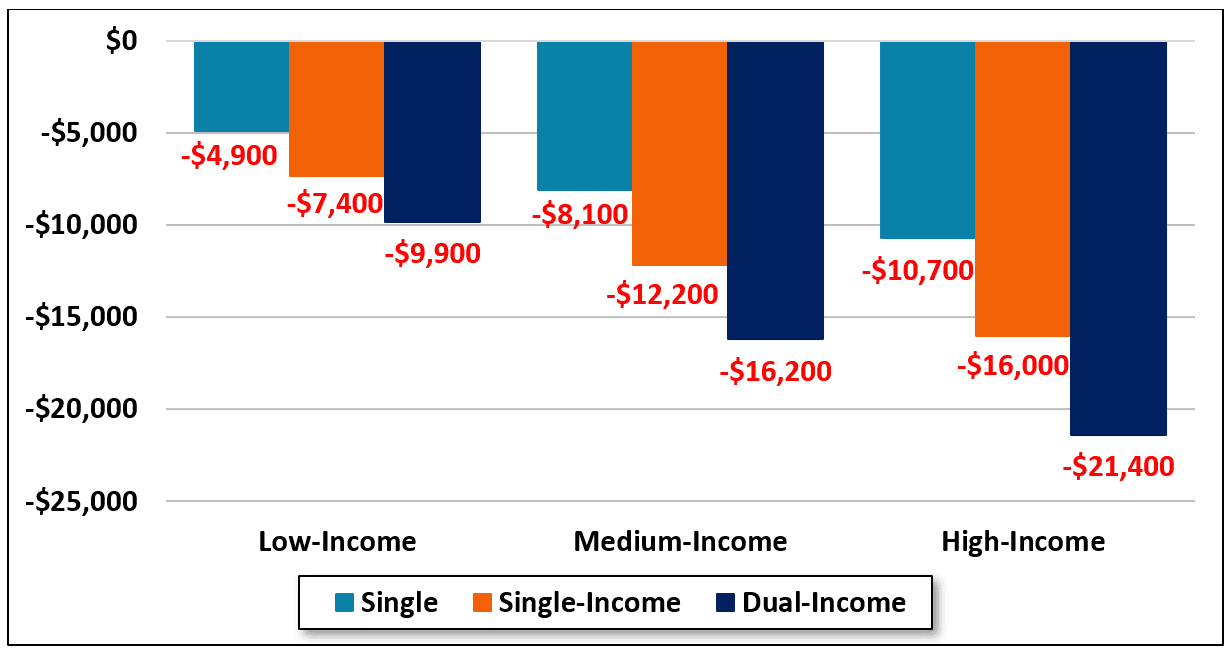
Sources: Social Security Administration and author’s calculations. Figures are in 2032 dollars and are rounded to the nearest $100.
Conclusion
Lawmakers have pledged not to touch Social Security, often declaring it “off the table” for reform. While this pledge is framed as a promise to protect benefits, it is an implicit endorsement of a 22 percent across-the-board benefit cut for nearly 71 million beneficiaries when Social Security’s retirement fund runs out in just six years. Action should be taken soon to make Social Security solvent and prevent abrupt benefit cuts.
[1] All figures are in 2032 dollars and are rounded to the nearest $100.