Research
July 14, 2026
Trump’s Potential Coal Tariffs: Overview and Implications
Executive Summary
- The U.S. Department of Commerce recently initiated a Section 232 investigation into certain coal imports, specifically coal used as inputs within the steel industry.
- This investigation may result in a Section 232 national security tariff on targeted coal imports, which aligns with the administration’s policy and financial support for the domestic coal industry, as well as its general positive view toward tariffs.
- This research estimates that a coal tariff would result in $6 million in additional annual costs for U.S. businesses, rising to $16–$26 million if trade agreement exemptions are not honored or import volumes rise to 2024 levels.
Introduction
On June 29, the U.S. Department of Commerce (DOC) initiated a Section 232 investigation into certain coal imports, specifically anthracite coal and metallurgical bituminous coal used as inputs in the steel industry.
This investigation may result in a tariff on targeted coal imports, which aligns with the administration’s strong policy and financial support for the domestic coal industry. By invoking the Section 232 national security legal authority, the administration is likely to make the case that coal tariffs would be critical for boosting domestic coal production and ensuring there is sufficient domestic supply for U.S. steel manufacturing.
This research estimates that a coal tariff would result in $6 million in additional annual costs for U.S. businesses, rising to $16–$26 million if trade agreement exemptions are not honored or import volumes rise to 2024 levels.
A Section 232 Investigation Into Coal
The DOC’s Section 232 investigation into certain coal imports will focus on anthracite coal and metallurgical bituminous coal used as raw materials in the production process of the steel industry. Section 232 refers to the Trade Expansion Act of 1962, which allows the president to impose tariffs or otherwise restrict imports in the name of national security (more information here). Unlike the president’s prior use of the International Emergency Economic Powers Act (IEEPA) to impose tariffs on the grounds of national security, Section 232 holds more robust historical precedent and has been used on a wide variety of imports including steel, aluminum, copper, wood, automobiles, semiconductors, and pharmaceuticals.
The targeted coal – anthracite and bituminous – have high carbon content and heating value compared to other varieties. Anthracite coal has the highest carbon content (86–97 percent) with the highest heating value of all types of coal. It is mainly used in the metal manufacturing industry, such as steelmaking. Bituminous coal contains 45–86 percent carbon. It serves as a raw material for making coking coal, which is essential for steel and iron production.
DOC highlighted the importance of the two targeted types of coal in steelmaking, stating they “are considered critical materials for domestic steel production and industrial processes, including their role as derivative articles of steel for potential coverage under Section 232 tariffs.”
While the anticipated timeline from start to finish for a Section 232 investigation varies, the recent use of the authority shows that a tariff can be expeditiously implemented. The typical process can take up to 375 days to go through the fact-finding process, public comment period, and finalization of recommended actions. During President Trump’s first term, for instance, it took 338 days to impose the initial tariffs on steel and aluminum. More recently, however, the 2025 investigation into copper was launched on March 10 and the executive order imposing a tariff took effect on August 1 – just 144 days. Using this case as an example, a coal tariff could be implemented as soon as the end of the year or in the first quarter of 2027.
Notably, the targeted coal products are exempt from the administration’s existing tariffs, including the overruled “reciprocal” tariffs under the International Emergency Economic Powers Act, Section 122 tariffs, and the Section 301 tariffs (the United States Trade Representative has proposed to exclude coal from the tariffs on “forced labor” ground).
U.S. Imports, Exports, and Production of Coal
Imports and exports
In 2025, the United States imported just over $120 million in anthracite and bituminous coal (harmonized tariff system codes 2701.11.0000 and 2701.12.0010) or close to 630,000 metric tons. Of the total imported coal in the same year, anthracite coal imports accounted for about $37 million, with a majority ($24 million) from Peru, and the rest from the United Kingdom and China. Metallurgical bituminous coal imports mostly originated from China with a total cost of $86 million for the year.
Despite the exorbitantly high tariff rates imposed by President Trump under IEEPA, calculated tariffs were just $5,000 in 2025 due primarily to exemptions. In fact, coal imports targeted in the 232 investigation have been tariff-free for 30 of the past 35 years. Imports from China have faced tariffs since 2019, but the effective tariff rates have rarely exceeded 1 percent.
Notably, the United States has been a net coal exporter, meaning that it exports more coal to other countries than it imports from the rest of the world. The net exporter status of the United States indicates that it is not critically reliant on foreign sources of coal which could in theory endanger domestic supply chains. The fact that there is not a significant reliance on imports means that justifying a national security action will require the administration to focus on other factors that threaten the U.S. economy in some way.
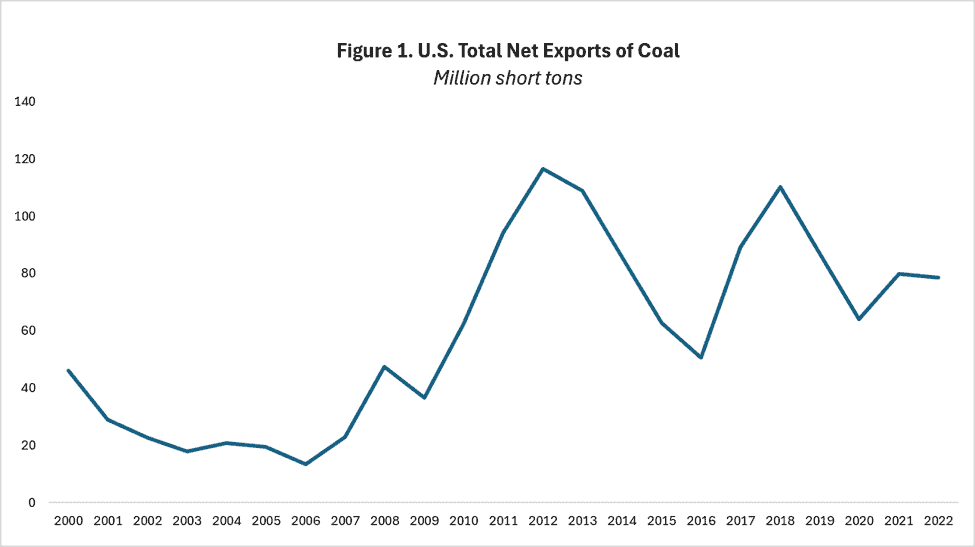
Source: The United States International Trade Commission
Production
As shown in Figure 2, U.S. total coal production has declined significantly over the past two decades, from 1,127 million short tons in 2001 to 512 million short tons in 2024. This is driven by a variety of factors, including the competition from the soaring U.S. domestic production of natural gas, aging coal plants scheduled for retirement, emissions reduction regulations at the federal and state levels, and U.S. steel manufacturing transitioning from using blast furnaces (consuming coal) to electric arc furnaces (consuming electricity). While bituminous coal accounts for about half of total U.S. coal production, anthracite coal accounts for less than 1 percent of the coal mined in the United States. It is also worth noting that although domestic production has fallen by 55 percent over the past 20 years, U.S. mines still produced roughly 230 million metric tons in 2024.
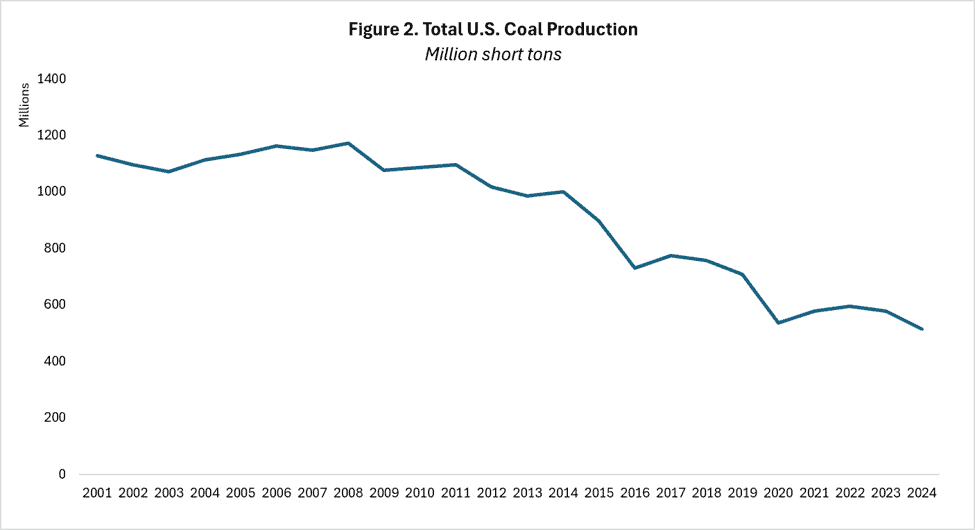
Source: United States Energy Information Administration
Trump Administration’s support for the coal industry
The Trump Administration has been providing strong policy and financial support for the U.S. coal industry. In 2025, the administration released several executive orders (EOs) to significantly boost U.S. production of “beautiful, clean” coal as part of President Trump’s energy independence agenda. American Action Forum’s previous insight provided an analysis of these EOs.
Earlier this year, President Trump announced $500 million in funds through the Defense Production Act and other grants to help support U.S. existing coal plants. The Department of Energy has also ordered five coal-fired power plants to delay their scheduled retirement to ensure sufficient electricity generation.
The administration’s potential levy of tariffs on high-carbon imported coal seems to align with its strategy in prioritizing domestic coal production. By invoking the Section 232 legal authority, the administration is likely to make the case that coal tariffs would be critical for boosting domestic coal production and ensuring there is sufficient domestic supply for U.S. steel manufacturing.
Impact of a Coal Tariff
As many of the Trump Administration’s Section 232 tariffs have had a 25-percent rate, it is reasonable to assume such a tariff on coal would follow suit. This research estimates that if the administration imposes a 25-percent tariff on anthracite and bituminous coal, it would result in approximately $16 million in additional annual tariff costs.
Assuming compliance with the United States-Mexico-Canada Agreement (USMCA) results in tariff exemptions, these costs could be lowered to around $6 million as about 70 percent of impacted coal imports came from Canada in 2025. If import volumes were to return to 2024 levels, additional annual tariff costs would rise to $26 million or about $5.5 million, assuming USMCA compliance exemptions.
Regardless of the exact import volumes and USMCA compliance, input costs for the U.S. steel industry would rise sharply from current levels, resulting in unintended headwinds against the Trump Administration’s goal of boosting domestic steel and aluminum production. As input costs rise, it will become more expensive for some U.S. steel producers to manufacture their steel products, thereby hurting the steel industry’s competitiveness and endangering steel jobs. Additionally, more expensive steel products will undoubtedly have ripple effects for other downstream manufacturing that rely on steel as an input for their industries.