The Shipment
April 2, 2026
“Liberation Day” Anniversary Edition
(Not So) Fun Fact: China has launched trade barrier investigations on the United States that may result in tariffs on U.S. exports, likely in response to new Section 301 investigations.
Looking Back at IEEPA to See What’s Next
What’s Happening: On this one-year anniversary of “Liberation Day,” the Trump Administration continues its attempt to recreate the now-defunct International Emergency Economic Powers Act (IEEPA) tariffs. The president has imposed a 10-percent tariff on many U.S. imports using Section 122 of the Trade Act of 1974 on the grounds of addressing a non-existent balance of payments deficit. But this is only a temporary fix, as the authority is limited to 150 days unless extended by Congress. To replace these temporary duties, the Trump trade team has been working on a third tariff regime, which will rely on Section 301 of the Trade Act of 1974 to combat unfair trade practices and Section 232 of the Trade Expansion Act of 1962 for national security concerns. These authorities have historic and legal precedent. Two 301 investigations covering 99 percent of imports are underway, as are multiple 232 investigations aimed at adding to the current list of purported national security tariffs.
Why It Matters: The end of IEEPA tariffs removed hundreds of billions of dollars in added annual costs for U.S. businesses and consumers, with up to $175 billion expected to be returned to importers who paid the tariffs. While the automated system for distribution is still being finalized, these refunds could materialize by the end of April if progress holds steady. Despite IEEPA refunds, the Trump Administration’s persistent efforts to “liberate” the United States from foreign goods continues to cause a great deal of uncertainty. Businesses that finally receive their IEEPA refunds may end up using that cash to pay the new – albeit lower – Section 122 tariffs that are facing legal challenges of their own. A group of 24 states alongside two small businesses have taken legal action against the administration that may result in a second wave of tariff refunds.
The Shipment estimates that Section 122 tariffs will cost U.S. consumers and businesses roughly $25 billion alongside other burdens including paperwork, ensuring compliance, and customs brokers. These additional burdens result in lost labor hours and higher administrative costs that will not be refunded if Section 122 is struck down. Additionally, money taken from U.S. importers is money not spent on investment, workers, or innovation which represents another opportunity cost. While the tariffs inflict direct costs, uncertainty itself adds additional economic costs that will continue to compound going forward.
Looking Ahead: The Shipment expects that more Section 301 investigations will be announced in the coming weeks. These may include investigations into fishing, digital services barriers, and agricultural practices to name a few of the topics the Trump Administration has zeroed in on when negotiating trade deals. Additionally, it is possible that new Section 232 tariffs will finally be imposed by mid-July, including those on pharmaceuticals, aircraft, polysilicon, and unmanned aircraft systems.
Figure 1: Inexhaustive List of Pending, Delayed, or Forgotten Tariff Threats
|
Tariff Threat |
Tariff Rate | Stated Reason | Status |
Date |
|
Colombia |
25% to 50% | Immigration | Never Implemented | Jan-25 |
|
Venezuela (Secondary) |
25% | Oil | Never Implemented | Mar-25 |
| Canadian Dairy | 250% | Unfair Trade Practices | Never Implemented |
Mar-25 |
|
Canadian Lumber |
250% | Unfair Trade Practices | Never Implemented | Mar-25 |
| Russia (Secondary) | 25% to 100% | Oil | Partially Implemented & Reversed |
Mar-25 |
|
China |
125% | Trade War | Reversed | Apr-25 |
| Movies | 100% | National Security | Never Implemented |
May-25 |
|
BRICS |
10% | Anti-American Policies | Never Implemented | Jul-25 |
| Countries with a Digital Service Tax | Not Specified | Unfair Trade Practices | Never Implemented |
Aug-25 |
|
Canada |
10% | TV Ad | Never Implemented | Oct-25 |
| China’s Maritime, Logistics, and Shipbuilding Sectors | Not Specified / Section 301 | Unfair Trade Practices | Delayed |
Nov-25 |
|
China’s Technology Transfer, Intellectual Property, and Innovation Practices |
Not Specified / Section 301 | Unfair Trade Practices | Delayed | Nov-25 |
| Mexico | 5% | Water Treaty Dispute | Never Implemented |
Dec-25 |
|
Wood Products |
Tariff Hike Paused for Year | National Security | Partially Delayed | Dec-25 |
| Iran (Secondary) | 25% | Oil | Never Implemented |
Jan-26 |
|
Canada |
100% | China Trade Deal | Never Implemented | Jan-26 |
| Cuba (Secondary) | Not Specified | Oil | Never Implemented |
Jan-26 |
|
Greenland (Secondary) |
10% to 25% | European Troop Deployment | Never Implemented | Jan-26 |
| Italian Pasta | 2% to 14% Instead of 92% | Unfair Trade Practices | Reduced |
Jan-26 |
|
Canadian Aircraft |
50% | Refusal to Certify Gulfstream Jets | Never Implemented | Jan-26 |
| French Alcohol Products | 200% | Unwilling to Join Board of Peace | Never Implemented |
Jan-26 |
In Other News
China Retaliates Against Section 301: Late last week, China’s Ministry of Commerce announced two trade barrier investigation into the United States, likely in retaliation for the U.S. Section 301 investigations on excess capacity and forced labor. The Chinese investigations cover U.S. measures to restrict imports of green energy products as well as measures that undermine global supply chains. Specifically, this includes restrictions on cooperation relating to green products, slowing down the deployment of green energy projects, restricting U.S. market access to Chinese goods, prohibiting U.S. exports of high-tech products to China, and limiting two-way investments in certain industries. The Chinese government claims this is economically damaging to Chinese companies, with the investigations set to complete in as soon as 6 months. Make no mistake, these investigations are almost certainly a direct response to anticipated U.S. tariffs and meant to build leverage in the leadup to the meeting between President Trump and Leader Xi in mid-May. The storm clouds of another U.S.-China trade war may be gathering.
The World Trade Organization: The World Trade Organization digital services and e-commerce tax ban expired this week, allowing countries to impose “tariffs” on streaming services and other digital domains. This comes despite the United States pushing for a permanent ban and coming to a side agreement with 66 countries to keep the moratorium in place. Brazil and Turkey blocked a move to extend the moratorium on digital taxes; however, it is possible that an agreement is reached at the next WTO meeting in May. The Trump Administration has made it clear in many of the U.S. trade deals struck so far that digital services should remain free from discriminatory fees that primarily hurt U.S. businesses. If a moratorium agreement is not reached and other countries begin imposing digital taxes, the Trump Administration is highly likely to launch a Section 301 investigation targeting these unfair trade practices.
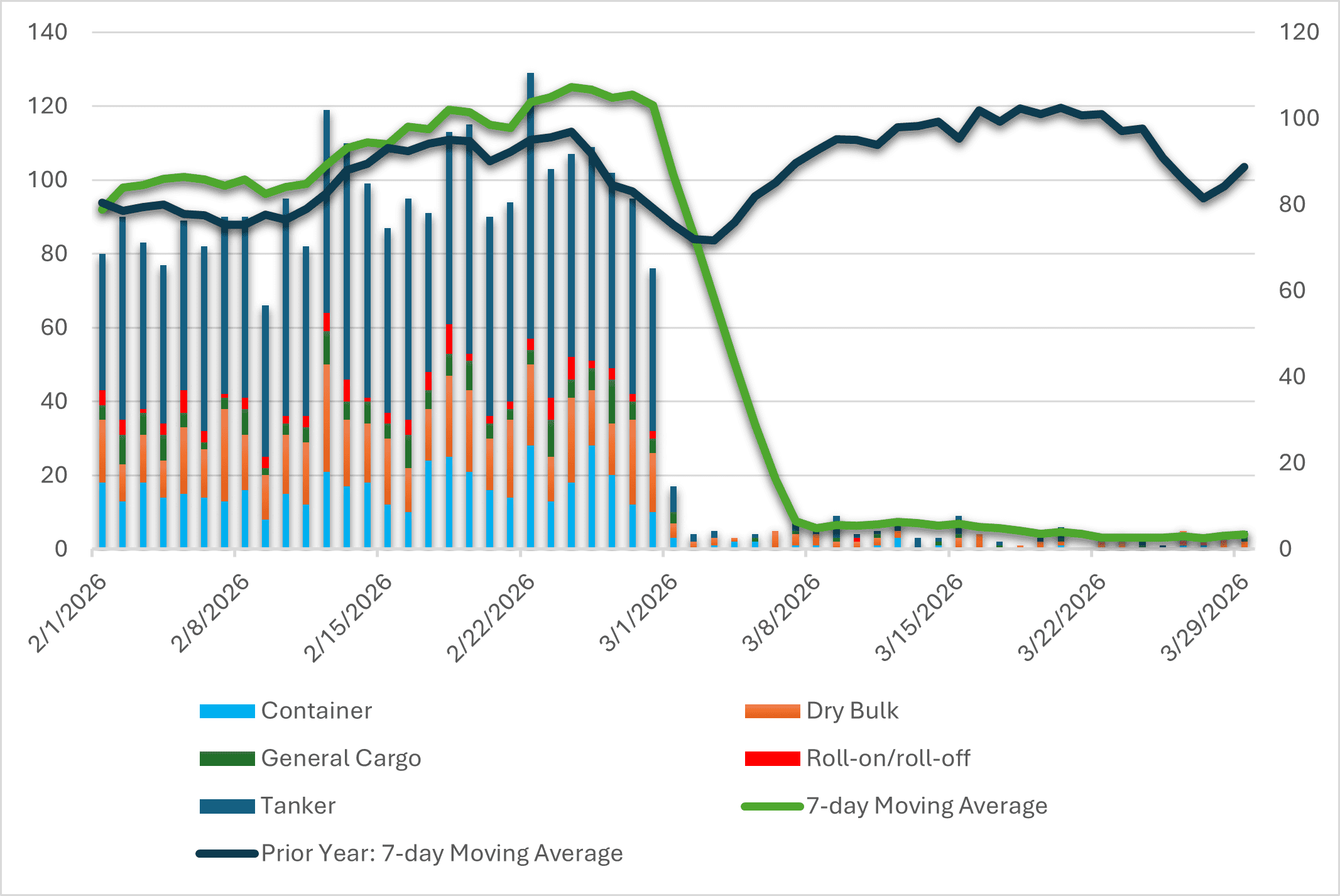
Updates on the Iran Conflict: Since President Trump’s speech on the Iran conflict last night, oil prices have surged roughly 8 percent for Brent crude and 10 percent for West Texas Intermediate crude. Global markets have also retraced the gains made earlier in the week, with the S&P 500 down about 1.5 percent likely due to the president stating that the United States will continue to strike Iran for another 2 or 3 weeks rather than seek a deal. The U.S. national average gas price now sits at $4.08, a 36-percent increase from one month ago and about a 2.5-percent increase from just one week ago. At the same time, the Strait of Hormuz is still effectively closed, with traffic at roughly 4 percent of normal levels. Now, 26 countries have taken measures to conserve and ration energy, particularly those in Asia that are almost exclusively reliant on imports. As the Shipment has covered extensively, a lack of energy, fertilizer, and other Middle East exports will have severe economic consequences that translate into higher global inflation and lower growth.
Figure 2: Strait of Hormuz Transit Calls by Number of Ships