The Shipment
July 9, 2026
Investigating Coal and Walmart Price Cuts

(Not So) Fun Fact: Only 13 tankers transited the Strait of Hormuz yesterday, as U.S. strikes on Iran resumed earlier this week; this break in the ceasefire has reversed much of the progress seen in recent weeks when traffic approached 40 percent of pre-conflict levels.
A Coal Tariff
What’s Happening: Last week, the U.S. Department of Commerce initiated a Section 232 investigation into certain coal imports, specifically the type of coal used as an input for the steel industry. Section 232 refers to the Trade Expansion Act of 1962 and allows the president to impose tariffs or otherwise restrict imports to promote national security concerns. This is just the latest use of Section 232 by the Trump Administration, which continues to rely on it to maintain a protective barrier for domestic industries it considers vital to the U.S. economy. Thus far, the administration has announced Section 232 tariffs between 10–50 percent on steel, aluminum, copper, wood, automobiles, semiconductors, and pharmaceuticals. Further investigations floating in the background include those on critical minerals, aircraft, wind turbines, drones, medical equipment, and industrial machinery. While current and potential 232 tariffs include hundreds of different imported products, the coal investigation is confined to just Anthracite and Metallurgical Bituminous coal – at least for now.
Why It Matters: In 2025, the United States imported just over $120 million in anthracite and bituminous coal (harmonized tariff system codes 2701.11.0000 and 2701.12.0010) or close to 630,000 metric tons. Despite the exorbitantly high tariff rates imposed by President Trump under the International Emergency Economic Powers Act (IEEPA), calculated tariffs were just $5,000 in 2025 due largely to exemptions. In fact, coal imports targeted in the 232 investigation have been tariff-free for 30 of the past 35 years. Imports from China have faced tariffs since 2019, but the effective tariff rates have rarely exceeded 1 percent. It is also worth noting that although domestic production has fallen by 55 percent over the past 20 years, U.S. mines still produced roughly 230 million metric tons in 2024.
As many of the Trump Administration’s Section 232 tariffs have had a 25-percent rate, it is reasonable to assume such a tariff on coal would spike costs for U.S. businesses that rely on this material. The Shipment estimates that if the administration imposes a 25-percent tariff on anthracite and bituminous coal, it would result in approximately $16 million in additional annual costs. Assuming compliance with the United States-Mexico-Canada Agreement (USMCA) results in tariff exemptions, these costs could be lowered to around $6 million as about 70 percent of impacted coal imports come from Canada. Regardless of USMCA compliance, input costs for the U.S. steel industry would rise sharply from current levels, resulting in unintended consequences for the Trump Administration’s goal of boosting domestic steel and aluminum production.
Looking Ahead: It will be months before a potential Section 232 tariff on coal is finally implemented, assuming President Trump gives the green light. It can take up to 375 days to go through the fact-finding process, public comment period, and finalization of recommended actions. During President Trump’s first term, for instance, it took 338 days to impose the initial Section 232 tariffs on steel and aluminum. In contrast, the investigation into copper was launched on March 10, and the executive order imposing a tariff took effect on August 1 – just 144 days. Based on this and the fact that recent investigations have been conducted expeditiously, the Shipment would not be surprised if a coal tariff was put in place by the end of 2026.
Walmart Price Cuts
What’s Happening: This week, Walmart – alongside its subsidiary Sam’s Club – announced that it will lower prices on certain groceries, household essentials, outdoor items, toys, and apparel. The press release states that this move will provide cost savings for customers across thousands of products nationwide, and highlights price reductions for ground beef, potato chips, paper plates, sodas, cherries, and corn. Sam’s Club plans to lower prices on around 250 items, including summer food staples such as hot dogs, chicken wings, ground beef, and ribs. President Trump posted on Truth Social on the same day as Walmart’s announcement, commending the company as “one of the biggest, best, and smartest Retailers in America.” The president also stated that Walmart was lowering prices at the request of the Trump Administration to celebrate the 250th anniversary of the United States and reverse the inflation seen under the Biden Administration. Walmart has yet to cite the administration as a reason for these price cuts, which were previewed in a May announcement of price reductions tied to tariff refunds.
Why It Matters: This news is significant for two main reasons. First, it is important for U.S. consumers who are concerned with rising grocery prices, general inflation, and the cost of living. Walmart is the largest retailer in the United States, with nearly $600 billion in retail sales and close to 20 percent of the e-commerce grocery market. Additionally, roughly 95 percent of U.S. consumers visit the store at least twice a year, meaning prices at Walmart have a substantial impact on both consumers and the plans of competing companies. Second, this provides further evidence that tariff refunds to U.S. importers/businesses are beginning to benefit U.S. households via lower prices and fewer price hikes. The Shipment has referred to these as “secondary refunds” as the direct tariff refunds are gradually passed along to consumers just as costs were gradually passed along (read more here). These “secondary refunds” from Walmart alone could amount to billions of dollars as the company is eligible for anywhere from $2.4 billion to as much as $10.2 billion in tariff refunds. From this perspective, the Trump Administration may correctly claim some responsibility for these price reductions as it sends back the tariff revenue it illegally collected, causing input costs for businesses to rise in the first place.
Looking Ahead: Walmart remains the only large U.S. retailer to announce price reductions, but it is highly possible that other businesses will follow suit as the refund process continues. One hiccup to future consumer cost savings is tariff uncertainty, and most notably the Section 301 tariffs planned by the Trump Administration. A Federal Reserve paper from this week shows that nearly 44 percent of manufacturers and 47 percent of service firms anticipate more tariff-related price increases going forward (most of which may come in the next six months). President Trump appears to be dead set on maintaining a formidable tariffs even after IEEPA was struck down and Section 122 tariffs expire on July 24. A third tariff regime may hinder consumer savings efforts as companies receive IEEPA tariff refunds only to pay for a third iteration of President Trump’s tariff agenda.
Figure 1: Walmart and Sam’s Club Price Reductions by Product (Featured in Press Release)
|
Product |
Old Price | New Price |
Percent Change |
| Fresh Sweet Corn on the Cob |
$0.68 |
$0.25 |
-63% |
| Fresh Red Cherries 2.25 lb. bag |
$11.18 |
$5.63 |
-50% |
| Coca-Cola, Diet Coke and Coca-Cola Zero Sugar 24-packs |
$14.97 |
$9.97 |
-33% |
| Pepsi, Diet Pepsi, Dr. Pepper and Diet Mountain Dew 24-packs |
$13.97 |
$9.97 |
-29% |
| Great Value Ice Cream 48 fl. oz |
$2.97 |
$2.50 |
-16% |
| Lay’s Classic Potato Chips 8 oz bag |
$2.97 |
$2.50 |
-16% |
| 1 lb. 73% Ground Beef Roll, Fresh |
$6.74 |
$5.94 |
-12% |
| Frito-Lay Family Fun Variety Pack, 18-count |
$9.97 |
$8.97 |
-10% |
| Great Value Disposable Paper Plates, 200-count |
$9.97 |
$8.97 |
-10% |
|
Sam’s Club |
|||
| Bone-In Chicken Wings (per pound) |
$2.88 |
$2.00 |
-31% |
| Beef Hot Dogs |
$12.96 |
$10.86 |
-16% |
| Whole Bone-In Pork Back Ribs (per pound) |
$3.48 |
$3.18 |
-9% |
| 88/12 Ground Beef (per pound) |
$6.17 |
$5.97 |
-3% |
Source: Walmart
Figure 2: Status of the IEEPA Tariff Refund Process (As of June 29, 2026)
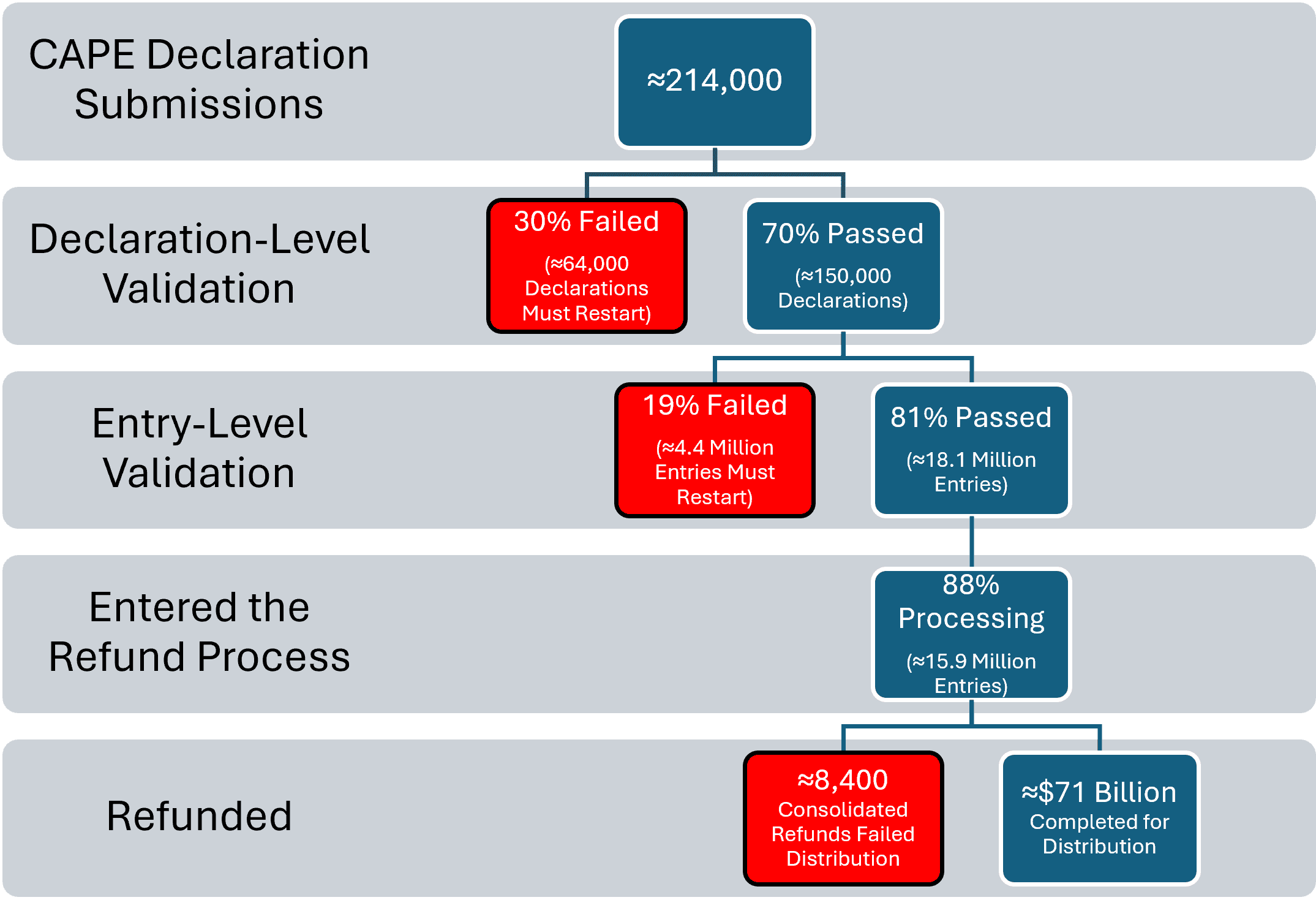
Source: United States Court of International Trade Court Filings