The Shipment
April 3, 2025
Post- “Liberation Day” Edition: Liberation From Global Trade
Reciprocal Tariffs in Name Only
What’s Happening: On April 2, which the administration has dubbed “Liberation Day,” President Trump announced new tariff rates on all U.S. trade partners alongside 25-percent tariffs on all automobile imports. These “reciprocal” tariffs are far larger and wide sweeping than predicted, and while many speculated on how the administration might calculate and implement these tariffs, almost no one anticipated the White House’s final decision. The reciprocal system the Trump Administration eventually chose places separate tariff rates on each U.S. trade partner ranging from a baseline rate of 10 percent up to 50 percent, depending almost entirely upon the size of the U.S. trade deficit with that country. This heavy-handed approach, which places 20- and 30-percent tariffs on numerous countries, has been met with widespread condemnation from many U.S. trade partners, some of whom have already announced future retaliatory tariffs.
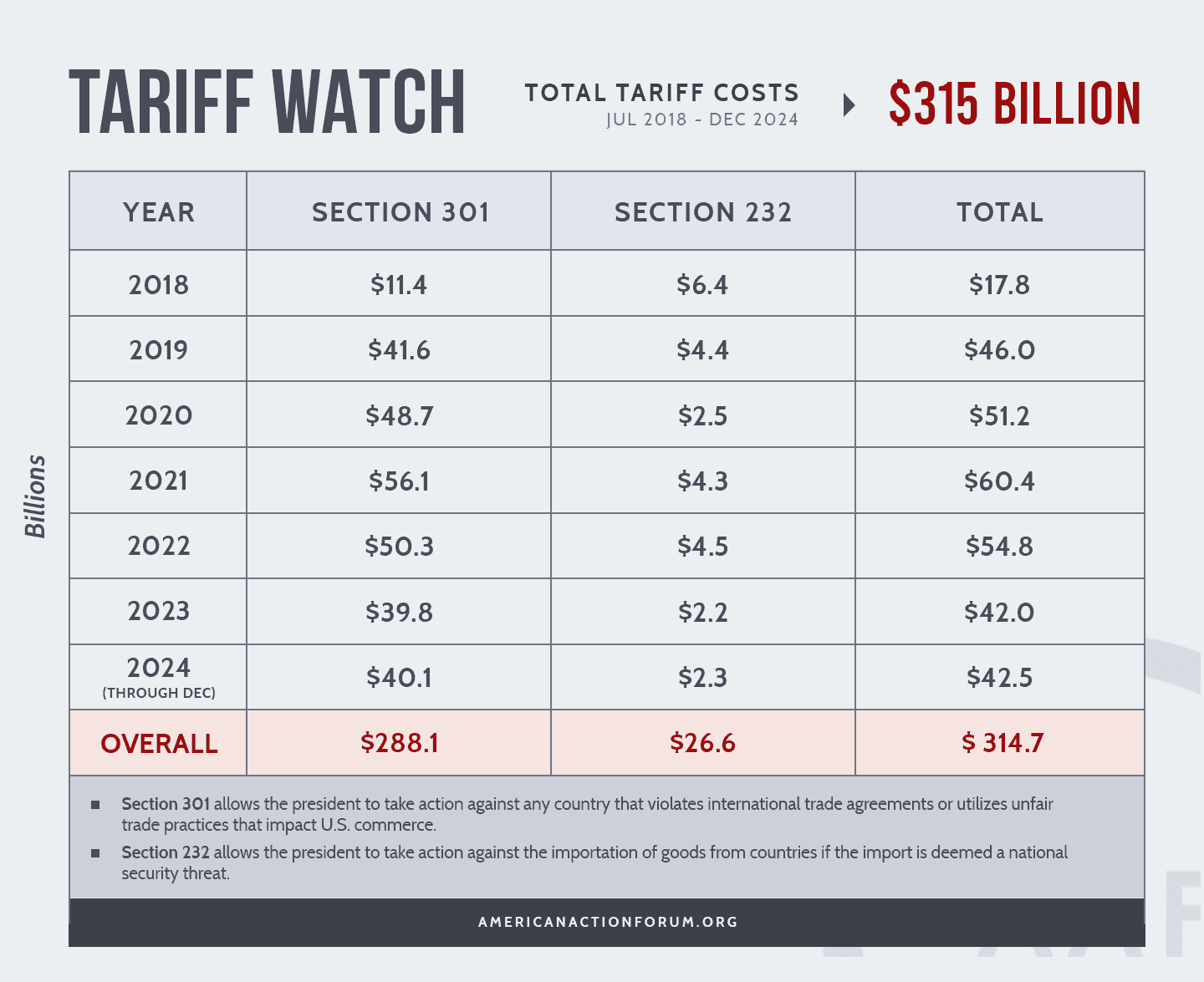
Why It Matters: The April 2 announcement marks one of, if not the, largest tax hikes in U.S. history. As outlined in recent American Action Forum research, the overall cost of “Liberation Day” tariffs, auto tariffs, and all other newly implemented tariffs will be between $366.5–391.6 billion on an annual basis. These tariffs are not, in fact, “reciprocal,” as they in no way match the weighted average tariffs of other countries and instead calculate reciprocity by considering any trade deficit as evidence of a non-tariff barrier. The most stunning consequences of these new tariffs are that they stack on top of many previously imposed tariffs, meaning the tariff rate on many imports from, for example, China, will be 54 percent going forward. China, the European Union (EU), Mexico, and Canada have each stated they will pursue greater retaliatory measures than previously announced. Retaliatory tariffs against U.S. exports and any other protectionist measures that might target U.S. companies will only amplify the pain of the current global trade war. It is difficult to determine the short-term impact retaliation may cause, but it will almost certainly lower U.S. growth expectations, damage U.S. market access abroad, and eventually contribute to labor market contractions.
Looking Ahead: The path ahead is clouded in uncertainty. The Trump Administration has provided no clarity on whether these tariffs might be lowered or any other indication that countries can negotiate an offramp. The fact that each tariff rate is connected to the U.S. trade deficit with that country is an indication that these tariffs may not go away any time soon and are really intended to completely upend the current global trade environment, perhaps by attempting to erase trade imbalances entirely – an impossible task.
Responses to Steel and Aluminum Tariffs
What’s Happening: On Tuesday, the EU trade commissioner met with the U.S. Trade Representative and the Department of Commerce secretary to discuss the new 25-percent tariffs on all U.S. steel and aluminum imports, which have been firmly in place for just over two weeks. The EU announced it would retaliate with tariffs on $28 billion worth of U.S. goods starting April 1 but has since pushed this back to April 13 to buy time for negotiations. Recent U.S. tariffs on steel and aluminum have sent shockwaves to other parts of the world, as well, influencing several countries to institute protectionist measures of their own and prompting global steel production cuts. Vietnam, South Korea, India, and Brazil have each implemented tariffs or launched investigations that will lead to protections against Chinese steel. As a response to an anticipated drop in demand, many Chinese steel producers plan to lower their production, with the world’s largest producer planning a 10-percent output cut this year.
Why It Matters: As of now, the trade meeting has not resulted in any concrete agreements to resolve the U.S.-EU trade war, meaning it may only escalate further. If EU retaliatory tariffs go into effect, they will primarily impact U.S. agricultural and alcohol products, which are already being hit by Chinese tariffs and Canadian boycotts. Additionally, the longer U.S. steel and aluminum tariffs remain in place, the costlier it will be for businesses to purchase these vital inputs, thereby raising prices all the way down the supply chain until they impact U.S. consumers. The same story holds true for other countries instituting steel tariffs of their own. This tariff ripple effect, alongside production cuts from China, may exacerbate rising material costs for the foreseeable future, negatively impacting construction and canned products.
Looking Ahead: As previously mentioned, President Trump and his trade team announced wide-sweeping reciprocal tariffs, as well as specific tariffs on automobiles, semiconductors, copper, pharmaceuticals, and lumber. These tariffs will compound the effects of the steel and aluminum tariffs and the 20-percent tariffs on China. That will only further complicate trade negotiations with the EU and China, which are still in the process of responding to past tariffs. The likelihood that major trade deals can be completed any time soon is not exactly high, yet some countries, such as India, have stated they are open to lowering their own tariffs to reduce the impact of U.S. reciprocal tariffs.