The Shipment
July 10, 2025
Tariff Deadline Fake-out: Tariff Delay Further Delayed
“Fun Fact”: President Trump announced that imports from Brazil will face a 50-percent tariff beginning August 1 despite the United States having had a roughly $6 billion trade surplus with Brazil in 2024.
The Tariffs That Were Promised
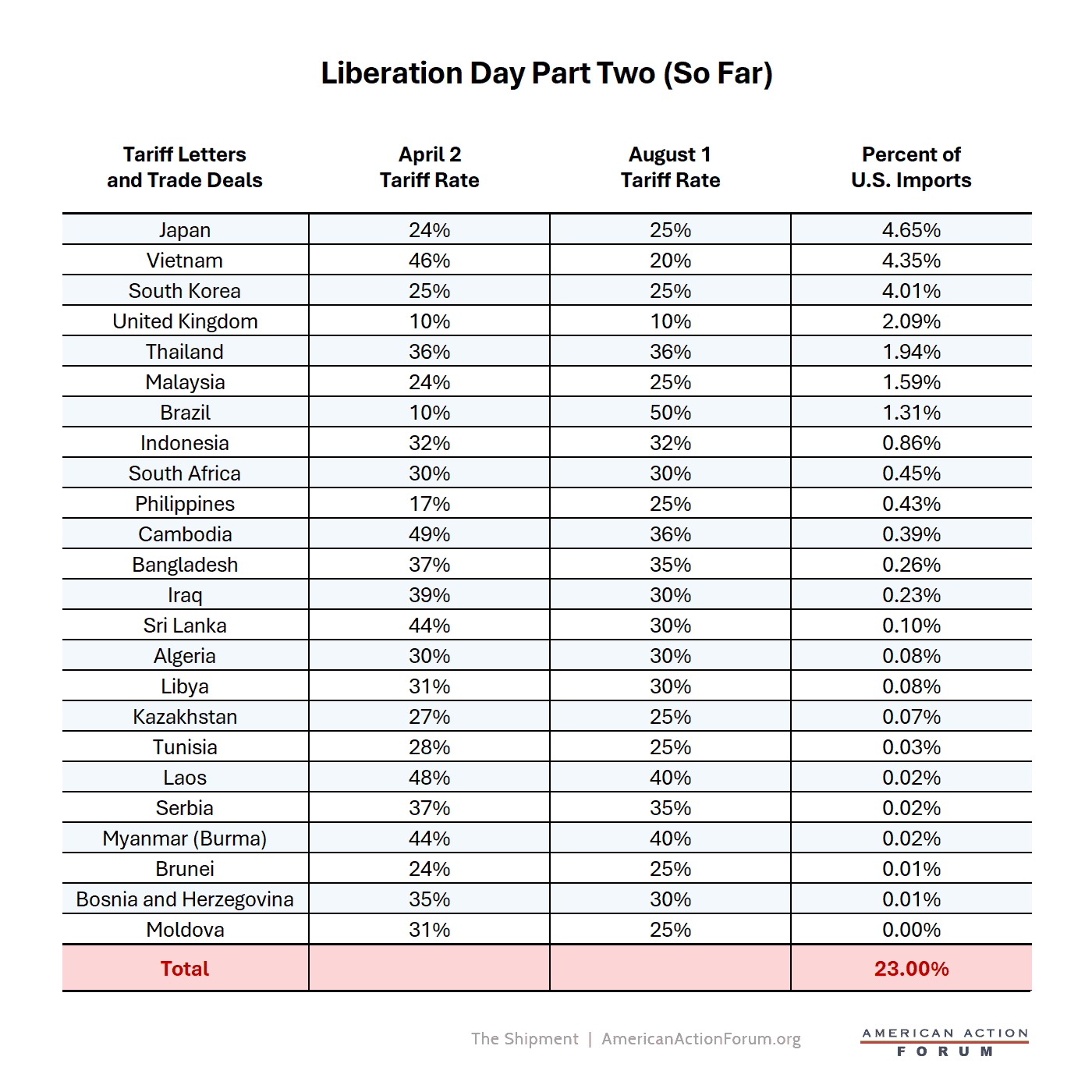
What’s Happening: The “Liberation Day” tariffs that were initially delayed until July 9 were delayed once again, this time until August 1. Reportedly, Treasury Secretary Scott Bessent was a key proponent of extending the deadline to provide more time for the administration to strike trade deals. Despite the delay, the Trump Administration has begun releasing letters to countries with their new tariff rates that will officially kick in on the day of the newly established deadline. These letters have been posted via the president’s Truth Social account and have yet to be published on the White House website or by the United States Trade Representative. Perhaps the most important tariff announcements were those placed on South Korea and Japan – both facing a rate of 25 percent – which signaled that new tariff rates on other countries might be nearly the same as on “Liberation Day.”
Why It Matters: As of now, 22 countries have received tariff letters, raising potential costs to U.S. businesses and consumers by nearly $45 billion annually. Including the recent Vietnam “trade deal” (which raised tariffs from 10 to 20 percent), the annual “Liberation Day” tariff costs have increased from approximately $225 billion to close to $279 billion. This means the Trump Administration is once again approaching the tariff levels of “Liberation Day,” which American Action Forum research estimates would cost anywhere between $366.5–391.6 billion, the highest effective tariff rate since the 1930s. Trump’s targeting of Japan came as no surprise: He previously expressed frustration with the country for failing to accept U.S. rice and holding firm during trade negotiations. The administration’s tariff rate for South Korea, on the other hand, was a bit more surprising because the country had just held elections in June, with trade negotiators beginning their new roles only recently. As for other countries, it is unclear whether they received letters first because they were furthest from a deal, difficult to work with, or simply unlucky. Many of the announced countries given tariff letters overlap with the BRICS countries – the bloc of emerging economies targeted by Trump with a separate 10-percent tariff – which might explain why they received early letters.
Looking Ahead: As the Shipment previously noted, for the past few weeks, the Trump Administration has been stuck between a rock and a hard place, in which it could either delay the tariff pause further – signaling that its deadlines are meaningless – or allow tariffs to snap back into place and face the economic fallout. It seems the Trump Administration has decided to go with the delay, delay, delay option. Predictably, markets are beginning to disregard the president’s tariff threats, as the S&P 500 barely reacted to “Liberation Day” part two and continues to maintain levels near all-time highs. The fact that global markets have largely brushed off Trump’s tariffs is a plus for avoiding extreme turbulence, but it might also indicate investors are unprepared in the event major economic damage materializes. If markets remain unconcerned with or unconvinced by Trump’s tariff threats, it might also provide insight into the minds of U.S. trade partners as they no longer take the Trump trade team seriously either regarding trade deals or tariff deadlines.
A Brief Note on Brazil
What’s Happening: In one of the most consequential tariff letters thus far, President Trump decided to impose a 50-percent tariff on all imports coming from Brazil, which comes alongside a Section 301 investigation that will likely result in additional tariffs.
Why It Matters: This new tariff rate is 40 percentage points higher than the “Liberation Day” rate. For whatever reason this tariff rate was raised, it certainly didn’t seem to have an economic rationale, given that the United States runs a trade surplus with Brazil. The initial reason behind “Liberation Day” was to address the national security threat trade deficits supposedly pose, meaning this targeted tariff on Brazil further shatters the argument of reciprocity. This rate hike may also be an unprecedented use of tariff and executive authority. The administration’s stated goal is to force Brazil to alter its judicial process in favor of a political ally, former Brazilian President Bolsonaro. Additional arguments were thrown in about Brazil restricting the free speech of U.S. citizens by targeting U.S. social media companies. The Brazilian Supreme Court has ruled that U.S. social media companies may be held liable for illegal posts by users, which means these companies may screen posts, although this could potentially only apply to what Brazilian users see in their feed.
Looking Ahead: It is unclear how negotiations with Brazil will play out after this trade war escalation. Brazil’s president has held firm, stating he will match U.S. tariffs, and there does not seem to be any discussion regarding the treatment of Bolsonaro or social media companies. Even if these asks were actually on the negotiating table, it may be outside the scope of the Brazilian executive to directly interfere in judicial branch proceedings. More likely than not, Trump’s actions will push Brazil further into an economic and geopolitical relationship with China and other BRICS countries that have also been threatened with tariffs.