The Shipment
June 4, 2026
The Beginning of the Third Tariff Regime

The Next Tariff Regime Takes Shape
What’s Happening: Late June 2, the Office of the United States Trade Representative (USTR) released its findings and proposed actions surrounding the Section 301 investigation “Relating to Failures to Take Action on Forced Labor,” which covers 86 countries that represent more than 99 percent of U.S. imports. As a reminder, Section 301 of the Trade Act of 1974 is a tested avenue for imposing tariffs on countries that use unfair trade practices to discriminate against U.S. goods or services. USTR launched this particular investigation on March 12 and is currently recommending a 10-percent tariff on 40 countries. These countries have either committed to addressing forced labor via recent trade agreements or have laws in place prohibiting goods made with forced labor but have failed to properly enforce such laws. The remaining 46 countries may be slapped with a 12.5-percent tariff because they have “failed to impose and effectively enforce a prohibition on the importation of goods produced with forced labor.” Notably, USTR has already outlined potential tariff exemptions that mirror those of the Section 122 tariff regime currently in place – the temporary replacement of the International Emergency Economic Powers Act (IEEPA) tariff regime. This announcement marks the third Section 301 recommendation in the past week – following separate proposed actions against Vietnam and Brazil – as the administration gears up for the July 24 expiration of the Section 122 tariffs.
Why It Matters: The unprecedented flurry of Section 301 investigations and proposed actions on dozens of countries indicates that the long awaited third tariff regime is right around the corner. As the Shipment outlined in the aftermath of the Supreme Court striking down IEEPA, the immediate implementation of a 10-percent Section 122 tariff was always meant to be a temporary solution. Section 122 was never a reliable long-term replacement for the Trump Administration’s tariff agenda as it legally expires after 150 days unless re-imposed by Congress (see countdown clock above) – not to mention the fact it faces legal challenges that may result in the tariffs being ruled illegal. By contrast, Sections 232 and 301 are far more reliable and are unlikely to be struck down by U.S. courts unless the administration fails to follow the formal investigation processes.
The Shipment estimates that if the Section 301 tariffs relating to forced labor were to go into effect, the annualized costs for U.S. consumers and businesses would be approximately $58 billion. The initial tariff cost estimate for 150-days of Section 122 was roughly $25 billion or close to $58 billion if the Section 122 tariff regime were to last for a full year. While this Section 301 regime is – from the point of view of proponents – almost a perfect replacement of Section 122, this estimate does not factor in additional 301 tariffs that will likely come in the future. The ongoing “Structural Excess Capacity and Production in Manufacturing Sectors” investigation as well as the investigations into Vietnam and Brazil will raise overall tariff costs and the average U.S. tariff rate further.
Looking Ahead: The Section 301 tariff proposal has yet to be imposed and there remains a chance that it changes as stakeholders voice their concerns or impacted countries attempt to find a solution to lower tariffs. USTR will hold a hearing on the proposed actions on July 7, with President Trump potentially making a final decision by the end of July – right around the day Section 122 expires. Based on the 301 process and past cases, the Shipment expects the administration will be able to impose the forced-labor tariffs on July 25. It will also be important to keep an eye out for proposed actions regarding the excess-capacity Section 301 investigation; an announcement could come within a few weeks.
In Other News
Vietnam Faces Potential Tariff: On March 29, USTR announced a new Section 301 investigation into Vietnam, specifically focusing on the country’s lack of intellectual property (IP) protection. This marks yet another Section 301 investigation – the authority used to examine and combat unfair trade practices – over the past few months that may result in a new set of tariffs. The Vietnam Section 301 investigation comes after the 2026 Special 301 Report concluded that the country qualifies as a “Priority Foreign Country” (PFC) – the first time in 13 years that a country has been put on that list. PFC status is reserved for countries with the worst record on IP practices, protection, and enforcement that translate into sizeable economic impacts on U.S. companies. Given an apparent lack of progress by the Vietnamese government to address U.S. concerns, USTR will focus on five major areas: the failure to combat online piracy (ranging from streaming to video games), the failure to enforce against counterfeit goods, the lack of effective border enforcement, the lack of enforcement against unlicensed software, and the lack of criminal measures against satellite signal theft. If this investigation results in tariffs, they would almost certainly stack on the Section 301 tariffs relating to forced-labor concerns, thereby raising Vietnam’s tariff rate to over 20 percent (assuming the 10-percent Section 122 tariffs expire). It is unclear whether this could jeopardize the previous U.S.-Vietnam trade deal struck during the IEEPA regime, which set the U.S. tariff rate at 20 percent.
Brazil Faces Potential Tariff: On June 1, USTR released its findings and proposed actions on its Section 301 investigation into “Brazil’s Unreasonable Acts, Policies, and Practices,” which was initiated on July 15, 2025. Based on the report, USTR recommends a 25-percent tariff on a wide swath of imports from Brazil similar to those impacted by the previous 40-percent IEEPA tariff targeting the country. The Trump Administration has learned from many of its past missteps by exempting many agricultural products in advance. The rationales behind this Section 301 include six major areas: the targeting of U.S. digital service companies, unfair preferential tariffs for Mexico and India, the failure to combat corruption, a lack of IP protection, the end of balanced tariffs on U.S. ethanol, and illegal deforestation. There will be a public hearing on the proposed actions on July 6, with potential action by the president in late July, around the time Section 122 expires.
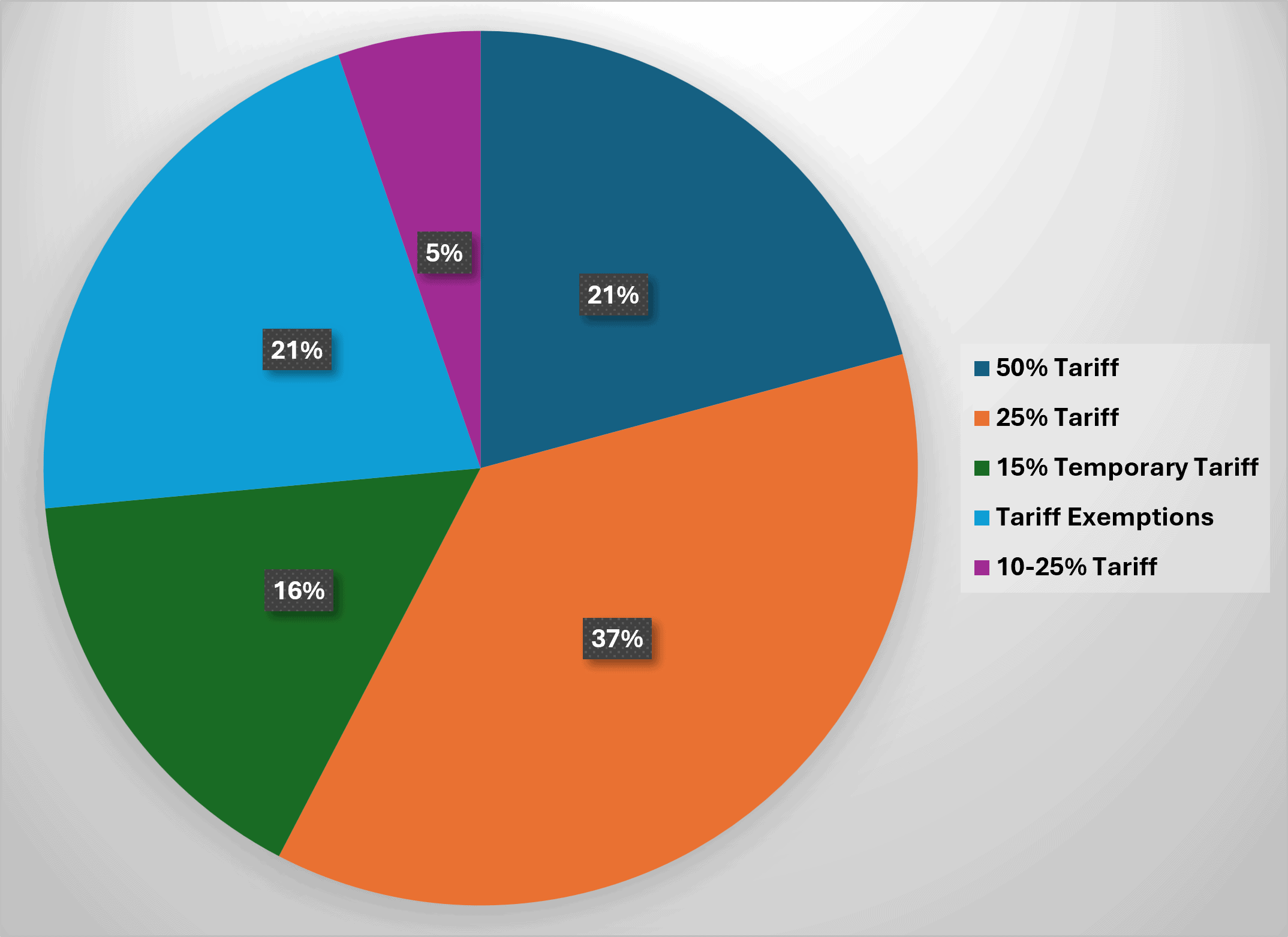
More Metal Tariff Adjustments: On June 1, President Trump signed an executive order that alters the Section 232 national security tariffs imposed on steel, aluminum, and copper. This follows up on the April 2 overhaul of the same Section 232 tariffs, which was an attempt to simplify how those tariffs are calculated and to limit the impact of rising consumer prices. The most recent executive order will lower tariffs on certain agricultural equipment, air conditioning systems, and other steel/aluminum industrial goods from 25 percent to 15 percent. The Trump Administration specifically targeted these products because they “serve an important role in productive domestic economic activity” and in the hope this move will ease rising costs for U.S. farmers who have been negatively impacted by “recent circumstances.” Additionally, the order creates a short list of steel and aluminum imports on which tariffs will be capped at 15 percent if they come from countries that have struck a trade deal. It also expands the imports that qualify for a lower 10-percent tariff by lowering the U.S. metal content requirement from 95 percent to 85 percent of the weight of the product. While the tariff adjustments primarily focus on reducing tariff costs, there are a few additions to the list of impacted imports that will now be subject to a 15-percent tariff. Previously, 70 percent of impacted imports had a tariff rate of 25 to 50 percent but with the recent adjustments this fell to 58 percent. Figures 1 and 2 show the breakdown of impacted steel, aluminum, and copper imports by their respective tariff rates. Figure 1 displays the breakdown after the April 2 overhaul of the metal tariffs. It shows that 21 percent of impacted imports faced a 50-percent tariff, 48 percent of imports faced a 25-percent tariff, 10 percent of imports faced a 15-percent tariff, and 21 percent of impacted imports were exempt. With the recent alterations, a new tariff category was created and many of the impacted imports shifted from the 25-percent tariff bucket to the 15-percent tariff bucket as shown in Figure 2.
IEEPA Tariff Refund Updates: On June 2, 2026, the Trump Administration formally appealed the Court of International Trade’s nationwide refund order to the Federal Circuit, arguing that the court lacks the authority to mandate refunds for importers that never filed individual lawsuits. The appeal deadline is June 7, 2026, and a successful appeal or stay could freeze payments to many impacted importers and severely slow down the tariff refund process. This has been a long time coming as President Trump and his administration have repeatedly criticized the Supreme Court’s decision on IEEPA for not clarifying whether universal tariff refunds were necessary. Roughly $40 billion in tariff revenue may be at risk of no longer being automatically refunded to U.S. importers, requiring each and every business to file a separate court case unless higher courts step in.
Figure 1: Impacted Steel, Aluminum, and Copper Imports by Tariff Rate (April 2, 2026)

Source: United States International Trade Commission; The White House
Figure 2: Impacted Steel, Aluminum, and Copper Imports by Tariff Rate (June 8, 2026)
Source: United States International Trade Commission; The White House