The Shipment
August 6, 2026
The Trade Lawyer Employment Program Kicks Into High Gear
(Not So) Fun Fact: As a result of the conflict in Iran, U.S. consumers and businesses have spent nearly $80 billion in additional gasoline and diesel costs, which amounts to over $600 per household.
Third Trump Tariff Regime Faces the Third Lawsuit
What’s Happening: On Monday, 25 states launched a lawsuit against the Trump Administration’s recently imposed Section 301 tariffs relating to forced labor. These 10–12.5 percent tariffs were implemented on July 24 and apply to 86 countries that comprise over 99 percent of all U.S. imports, replacing the previous 10-percent Section 122 tariffs that expired the same day. The new tariff regime relies on Section 301 of the Trade Act of 1974 which delegates certain tariff authorities to the president to respond to unfair practices that discriminate against U.S. goods abroad. The U.S. Court of International Trade will hear the case alongside a separate suit from two small businesses regarding the same Section 301 forced-labor tariffs. The White House responded to the legal challenges by stating that the 301 process remains a “legally durable tool” for President Trump and the United States Trade Representative (USTR).
Why It Matters: The plaintiffs’ argument against the Section 301 forced labor tariffs can be broken down into a few main points, but let’s briefly recap what these tariffs are all about. In March – about one month after the tariffs under the International Emergency Economic Powers Act (IEEPA) were struck down – USTR launched a Section 301 investigation “Relating to Failures to Take Action on Forced Labor,” stating that numerous trade partners have failed to prohibit imports made with forced labor. In June, USTR recommended 10-percent tariffs on countries committed to addressing U.S. concerns and those with laws on the books that have not properly been enforced. Meanwhile, countries that lack any mechanisms to prohibit forced labor products would face a 12.5-percent tariff. USTR received numerous public comments regarding the Section 301 actions, but the tariffs went into effect with limited changes to rates or the exemptions that mirror those of the Section 122 tariff regime and that have carveouts catered to President Trump’s trade deals. (Read here for more information on Section 301).
The legal case against the forced-labor tariffs relies on three main arguments. The first is that the tariffs exceed the authority granted by Section 301 and fail to correctly follow the established statutory process. The plaintiffs point out that USTR fails to provide individualized treatment for each impacted economy, instead relying on broad, blanket measures across 60 economies, representing an apparently unprecedented use of Section 301. The statute does not allow the executive to impose broad tariffs but provides for a focused investigation into particular policies or practices by a targeted country. According to the plaintiffs, the government also failed to adequately respond to public comments or consult trade partners to inform the action taken under Section 301. The second argument is that this tariff action was pretextual, meaning it was pre-determined to fulfill the Trump Administration’s tariff agenda rather than address real forced labor concerns. For instance, the court filing points out that USTR purposefully timed the Section 301 tariffs to take effect the day Section 122 expired. The administration completed the investigations in record time and proposed tariff rates and exemptions that mirrored Section 122. Additionally, there were multiple statements from administration officials – including President Trump – that indicated Section 301 would be used to shore up the tariff regime in the aftermath of IEEPA and Section 122. Finally, the third argument is that these tariffs appear to be arbitrary and don’t include a process for exempting those countries that address forced-labor concerns. The most compelling component of this argument is that there is no link between tariff rates and a country’s mechanisms for combatting the importation of forced-labor products other than grouping countries into 10-percent or 12.5-percent buckets. In other words, the policy treats all of these countries the same, even though they may have very different policies, compliance records, and enforcement mechanisms. For example, USTR notes that certain countries have made progress in reducing forced-labor inputs, yet face the same tariff rates as countries that have failed to move the needle. Furthermore, there is no distinction between goods that may be prone to forced-labor concerns, there is no relationship between tariff rate and the prevalence of forced labor, and there are no benchmarks for a country to meet to end the Section 301 action. In the view of the plaintiffs – and as discussed in last week’s Shipment – the structure of tariffs relies more on honoring trade deal commitments than addressing the global forced-labor issue.
Looking Ahead: It will likely be weeks or months before there is further legal clarity surrounding the Section 301 tariffs relating to forced labor, meaning the Trump Administration may continue to collect tariff revenue. It is also highly likely that additional 301 investigations will result in proposed tariff actions in the not-too-distant future, including the investigation into excess capacity which targets over a dozen of the largest U.S. trade partners. The Shipment expects that the legal battles against Section 301 will advance to the Supreme Court, given that while there is strong historical precedent for Section 301 action generally, there is a strong case against the unprecedented implementation of the current actions.
In Other News
The U.S. Trade Deficit: Data from the Bureau of Economic Analysis showed that the U.S. trade deficit decreased from $77.6 billion in May to $73.3 billion in June, a 5.6 percent month-over-month decline. This drew widespread attention given the ongoing uncertainty surrounding trade policy stirred up by the Trump Administration’s continued pursuit of tariffs – no matter what authority it relies upon. The drop in the deficit is primarily due to imports declining more rapidly than exports, which can be partially explained by the uptick in front-loading imports in the past few months to get ahead of Section 301 tariffs. This is not the full story, however, as it misses the fact that the trade deficit is 21.7 percent larger than in June 2025; there is therefore no sign of any new trend toward President Trump’s objective of eliminating the trade deficit. It is also worth noting that the trade deficit is not a useful measure of anything other than the fact U.S. imports exceeded exports at any given time. This is not necessarily indicative of economic well-being, geopolitical risks, or the “success” of tariff policy, given the numerous factors that influence it.
Tariff Refunds Updates: As of July 31, $128.68 billion in both potential and certified IEEPA tariff refunds have been accepted for processing in the Consolidated Administration and Processing (CAPE) process. Of this total amount, approximately $100 billion (including interest) have been completed and sent to the U.S. Department of Treasury for disbursement to impacted importers. Before entering the refund process, importers must submit a refund request (known as a CAPE declaration) which may include up to 9,999 separate import entries. According to the court filing, there have been approximately 252,496 CAPE declarations submitted, of which 178,213, or 71 percent, have passed the first validation round. Of the CAPE declarations that passed the first round, 25.1 million, or 83 percent, of the individual import entries passed the second validation round. Each of these validation rounds saw a slight uptick in the passage rate – which is good news for U.S. businesses waiting to receive refunds. It is worth noting that nearly 20,000 refunds – which may include multiple CAPE declarations – totaling about $1.6 billion have not yet been sent due to a lack of information provided by the importer of record. Notably, consumers may begin feeling the impact of the “secondary refunds” from importers that initially passed on costs to spread out the tax burden. Walmart announced it will lower prices in part due to billions in refunds received, and Amazon will send a portion of its $600 million in refunds to customers.
Figure 1: Status of the IEEPA Tariff Refund Process (As of July 31, 2026)
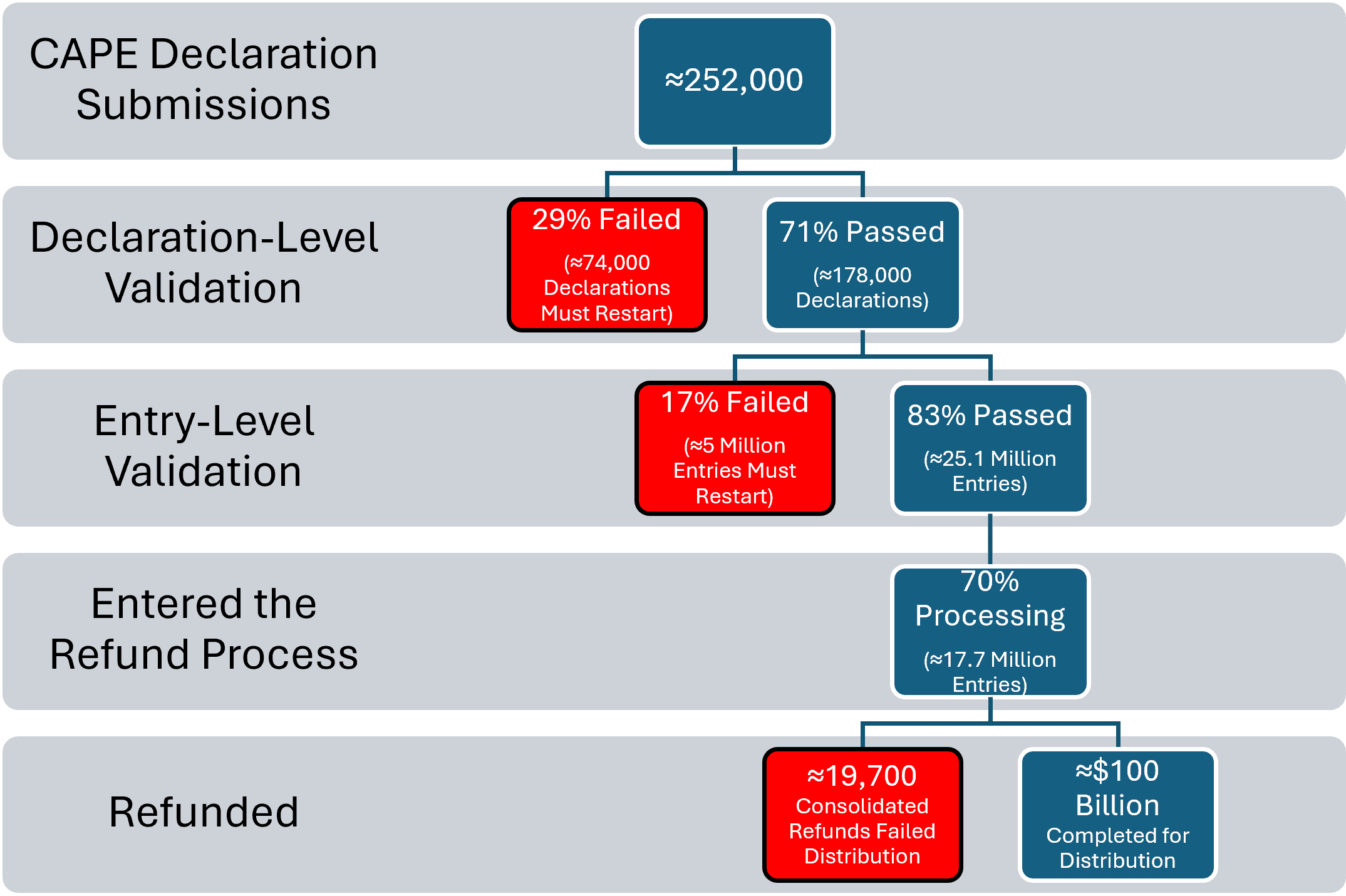
Source: United States Court of International Trade Court Filings