The Shipment
March 20, 2025
Trade Deficits: An Egg-cellent Lesson
Eggs: Increasing the Supply Decreases the Price?
What’s Happening: Both sides of the political aisle have used the rapid increase in egg prices to take a crack at the other, with Republicans criticizing former President Biden and now Democrats criticizing President Trump. The average price of a dozen eggs reached a high under Biden of roughly $4.82 in January 2023; under Trump the high hit $5.90 in February 2025, an increase of nearly $3 from one year ago. According to the White House, the current average cost per dozen sits between $3.10 and $3.45, which indicates prices may be on the decline. Notably, the recent surge in egg prices is in large part due to an outbreak of avian flu that resulted in the death of about 10 percent of the U.S. egg-laying population. Readers may be surprised to learn that one of the Trump Administration’s responses to combat rising prices has been to increase the supply of eggs by increasing egg imports from outside the United States.
Why It Matters: Contrary to popular belief, U.S. presidents do not hold a magic wand that can instantly change the price of basic consumer goods. As Fred Ashton put it, “the laws of supply and demand offer a more plausible and straightforward explanation” for why prices, in this case of eggs, fluctuate. To claim otherwise ignores the fundamentals of economics and individual consumer responses within a market economy. One caveat to this, however, is that administrations can make it easier to facilitate trade with other nations to ease domestic supply shocks that can increase prices. The Trump Administration is taking this approach with eggs by allowing the importation of around 420 million from Turkey this year alone, which is about 600 percent more than a typical year. While import data for recent months are not yet available, this offers a partial explanation for why prices are beginning to dip alongside claims that demand has slightly diminished. The move to increase supply via imports may also act as an important lesson to the Trump Administration: Trade is beneficial because it can lower consumer costs. The egg trade deficit with Turkey may have ballooned, but that deficit will supply U.S. grocery stores, feed U.S. families, and ultimately stabilize or lower consumer costs. In other words, while the move to import more eggs from Turkey is completely contradictory to the administration’s current protectionist tariff policies, it teaches the valuable lesson that focusing solely on trade deficits does not paint a complete picture of economic well-being.
Looking Ahead: One may hope that the administration’s decision to use imports as a means to reduce the shortage – and thus the price – of eggs is whether it may also reconsider its trade policy. If the administration acknowledges that importing more eggs to increase the supply will help alleviate costs for Americans, perhaps President Trump and his advisers will apply this reasoning to other goods – or at the very least limit the use of restrictive trade policies such as tariffs. Unfortunately for U.S. consumers and businesses, it does not appear that this real-world example will change much. The secretary of Agriculture has already stated that ramping up egg imports will be a temporary solution to avoid jeopardizing the longer-term market for U.S. farmers. Rather than reducing trade barriers to reduce prices, it is far more likely that the Trump Administration will double down on domestic solutions such as providing financial aid for farmers, lowering regulatory burdens, increasing vaccinations of U.S. chickens, or limiting the entry of foreign chickens.
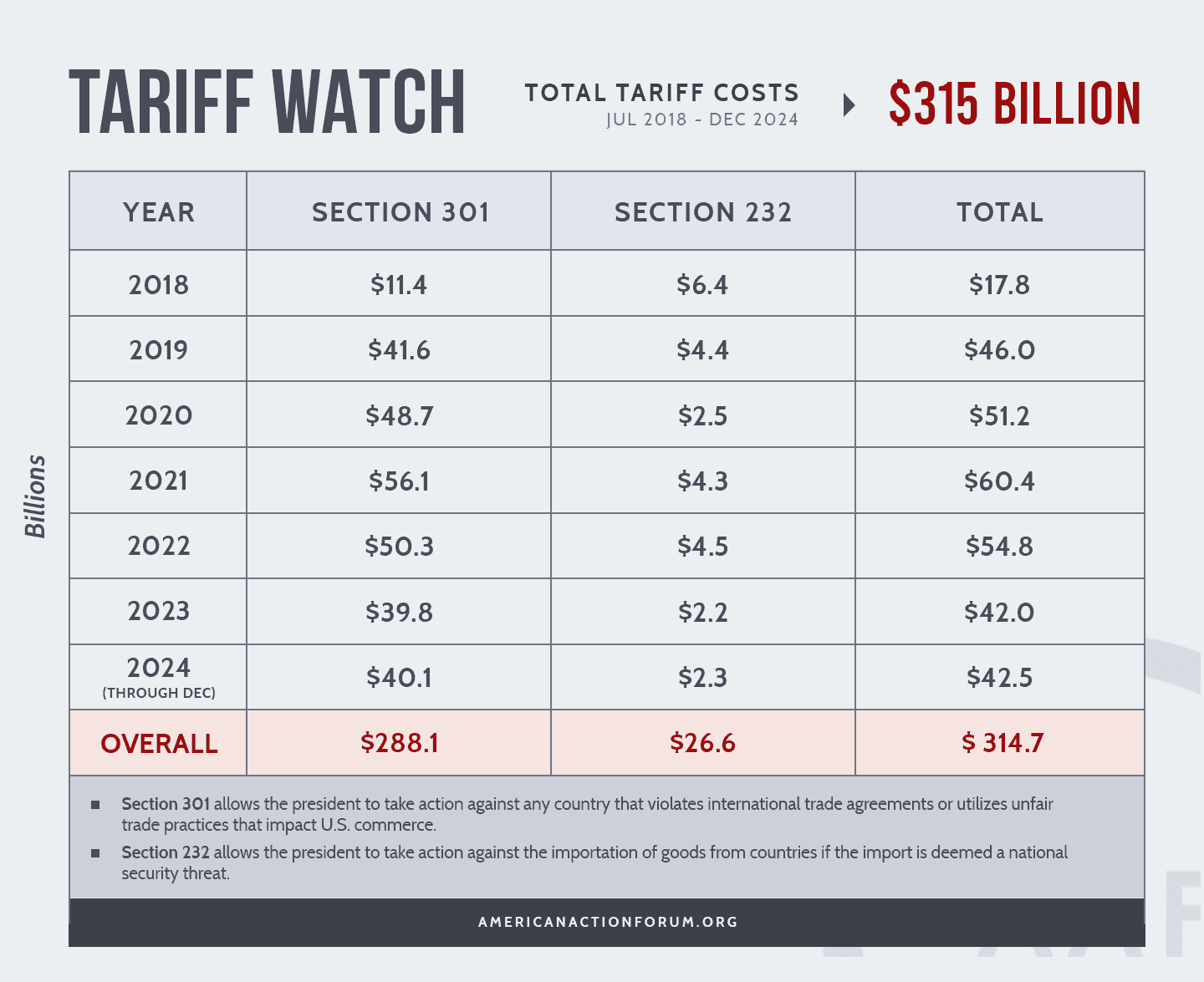
Tariffs Implemented
February 4: 10-percent tariff on all imports from China.
March 4: 25-percent tariffs on all imports from Mexico and Canada alongside an additional 10-percent tariff on all imports from China.
March 5: Auto imports from Mexico and Canada are excluded from 25-percent tariffs for one month.
March 6: Imports from Mexico and Canada that fall under the USMCA are exempt from tariffs until April 2.
March 12: 25-percent tariffs on steel and aluminum.
Upcoming Tariffs:
April 1: Target date for USTR trade policy review and recommendations.
April 2: Reciprocal tariffs on many or all countries may take effect and delayed tariffs on Canada and Mexico may resume.
April 2–4: Auto imports from Mexico and Canada may be subject to 25-percent tariffs.
Unspecified Date: Various tariffs on pharmaceuticals, semiconductors, automobiles, copper, and the EU and BRICS countries.