Week in Regulation
April 13, 2026
A (Potentially) Sizable Deregulatory Week
There was a good bit of activity in the Federal Register over this past week. Agencies produced 14 rulemakings that contained some kind of measurable economic impact – including one on “Weird Space Stuff,” no less. The week’s haul of action tilted decidedly in the cost-saving direction. The main items that stood out were two rulemakings from the Department of Labor (DOL) and Environmental Protection Agency (EPA), respectively, that bring estimated effects worth billions of dollars. Overall, federal agencies published roughly $5.4 billion in total cost savings but added more than one million paperwork burden hours.
REGULATORY TOPLINES
- Proposed Rules This Week: 48
- Final Rules This Week: 39
- 2026 Total Pages: 18,727
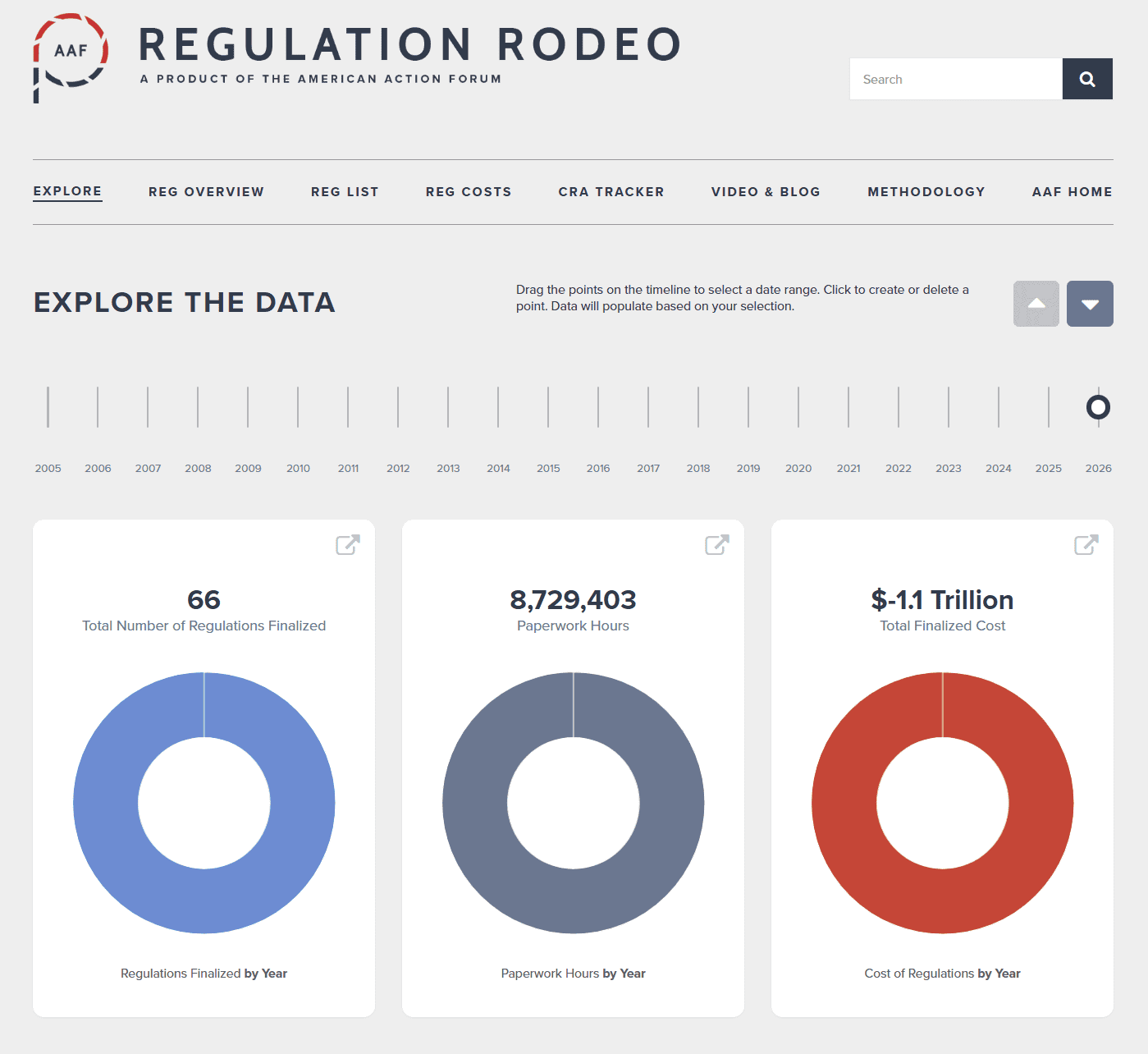
- 2026 Final Rule Costs: -$1.1 trillion
- 2026 Proposed Rule Costs: $131.9 billion
NOTABLE REGULATORY ACTIONS
The most significant rulemaking from a cost-reduction perspective may be the DOL proposed rule on “Walking-Working Surfaces.” The proposal comes in response to an industry petition on the matter and would “remove a provision that sets a deadline (November 18, 2036) for the installation of personal fall arrest systems or ladder safety systems on all fixed ladders that extend more than 24 feet above a lower level,” that was included in a broader Obama Administration rule. This rulemaking only may be the most significant of the week because its “Preliminary Economic Analysis” is, indeed, quite preliminary. The core of the agency’s estimate is the following:
Based on petitioners’ data, [Occupational Safety and Health Administration] OSHA calculates a compliance cost of $55,000 per ladder ($1.2 billion divided by 22,000 ladders rounded to the nearest thousand); however, other entities in the petitioners’ industry not surveyed could indicate different potential cost savings associated with the other two-thirds of this industry’s ladders, thus the $55,000 estimate may not reflect the true average. By applying these per-ladder compliance costs to an estimated 66,000 ladders in this industry sector (extrapolating the petitioner’s report of 22,000 ladders in one third of the industry to the whole industry), OSHA estimates cost savings over $3.6 billion could be achieved in this sector alone by eliminating the compliance deadline. OSHA seeks public comment on these estimates.
The “per ladder” cost used here is markedly higher than the $983 figure included in the 2016 rule that pegged the overall costs of this requirement in the mere millions of dollars. This is an instance where the final estimate could end up wildly different from the proposed one based on further public input, but for the time being, the American Action Forum (AAF) will record the $3.6 billion figure as DOL’s official savings estimate.
The most significant final rulemaking of the week comes in the EPA rule on “Reconsideration of Standards of Performance for New, Reconstructed, and Modified Sources and Emissions Guidelines for Existing Sources: Oil and Natural Gas Sector Climate Review.” As the title suggests, the agency “is finalizing amendments to the New Source Performance Standards (NSPS) and Emission Guidelines (EG) for Existing Sources for the Crude Oil and Natural Gas Source Category in response to petitions for reconsideration of the March 8, 2024, final rule.” EPA estimates that such changes to the Biden-era rule on the matter could yield $1.9 billion in total cost savings for affected entities.
TRACKING TRUMP 2.0
In assessing 2026 rulemakings that include an Executive Order (EO) 14192 determination, there have been 24 “deregulatory” rules with combined total savings of $1.1 trillion against four “regulatory” rules that involve roughly $41.6 billion in costs. Adding that to the total agencies produced during 2025 (at least from rules that had a clear “regulatory” or “deregulatory” designation), the Trump Administration has enacted $1.2 trillion in total cost reductions thus far under EO 14192. Rules for which agencies have claimed one of the EO’s explicit exemptions have accounted for an additional $508 million in costs so far in 2026.
CONGRESSIONAL REVIEW ACT (CRA)
The only CRA news of the week was the introduction of a resolution of disapproval in the House regarding a Trump Administration rule on student lending from last October. The AAF CRA tracker provides a full survey of activity under the law thus far into this term. As of today, members of the 119th Congress have introduced CRA resolutions of disapproval addressing 113 “rules” across the Biden and Trump Administrations that collectively involve $135.7 billion in estimated compliance costs. Of these, 22 have been passed into law, repealing a series of Biden Administration rules that had a combined $3 billion in associated compliance costs. The Trump Administration estimates that the repeal of this rule yields an additional $936 million in savings. While the main window of CRA action has largely passed, there are still outstanding resolutions that could move legislatively. AAF will continue to monitor and update such developments as appropriate.
TOTAL BURDENS
Since the start of 2026, the federal government has published $927.6 billion in total regulatory net cost savings (with $1.1 trillion in reductions from finalized rules) and 39.1 million hours of net annual paperwork increases (with 8.7 million hours coming from final rules).