Week in Regulation
April 6, 2026
Renewable Fuel Standards Rule Leaves a Mark
Last week was a somewhat busy one when it came to the flow of new regulatory actions. There were 10 rulemakings that contained some kind of measurable economic impact. Of these, a couple popped out that had billions of dollars in effects – just in different directions. The most significant cost-adding item was the latest rule from the Environmental Protection Agency (EPA) on Renewable Fuel Standards (RFS). The most substantial cost-cutting action was the proposed rule from the Department of Labor (DOL) on “investments in alternative assets” in retirement accounts. Overall, federal agencies published roughly $33.9 billion in total costs but cut 162,690 paperwork burden hours.
REGULATORY TOPLINES
- Proposed Rules This Week: 34
- Final Rules This Week: 51
- 2026 Total Pages: 17,091
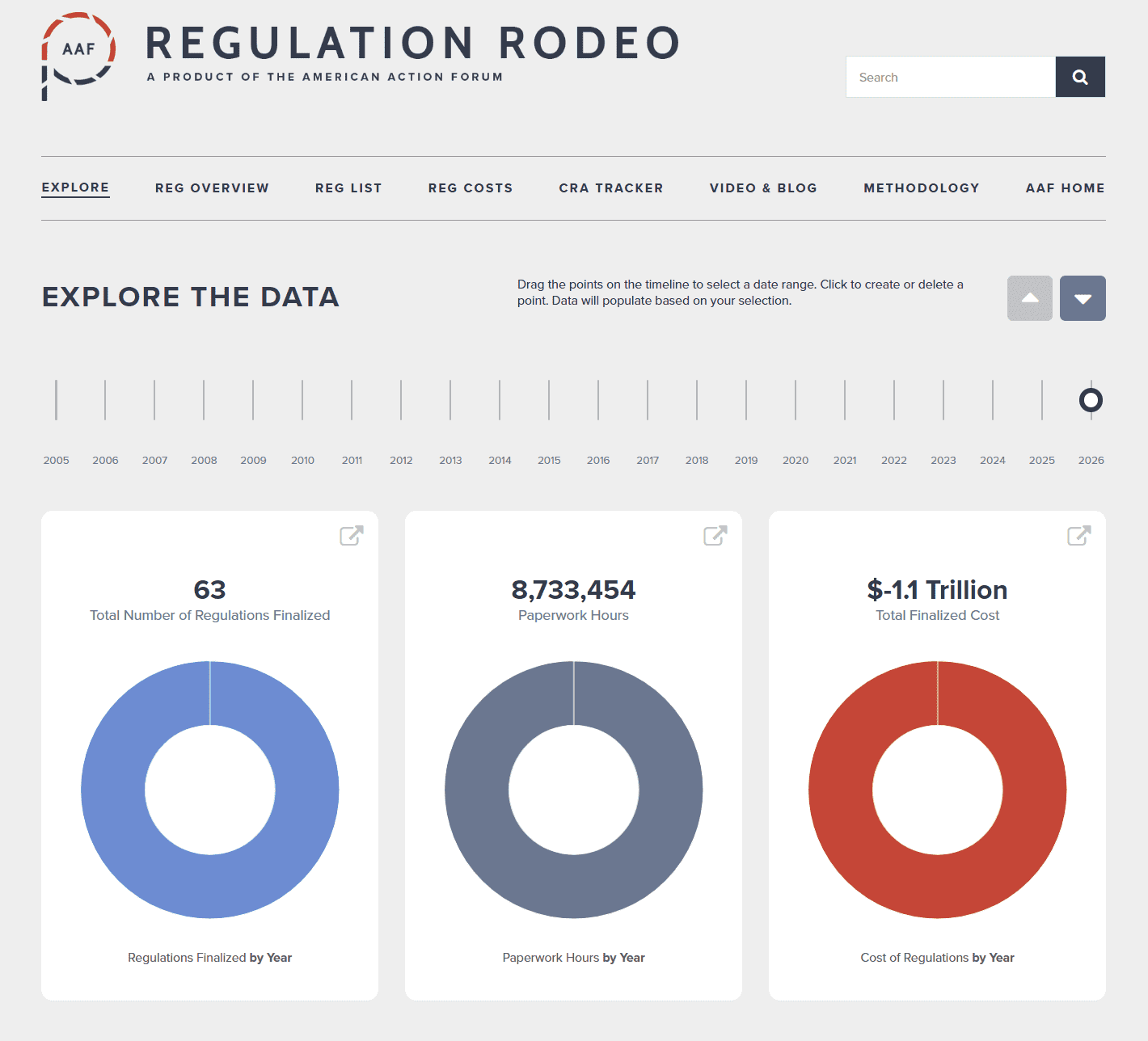
- 2026 Final Rule Costs: -$1.1 trillion
- 2026 Proposed Rule Costs: $135.3 billion
NOTABLE REGULATORY ACTIONS
The most consequential rulemaking of the week was the EPA rule on “Renewable Fuel Standard (RFS) Program: Standards for 2026 and 2027, Partial Waiver of 2025 Cellulosic Biofuel Volume Requirement, and Other Changes.” More specifically:
The EPA is establishing the applicable volumes and percentage standards for 2026 and 2027 for cellulosic biofuel, biomass-based diesel (BBD), advanced biofuel, and total renewable fuel. The EPA is also partially waiving the 2025 cellulosic biofuel volume requirement and revising the associated percentage standard due to a shortfall in cellulosic biofuel production. Finally, the EPA is promulgating several regulatory changes to the RFS program, including removing renewable electricity as a qualifying renewable fuel under the RFS program (eRINs) and making minor revisions to the biogas provisions of the RFS program.
The main quantifiable effect of RFS rules comes in essentially mandating the consumption of more expensive renewable fuels over fossil fuels that consumers would otherwise purchase in the absence of such a regulatory framework. The last round before this one, under the Biden Administration, brought $23 billion in total increased fuel costs. This latest set of standards, however, blows right past that with more than $38 billion in total increased costs.
The week’s main deregulatory action was a proposed rule from DOL regarding “Fiduciary Duties in Selecting Designated Investment Alternatives.” As the title suggests, the proposal: “clarifies, and provides a safe harbor for, a fiduciary’s duty of prudence under the Employee Retirement Income Security Act of 1974 (ERISA) in connection with selecting designated investment alternatives for a participant-directed individual account plan, including asset allocation funds that include alternative assets.” The alternative assets that the proposed rule refers to include (but are not limited to) investments in “private equity, hedge funds, real estate, and commodities.” DOL expects that the primary economic effect will be the reduction in “litigation risk” for affected fiduciaries that proceed to trade in such areas. The agency estimates this will save affected firms roughly $578 million in legal expenses each year.
TRACKING TRUMP 2.0
The main action with regulatory budget implications this past week was the RFS rule discussed above, which represents the costliest “regulatory” rulemaking under the auspices of Executive Order (EO) 14192 to date. In assessing 2026 rulemakings that include an EO 14192 determination, there have been 22 “deregulatory” rules with combined total savings of $1.1 trillion against four “regulatory” rules that involve roughly $41.6 billion in costs. Adding that to the total agencies produced during 2025 (at least from rules that had a clear “regulatory” or “deregulatory” designation), the Trump Administration has enacted $1.2 trillion in total cost reductions thus far under EO 14192. Rules for which agencies have claimed one of the EO’s explicit exemptions have accounted for an additional $508 million in costs so far in 2026.
CONGRESSIONAL REVIEW ACT (CRA)
There were no new CRA developments this past week. The American Action Forum (AAF) CRA tracker provides a full survey of activity under the law thus far into this term. As of today, members of the 119th Congress have introduced CRA resolutions of disapproval addressing 96 “rules” across the Biden and Trump Administrations that collectively involve $135.7 billion in estimated compliance costs. Of these, 22 have been passed into law, repealing a series of Biden Administration rules that had a combined $3 billion in associated compliance costs. The Trump Administration estimates that the repeal of this rule yields an additional $936 million in savings. While the main window of CRA action has largely passed, there are still outstanding resolutions that could move legislatively. AAF will continue to monitor and update such developments as appropriate.
TOTAL BURDENS
Since the start of 2026, the federal government has published $922.2 billion in total regulatory net cost savings (with $1.1 trillion in reductions from finalized rules) and 38.1 million hours of net annual paperwork increases (with 8.7 million hours coming from final rules).