Week in Regulation
July 28, 2025
A (Slight) Deregulatory Rumble
The relatively subdued pace and magnitude of federal regulatory activity seen in recent weeks generally continued this past week. There were 11 rulemakings that contained some kind of measurable economic impact. Most of these items were quite minor in scale, the most consequential of the bunch being a deregulatory Environmental Protection Agency (EPA) rule extending various deadlines for previous coal run-off regulations. Across all rulemakings, agencies published $82.1 million in total cost savings but added roughly 1 million paperwork burden hours.
REGULATORY TOPLINES
- Proposed Rules: 34
- Final Rules: 49
- 2025 Total Pages: 35,309
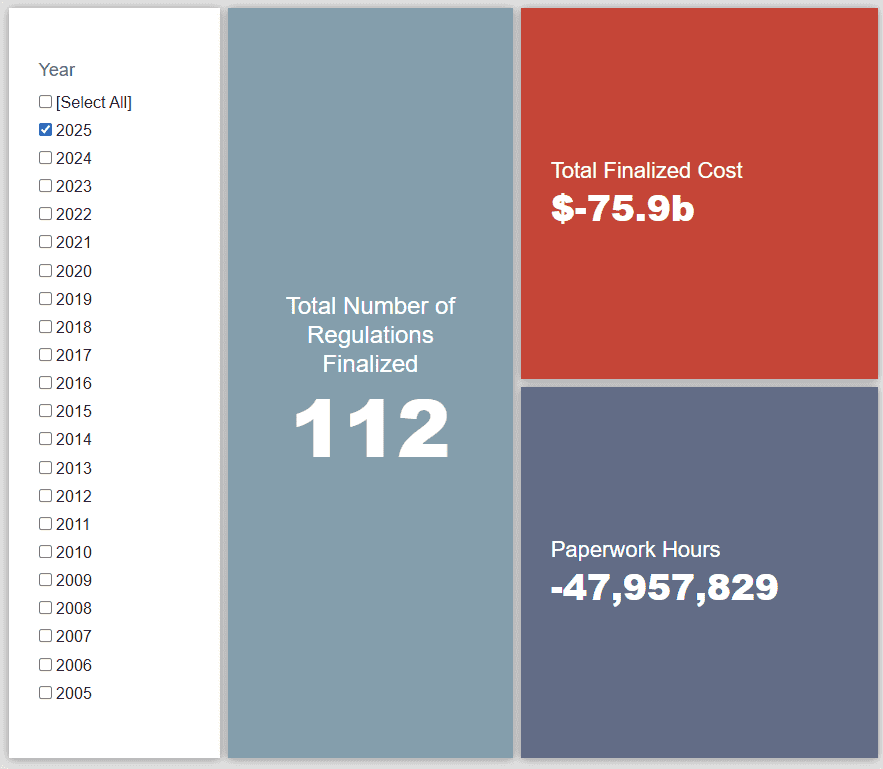
- 2025 Final Rule Costs: -$75.9 billion
- 2025 Proposed Rule Costs: $174 billion
NOTABLE REGULATORY ACTIONS
The most significant rulemaking of the week was the EPA direct final rule regarding “Hazardous and Solid Waste Management System: Disposal of Coal Combustion Residuals [CCR] From Electric Utilities; CCR Management Unit Deadline Extension Rule.” The rulemaking’s main purpose is to push back a series of compliance deadlines from prior CCR rules by between one to two years. EPA expects that such delays will provide roughly $10.4-million-worth in annualized regulatory relief (the midpoint of the estimated $9.43–$11.3 million per year range), or roughly $147.5 million in net present value.
TRACKING TRUMP 2.0
Last week, the American Action Forum (AAF) reviewed the Trump Administration’s deregulatory record through its first six months back in office. The key finding of that report was that while the top-line reductions of $86 billion in regulatory costs and 52.2 million paperwork hours were substantial, they were largely the function of a single action. As noted above, this past week’s CCR Deadline Extension Rule provides a nominal addition to the current administration’s cost-cutting track record. Of note, this also marked another instance of the administration using the “direct final rule” path – a practice AAF discussed further in the aforementioned six-month review insight – to implement its agenda.
The most significant piece of non-rulemaking news from the White House with regard to regulatory policy was likely the president’s executive order (EO) on “Accelerating Federal Permitting of Data Center Infrastructure.” The EO, as its title quite plainly suggests, directs relevant agencies to take a series of steps to streamline the permitting process during the construction of artificial intelligence data centers as well as any related power generation and transmission infrastructure. The particular steps largely focus on agencies involved granting the covered projects’ relevant determinations that allow them to bypass certain associated permitting hurdles.
Turning to the Congressional Review Act (CRA) front, there were some surprising developments. The expected votes on a series of CRA resolutions that address certain Department of Interior actions ended up stalling out, having been part of the House “rule” that got tied up in the political wrangling over congressional action on the release of the Jeffrey Epstein files. These votes will now apparently have to wait until Congress returns from its August recess.
The other intriguing CRA items of the week came in a series of resolutions of disapproval introduced by Senator Sheldon Whitehouse (D-CT). The four such resolutions introduced this past week (adding to one he introduced last month) represent the first real CRA volley focused on rules from the current Trump Administration. Given the underlying political dynamics, one does not expect these – or any other resolutions from Democratic lawmakers – to really see much movement anytime soon. Nevertheless, this set of resolutions does illustrate that the CRA represents a tool for lawmakers of either party to draw legislative attention to administrative actions they disagree with.
Be sure to check the AAF CRA tracker for a full survey of activity under the law during the first part of 2025. As of today, members of the 119th Congress have introduced CRA resolutions of disapproval addressing 54 rulemakings across the Biden and Trump Administrations that collectively involve $138 billion in compliance costs. Of these, 16 have been passed into law, repealing a series of Biden Administration rules that had a combined $3 billion in associated compliance costs – roughly 2 percent of that potential $138 billion total. While the main window of CRA action has largely passed, there are still outstanding resolutions that could move legislatively. AAF will continue to monitor and update such developments as appropriate.
TOTAL BURDENS
Since January 1, the federal government has published $98.2 billion in total regulatory net costs (with $75.9 billion in cost savings from finalized rules) and 85.4 million hours of net annual paperwork cuts (with 48 million hours coming from final rules).