Week in Regulation
July 21, 2025
Another Quiet One
Following on the heels of a relatively understated week, this past week in regulation was even less notable. There was a grand total of six rulemakings with some kind of measurable economic impact, most of which were fairly minor. To put a finer point on just how modest this week was: A pair of proposed rules from the Department of Health and Human Services (HHS) regarding Medicare and Medicaid payment schedules were the main items. Across all rulemakings, agencies published $33.5 million in total costs but cut 6.3 million paperwork burden hours.
REGULATORY TOPLINES
- Proposed Rules: 30
- Final Rules: 74
- 2025 Total Pages: 34,092
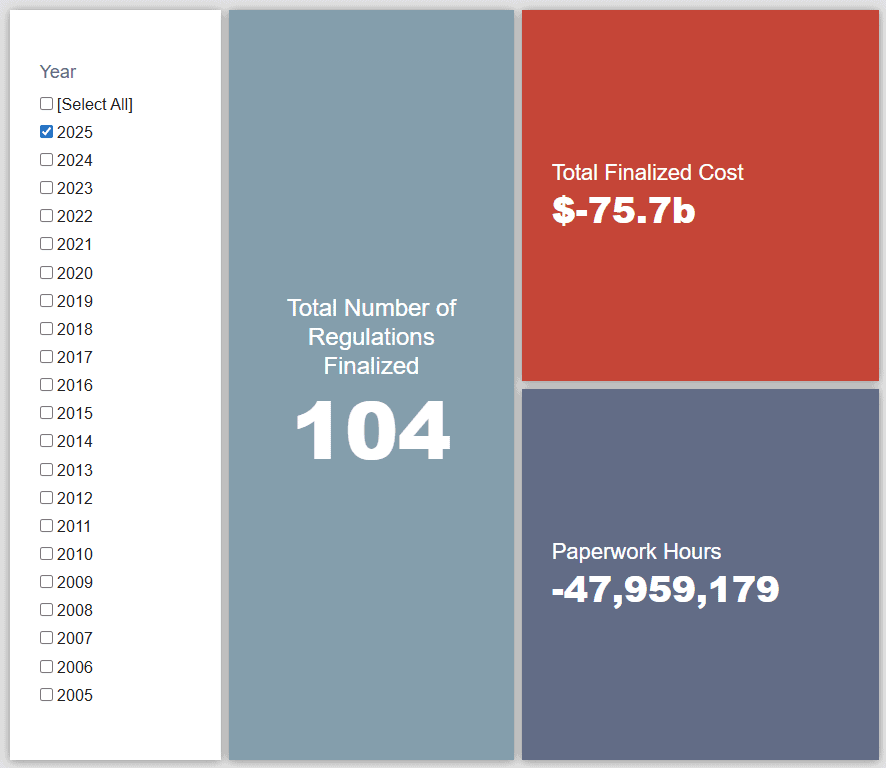
- 2025 Final Rule Costs: -$75.7 billion
- 2025 Proposed Rule Costs: $174 billion
NOTABLE REGULATORY ACTIONS
The most significant rulemakings of the week were two proposed rules from HHS that primarily focus on annual updates to Medicare and Medicaid transfer payment allocations but also include some changes to administrative reporting requirements. The first, regarding “CY 2026 Payment Policies Under the Physician Fee Schedule and Other Changes to Part B Payment and Coverage Policies; Medicare Shared Savings Program Requirements; and Medicare Prescription Drug Inflation Rebate Program,” involves a roughly 200,000-hour increase in annual paperwork burdens (and $23.5 million in associated costs). The second, regarding “Hospital Outpatient Prospective Payment and Ambulatory Surgical Center Payment Systems; Quality Reporting Programs; Overall Hospital Quality Star Ratings; and Hospital Price Transparency,” brings $2.54 million in annualized costs savings (or roughly $36 million in present value) and cuts annual paperwork burden hours by nearly 6.5 million over the next few years. The American Action Forum (AAF) covered some of the broader policy implications for each rule here.
TRACKING TRUMP 2.0
The most substantial regulatory policy announcements out of the White House last came in the form of a quartet of presidential proclamations invoking authority under section 112(i)(4) of the Clean Air Act to provide a series of two-year compliance exemptions for entities covered by certain Biden-era Environmental Protection Agency rules. President Trump issued a similar proclamation earlier this spring. While these are time-limited actions that only affect certain regulated entities, this exemption authority is one of the more interesting deregulatory tools that the current administration has at hand in lieu of needing to go through the full rulemaking process to change or rescind the underlying regulations involved.
There was only marginal action on the Congressional Review Act (CRA) front. Similar to the resolutions introduced the week before, this past week saw the introduction of a resolution addressing a Department of Interior Resource Management Plan (RMP) determination regarding the “Central Yukon” area of Alaska. All three of these RMP determination CRA resolutions are set to hit the House floor sometime this coming week.
Be sure to check the AAF CRA tracker for a full survey of activity under the law during the first part of 2025. As of today, members of the 119th Congress have introduced CRA resolutions of disapproval addressing 48 Biden-era rules that collectively involve $138 billion in compliance costs. Of these, 16 have been passed into law, repealing a series of Biden Administration rules that had a combined $3 billion in associated compliance costs – roughly 2 percent of that potential $138 billion total. While the main window of CRA action has largely passed, there are still outstanding resolutions that could move legislatively. AAF will continue to monitor and update such developments as appropriate.
TOTAL BURDENS
Since January 1, the federal government has published $98.2 billion in total net costs (with $75.7 billion in cost savings from finalized rules) and 86.4 million hours of net annual paperwork cuts (with 48 million hours coming from final rules).