Week in Regulation
February 17, 2026
Brisk, Cross-cutting Set of Rules
There was a decent amount of action in the Federal Register last week. There were 10 rulemakings with some kind of quantified economic impact. Among these were a couple of sizable deregulatory actions that were nevertheless overshadowed by a major cost-adding proposed rule from the Department of Health & Human Services (HHS). Additionally, while it has not been published in the Federal Register, the major news of last week was the release of the Environmental Protection Agency’s (EPA) rule that seeks to rescind the “endangerment finding” on greenhouse gases (GHG). Federal agencies published roughly $1.8 billion in total costs and added 16.1 million paperwork burden hours.
REGULATORY TOPLINES
- Proposed Rules This Week: 44
- Final Rules This Week: 38
- 2026 Total Pages: 7,092
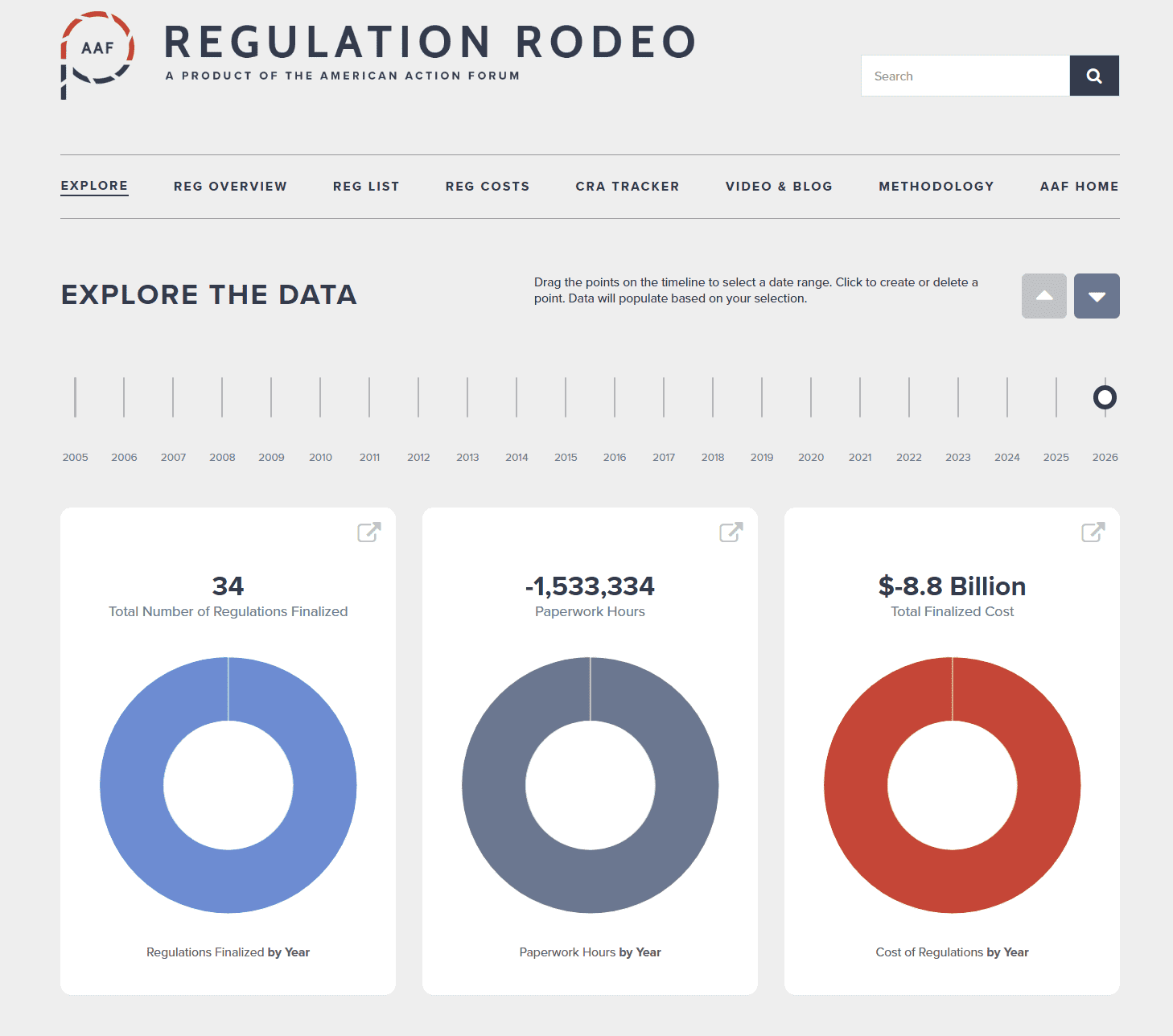
- 2026 Final Rule Costs: -$8.8 billion
- 2026 Proposed Rule Costs: $9.5 billion
NOTABLE REGULATORY ACTIONS
The most consequential rulemaking of the week – despite not yet hitting the Federal Register – was the EPA rule on “Rescission of the Greenhouse Gas Endangerment Finding and Motor Vehicle Greenhouse Gas Emission Standards Under the Clean Air Act.” The American Action Forum (AAF) previously covered the proposed version here. EPA claims $1.3 trillion in total cost reductions from the rule. The “Vehicle Technology” savings – the figure AAF has recorded for these rules in the past – add up to nearly $1.1 trillion when using a 3-percent discount rate. At the time of the rule’s release late last week, there were scant details about the agency’s updated calculations. As more documentation becomes available, AAF will further examine how EPA arrived at such totals.
The most significant rule that did hit the Federal Register was the proposed rule from HHS regarding “Patient Protection and Affordable Care Act, HHS Notice of Benefit and Payment Parameters for 2027; and Basic Health Program.” The proposal is one of those rulemakings produced each year to make various changes to the relevant programs. This one, however, brings some fairly substantial new administrative burdens. HHS estimates that the compliance requirements attached to it will involve nearly 18.6 million hours of paperwork and $606 million in associated costs each year.
The two main deregulatory actions in the pages of the Federal Register were the rules from EPA and the Federal Trade Commission (FTC) regarding “Hazardous and Solid Waste Management System: Disposal of Coal Combustion Residuals [CCR] From Electric Utilities; CCR Management Unit Deadline Extension Rule” and “Revision of the Negative Option Rule, Withdrawal of the CARS Rule, Removal of the Non-Compete Rule To Conform These Rules to Federal Court Decisions,” respectively. Each rule’s objective is stated rather clearly in its title. EPA estimates that extending the deadlines for affected entities will yield roughly $390 million in total cost savings. Meanwhile, FTC expects that the subsequent rescission of various paperwork requirements due to the repeal of the underlying rulemakings will result in 2.2 million hours in paperwork reductions (with $104 million in associating savings) each year.
TRACKING TRUMP 2.0
In assessing 2026 rulemakings that include an Executive Order (EO) 14192 determination, there have been 16 “deregulatory” rules with combined total savings of $9.4 billion against one “regulatory” rule that involves roughly $70 million in costs. Adding that to the total agencies produced during 2025 (at least from rules that had a clear “regulatory” or “deregulatory” designation), the Trump Administration has enacted $149.3 billion in total cost reductions thus far under the auspices of EO 14192. Rules for which agencies have claimed one of the EO’s exemptions have accounted for an additional $372 million in costs so far in 2026.
CONGRESSIONAL REVIEW ACT (CRA)
The only CRA news of the week was Senator Catherine Cortez Masto (D-NV) introducing a resolution of disapproval against an Internal Revenue Service guidance document on “Beginning of Construction Requirements for Purposes of the Termination of Clean Electricity Production Credits and Clean Electricity Investment Credits for Applicable Wind and Solar Facilities” published last year. The AAF CRA tracker provides a full survey of activity under the law thus far into this term. As of today, members of the 119th Congress have introduced CRA resolutions of disapproval addressing 74 “rules” across the Biden and Trump Administrations that collectively involve $135.7 billion in estimated compliance costs. Of these, 22 have been passed into law, repealing a series of Biden Administration rules that had a combined $3 billion in associated compliance costs. The Trump Administration estimates that the repeal of this rule yields an additional $936 million in savings. While the main window of CRA action has largely passed, there are still outstanding resolutions that could move legislatively. AAF will continue to monitor and update such developments as appropriate.
TOTAL BURDENS
Since the start of 2026, the federal government has published $696.3 million in total regulatory net costs (with $8.8 billion in reductions from finalized rules) and 26.2 million hours of net annual paperwork increases (with 1.5 million hours in reductions coming from final rules).